The Digital Revival of Nusantara Fashion: Traditional Attire of the Dayak Ngaju – Symbols of Cosmology and Cultural Identity
The traditional attire of the Dayak Ngaju people, one of the prominent sub-ethnic groups of the Dayak in Central Kalimantan, Indonesia, embodies a rich tapestry of cosmological beliefs, social identity, and material symbolism. At the heart of their cultural expression lies the emblematic Batang Garing, or “Tree of Life,” a central symbol that encapsulates their spiritual worldview and connection to the universe. This motif is omnipresent in Dayak Ngaju arts and rituals—appearing in carvings, tattoos (tutang or cacah), and especially in their traditional garments. Far from being a decorative element, Batang Garing represents the sacred balance between the realms of existence: the upper world (rungan atas), the middle world (rungan tengah), and the underworld (rungan bawah). As such, traditional clothing becomes a medium through which cosmological understanding and ancestral values are continually transmitted.
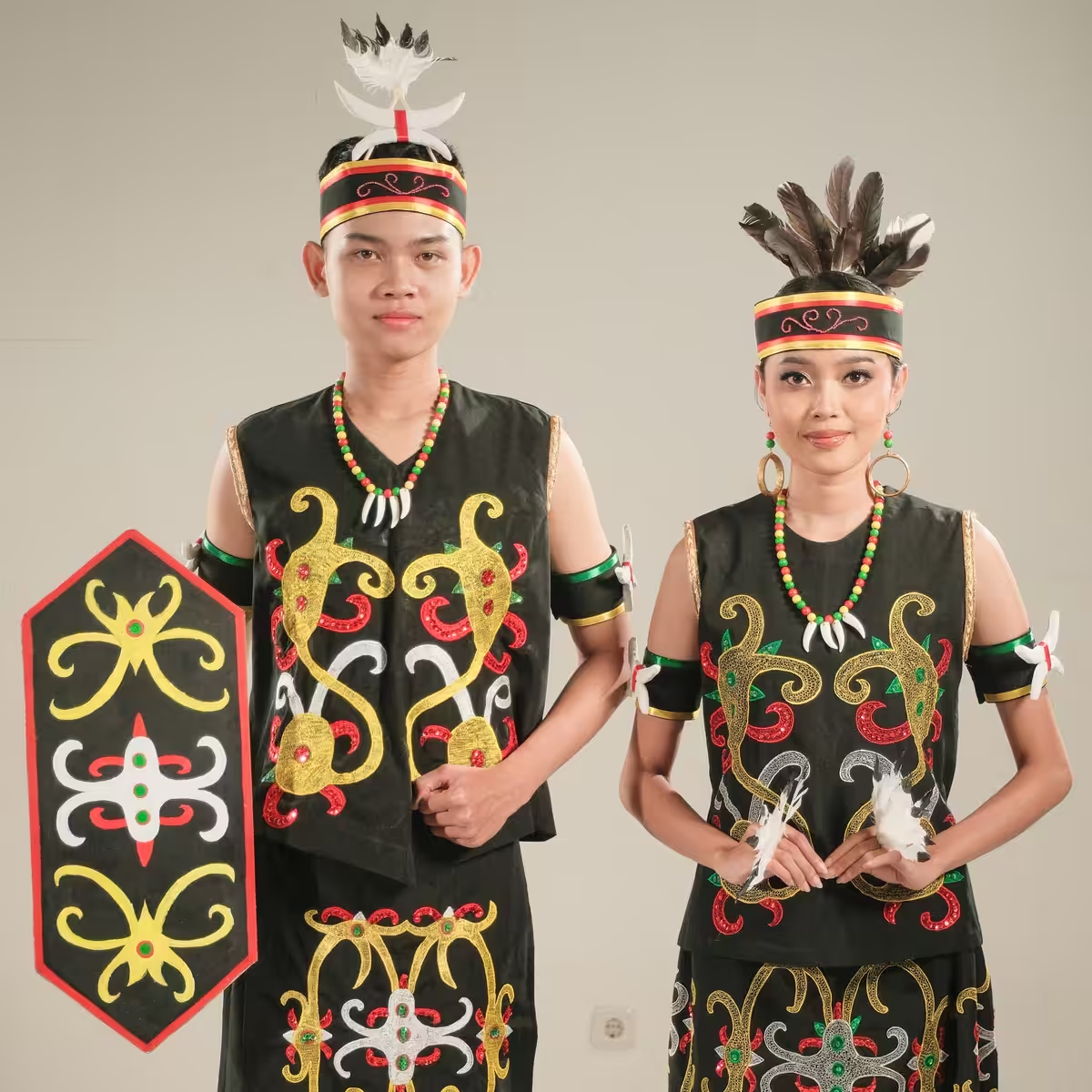
The attire distinctly differs between men and women, with each bearing specific components that reflect gender roles, spiritual function, and social rank. Dayak Ngaju men traditionally wear knee-length trousers paired with a selempit or fabric belt, and a headband (ikat kepala) adorned with hornbill feathers. These feathers are not arbitrary; the hornbill bird (rangkong) is revered as a messenger of the spirit world, symbolizing strength and divine protection. Male accessories often include two types of necklaces: the inuk, a long necklace made from beads, bone, or wood; and the cekoang, a shorter necklace often used in rituals, signifying spiritual connection and status. Meanwhile, Dayak Ngaju women wear a short skirt (often handwoven) and a sleeveless vest (rompi), complemented by a feathered headband similar in style but finer in design than that of the men. They wear ornate necklaces and earrings (subang), crafted from natural materials like shells, beads, or metals—each piece signifying femininity, maturity, and clan affiliation.
What renders Dayak Ngaju attire particularly profound is the presence of symbolic motifs embedded within each garment. One of the most meaningful is the Kalalawit motif, inspired by the sharp claws of wild animals such as bears or tigers. Representing raw strength, protection, and survival, this motif acts as a visual invocation of natural forces. It not only symbolizes power but also the interconnectedness between humans and the spirit world of animals, a core tenet of Dayak cosmology. These motifs are not merely decorative but are interpreted as part of a broader symbolic language, where patterns encode stories, taboos, ethics, and ancestral memory. The process of creating these garments is highly ritualized and deeply respectful of tradition, often requiring elders or designated craftspeople who understand the philosophical meanings behind each design.
Every aspect of the attire reflects ecological sensitivity and spiritual intentionality. The use of organic fibers, natural dyes, and handmade accessories underscores a worldview where the forest is not merely a resource but a sacred living system. By wearing such garments during ceremonies, rituals, and festivals, Dayak Ngaju people reaffirm their bond with the land and the spirits that inhabit it. Male and female costumes, though different in form, work in harmony to enact the Dayak principle of balance and reciprocity. This duality manifests during community performances such as ritual dances, where the attire contributes not only to aesthetic beauty but also to the enactment of cosmological narratives.
In the face of modern influences and cultural homogenization, Dayak Ngaju traditional clothing continues to stand as a resilient symbol of indigenous identity. Although such attire may no longer be used in daily life, it retains its function in ceremonial contexts and is being revitalized through cultural festivals, educational programs, and digital preservation efforts. This exhibition contributes to that ongoing effort by digitizing Dayak Ngaju attire and presenting it as part of a global conversation on cultural heritage and innovation. By engaging with these garments in a virtual format, audiences are invited to see not just the aesthetic richness of Dayak textiles, but also their role as living repositories of spiritual belief, ecological wisdom, and social philosophy.
Through this work, Dayak Ngaju clothing transcends the category of traditional costume. It becomes a visual text, a spiritual map, and a vessel of cultural continuity. In its motifs, colors, and forms, we find the enduring presence of a people who see the world not in fragments, but in interconnected cycles of nature, spirit, and community. By preserving and sharing this legacy through digital means, we honor not only the artistry of Dayak hands but also the profound cosmology that gives their culture its depth and resilience.