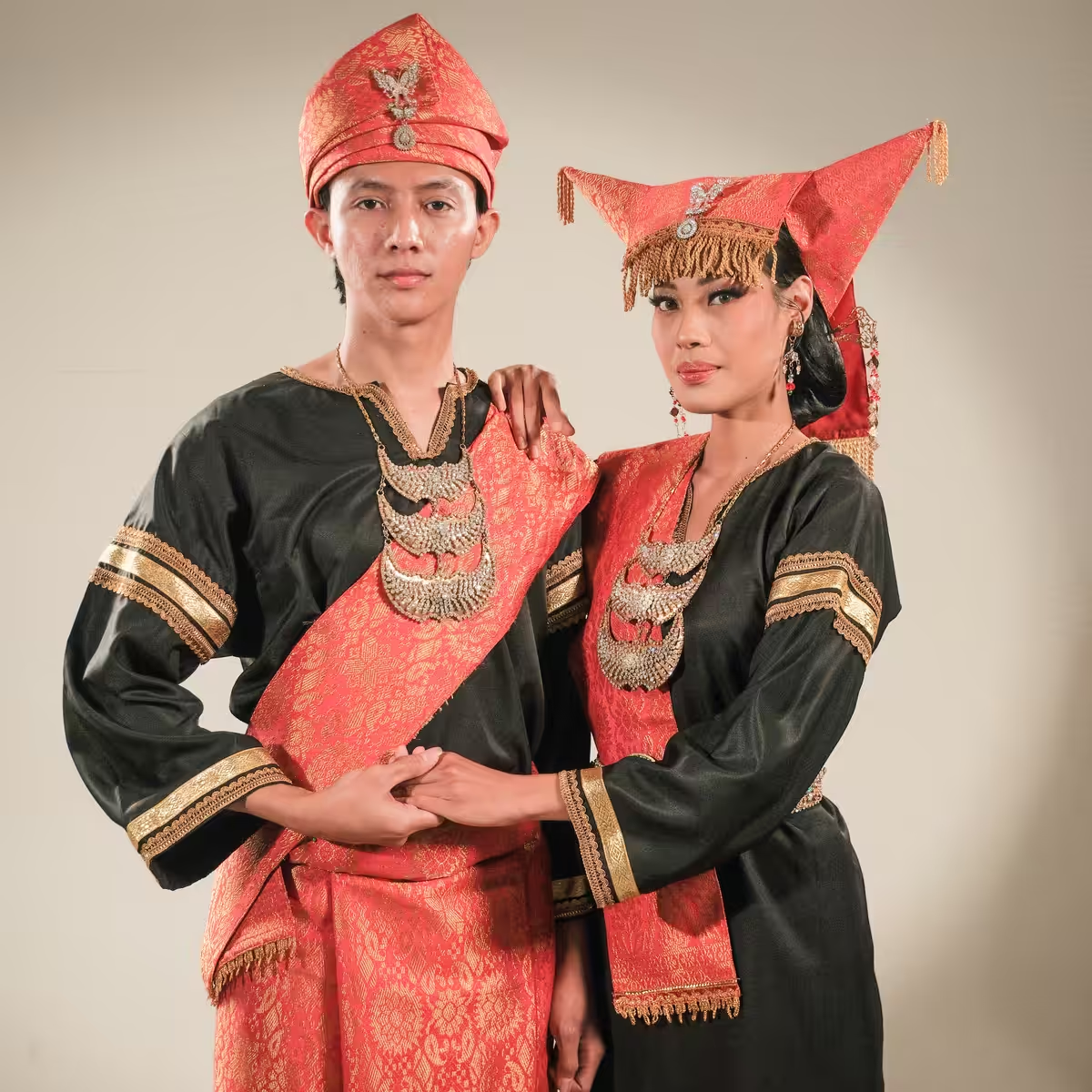
The Digital Revival of Nusantara Fashion: Traditional Attire of Bundo Kanduang – Minangkabau Matrilineal Nobility
The traditional ceremonial attire of Bundo Kanduang stands as a profound symbol of feminine leadership, moral authority, and cultural stewardship within the matrilineal society of the Minangkabau in West Sumatra, Indonesia. More than mere garments, the Bundo Kanduang costume embodies an entire cosmology of values, ethics, and social structures that place women at the core of familial, communal, and spiritual life.
In the Minangkabau worldview, Bundo Kanduang is not simply a title—it is a revered social role. As the moral exemplar of the clan (kaum), she is entrusted with the responsibility of guiding her community with wisdom, humility, dignity, and restraint. These virtues are not only inscribed in behavior but are made manifest through the clothing she wears. The traditional attire of Bundo Kanduang serves both as a visible declaration of leadership and a pedagogical instrument, educating the community—particularly the younger generation—about the ideal qualities of womanhood in Minangkabau society.
Constructed through meticulous craftsmanship, the Bundo Kanduang ensemble is typically composed of a baju kurung—a loose-fitting, long-sleeved blouse—and a richly patterned sarung, often paired with a shoulder-draped selendang. The fabrics are crafted using songket weaving techniques, renowned for their labor-intensive, hand-woven processes. These textiles are not simply aesthetic; they are repositories of cultural memory. Songket materials are traditionally woven with silk or cotton threads, interlaced with gold or silver yarns, producing shimmering motifs that reflect both physical beauty and metaphysical symbolism.
Among the most culturally significant motifs found in Minangkabau songket are Saik Galamai and Pucuk Rabung. The Saik Galamai design, resembling the striations of sticky sweet rice confections, symbolizes communal harmony, cooperation, and resilience—core values in the collectivist Minangkabau ethos. Meanwhile, the Pucuk Rabung, or "bamboo shoot tip," represents growth, continuity, and the cyclical nature of life and knowledge. Bamboo, in local wisdom, grows in tight clusters with hollow cores, a metaphor for humility and unity—qualities that a Bundo Kanduang must embody.
What sets this traditional attire apart is its layered symbolic language. Every component—from fabric choice and weaving technique to the cut and color palette—communicates social status, spiritual readiness, and moral integrity. The tengkuluk tanduk (horn-shaped headgear), for instance, serves not only as an iconic aesthetic feature but also as a visual cue for the wearer’s role as a guardian of adat (customary law). Its form is reminiscent of buffalo horns, a sacred animal in Minangkabau lore that represents strength, persistence, and negotiation—values deeply rooted in the legendary founding narrative of the Minangkabau people.
The significance of this attire becomes even more powerful within the broader context of Minangkabau matrilineality—the largest extant matrilineal society in the world. In this system, lineage and property are inherited through the female line, placing women at the structural heart of the community. The Bundo Kanduang, therefore, holds not only symbolic power but also tangible authority in matters such as inheritance, religious affairs, and education. She functions as both the cultural transmitter and moral compass of the suku (clan), and her attire reflects the weight and respect afforded to her role.
As a piece of cultural heritage reimagined through digital media, the Bundo Kanduang attire affirms that tradition and technology are not mutually exclusive. Rather, they can intersect productively when guided by ethical frameworks of representation and cultural sensitivity. Whether woven by hand in a Minangkabau village or rendered digitally as a collectible artifact, this attire remains a profound symbol of female agency, indigenous wisdom, and the enduring power of community-centered leadership.
In sum, the Bundo Kanduang costume is far more than a traditional dress. It is a vessel of history, an emblem of philosophical ideals, and a testament to the centrality of women in sustaining the cultural and moral life of the Minangkabau people. Through its visual language and historical resonance, it continues to inspire not only pride in cultural identity but also critical reflection on the role of tradition in shaping equitable, resilient futures.