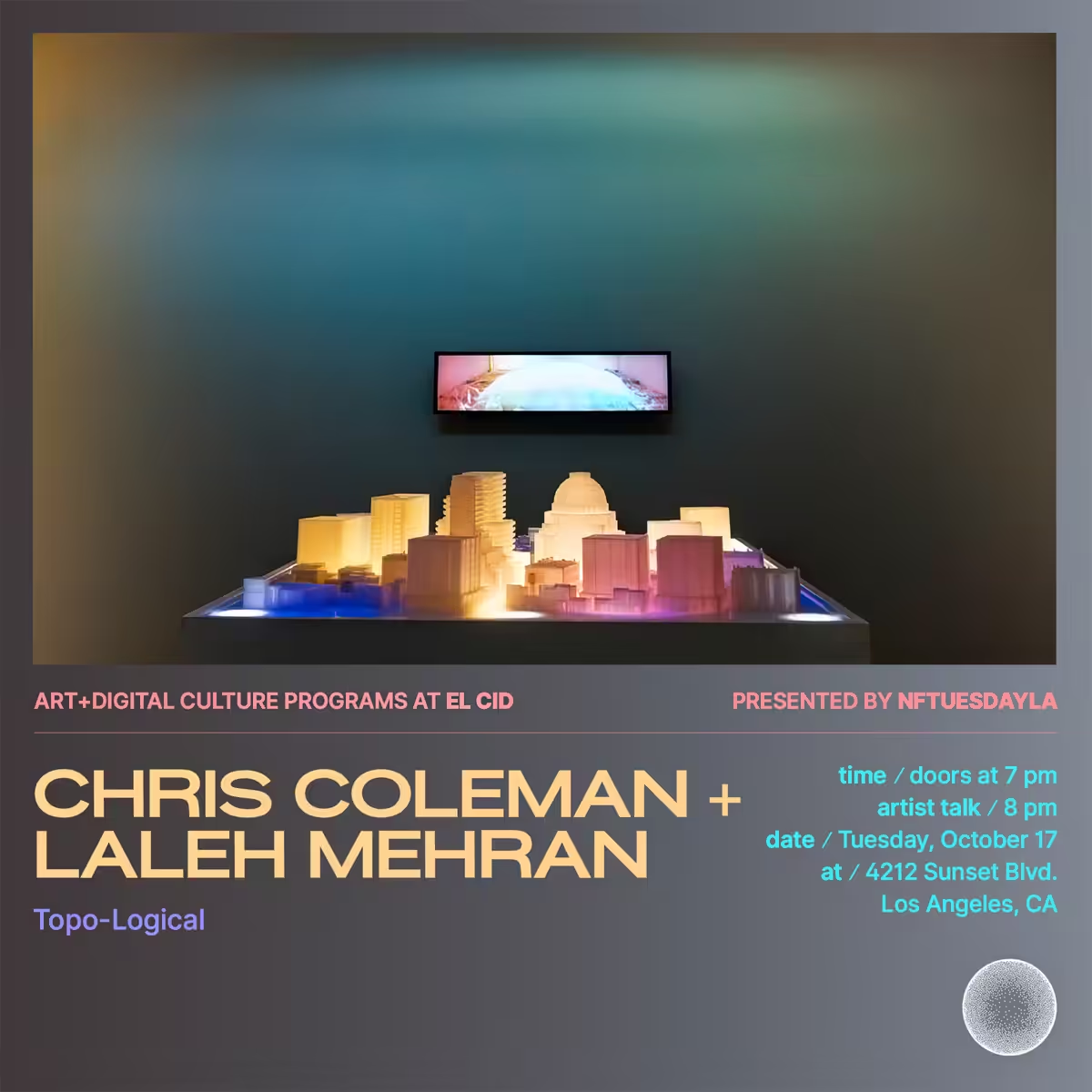
Topo-Logical - Chris Coleman & Laleh Mehran (PF27)
Chris Coleman and Laleh Mehran join NFTuesdayLA to share their individual and collaborative art practices looking into ideologies, identity and landscapes. They have been creating experiences since the turn of the century, leveraging digital technologies to speak about 21st century subjects. Mehran uses metaphor and the language of science to speak about fanaticism and the ways it is used to manipulate people. Coleman explores how our perceptions are changing in an increasingly digitized world. They both explore the systems that are put into place to keep people apart, and how we might find better futures working together in spaces like national borders and the internet.
Coleman and Mehran have been building a collection of digital art over the last 15 years as part of their work engaging with the digital arts and experimenting with models of support. They also started the Clinic for Open Source Arts (COSA) to help free and open source tools for digital creativity become more accessible and sustainable. These efforts, in addition to their decades as educators, are all part of a strong belief that expressing creative ideas through digital lenses is critical to our collective futures.
ABOUT CHRIS COLEMAN
Chris Coleman was born in West Virginia and he received his MFA from SUNY Buffalo in New York. His work includes sculptures, videos, creative coding and interactive installations. Coleman has had his work in exhibitions and festivals in more than 25 countries including Brazil, Argentina, Singapore, Finland, the U.A.E., Italy, Germany, France, China, the UK, Latvia, and across North America. He currently resides in Denver, CO and is a Professor of Emergent Digital Practices and the Director of the Clinic for Open Source Arts at the University of Denver.
ABOUT LALEH MEHRAN
Laleh Mehran was born in Iran and relocated with her family to the United States at the start of the Iranian Islamic Revolution. Mehran creates elaborate environments in digital and physical spaces focused on complex intersections between politics, religion, and science. In a political climate in which certain views are increasingly suspect and can have extreme consequences, Mehran’s artworks are invitations to think again about each of these paradigms and the profound connections that bind them. Her research, often modeled on and about the very ideas of science and technology, takes advantage of their cultural importance in order to articulate a set of ideas which require precisely these kinds of mediations from both political and religious intolerance. Out of necessity, her artwork is as veiled as it is explicit, as personal as it is political and as critical as it is tolerant.