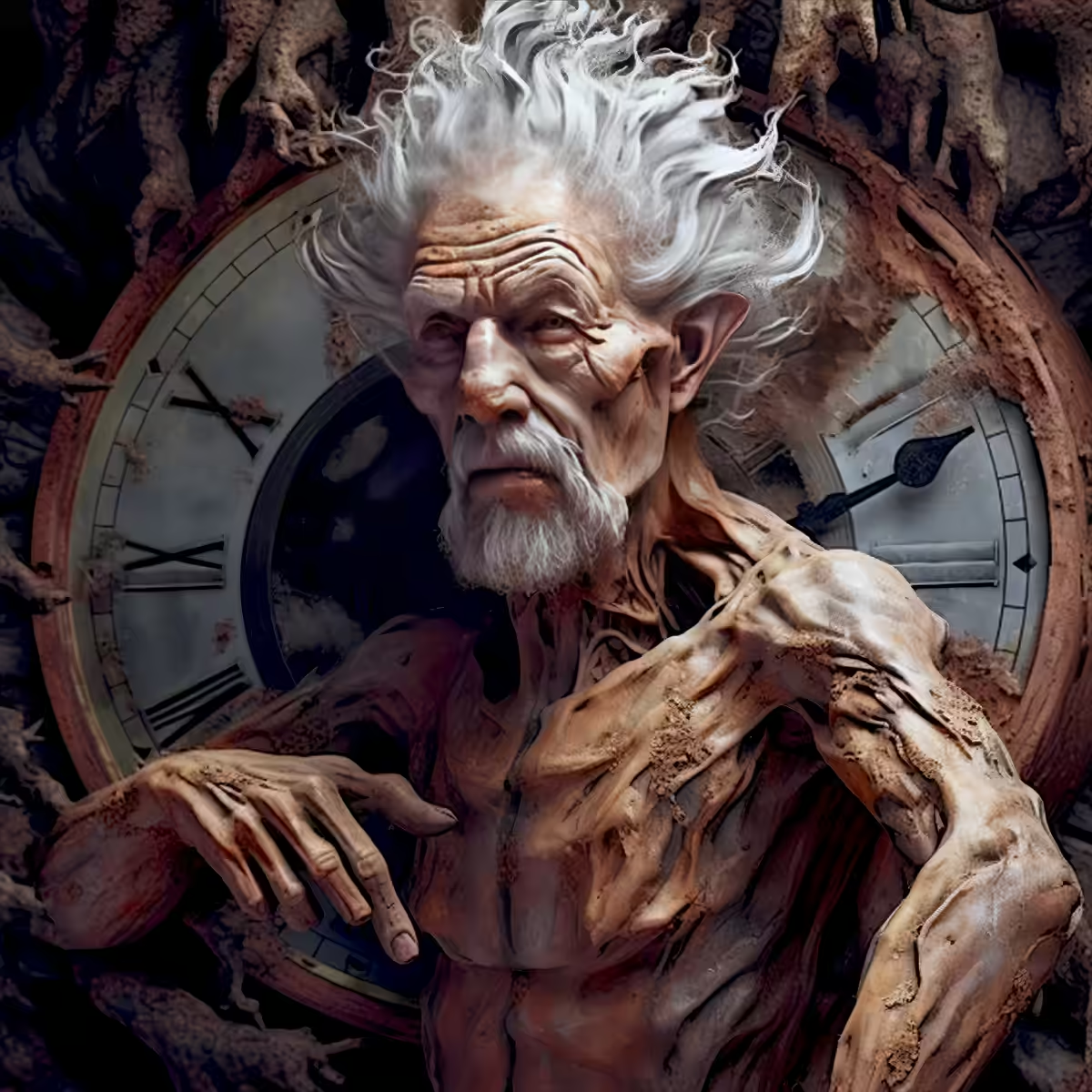
Old Gods of Tezos: Old God of Time
Long ago, in the realm of The Old Gods of Tezos, there stood the Old God of Time, a figure as ancient as the whispering winds and as enduring as the mighty mountains. This majestic being took the form of a towering tree, its bark etched with the marks of countless ages, like the stories etched upon the faces of wise elders. Its branches reached towards the heavens, adorned with leaves that shimmered in hues that mirrored the changing seasons, a vibrant tapestry of life's eternal dance.
To the gods who dwelled beyond mortal comprehension, time was but an elusive concept. Yet, the Old God of Time understood the profound significance it held for the mortals who walked upon the earth. With wisdom born from time's deepest depths, the ancient deity revealed a truth to the early humans: it was not the mere passing of time that held meaning, but rather what one did with the precious moments they were granted.
Thus, the Old God taught the ancient ones the value of each fleeting second. It instilled within them the understanding that every breath, every heartbeat, was a precious gift. The God's voice, like whispers carried by the rustling leaves, urged them to seize the essence of existence and make the most of their allotted time.
Patience and perspective were virtues bestowed upon mortals by this timeless arboreal deity. It encouraged them to be patient in their endeavors, for just as the seeds take time to sprout and bloom into magnificent trees, so too did the fruits of their labor require nurturing and the passage of time. With gentle whispers carried upon the breeze, the Old God reminded them to step back and behold the grand tapestry of life, to understand that their actions, like ripples in a pond, extended far beyond the present moment.
Within the Old God's ancient heart flowed the wisdom of countless generations. It recounted the tales of civilizations rising and falling, of triumphs and failures, and the echoes of history that reverberated through the ages. The deity urged the mortals to learn from the past, to draw lessons from the annals of time, and to wield that knowledge as a guiding light for the present. Through the Old God's teachings, the ancient ones were empowered to shape their own destiny and pave a path towards a brighter future.
As a guardian of time itself, the Old God remained ever watchful. It ensured that the delicate balance between past, present, and future remained intact. With a solemn voice that echoed through the corridors of eternity, it cautioned mortals against recklessness. It implored them to ponder the consequences of their actions, for each choice made in the present sent ripples across the vast tapestry of time, shaping destinies and weaving the intricate threads of fate.
Symbolically, the Old God of Time embodied the essence of rootedness and connection to the earth. Its ancient, gnarled form stood as a testament to the grounding nature of time, its roots delving deep into the fertile soil of existence. Its leaves, ever-changing with the passage of seasons, mirrored the impermanence and fluidity of life, reminding mortals of the ever-turning wheel of destiny. The wrinkled bark, etched with the marks of countless ages, bore witness to the accumulated wisdom of time itself. And its towering stature, stretching towards the heavens, represented the vastness and grandeur of time's eternal domain.
Thus, the Old God of Time, the Timeless Arbor, remained a powerful reminder to mortals that time was a cherished gift. It was a reminder that their choices and actions defined the legacy they left behind, and that every moment held the potential to shape their own destinies and the fate of the world. Through the teachings of this ancient arboreal deity, humanity discovered that time was not their master, but rather a canvas upon which they painted their lives, crafting a tapestry of meaning and purpose with each passing breath.