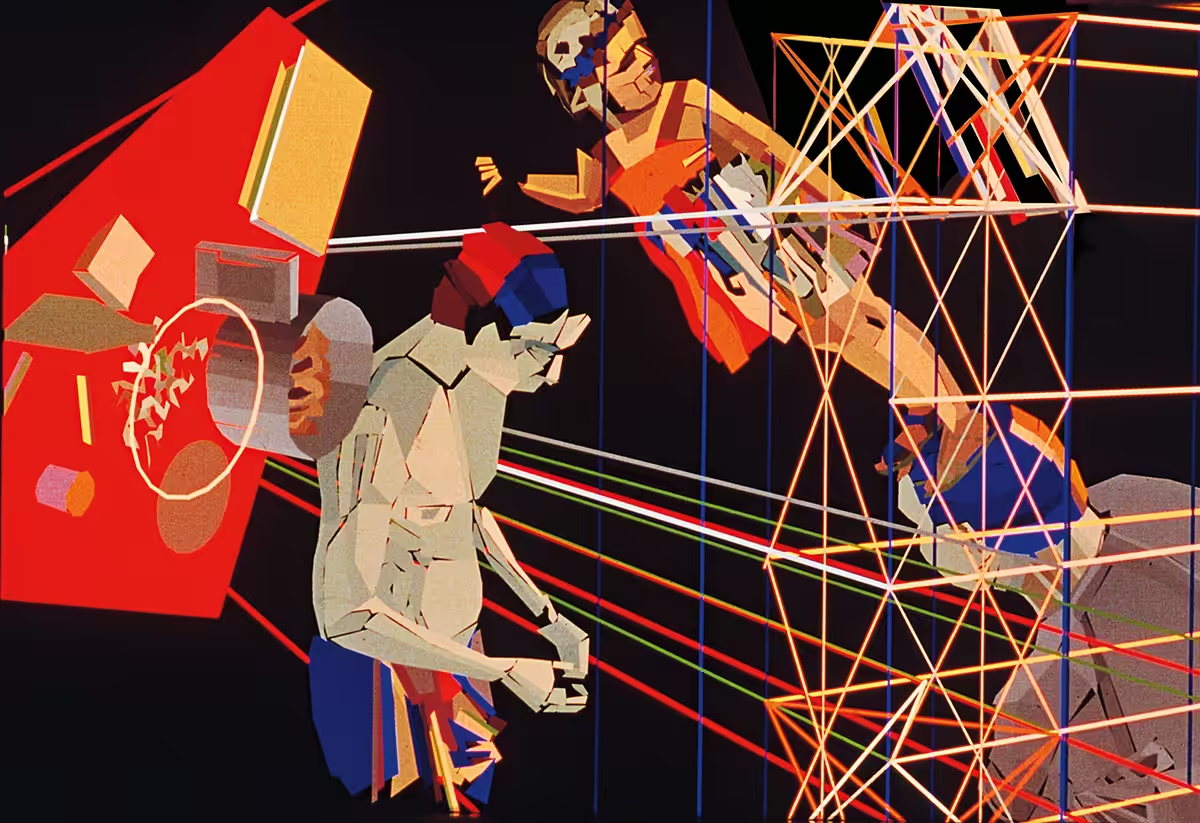
Metalogue v01.02
Metalogue as it’s called for short, is a digital image that was created by artist Victor Acevedo in the Spring of 1987. It is an image variant of Acevedo’s well-known Ectoplasmic Kitchen series from the same year. It presents an alternative arrangement of the graphic renderings of human figures and still-life objects as used in Ectoplasmic Kitchen v01, among others.
It was created with a software package called Artworks. This was a 2.5D Vector Graphics Software licensed by West End Film/Pansophic. 2.5D (Two and a half ‘D’, D=dimensions) means it supported mouse controlled, manipulation of on-picture-plane graphical objects within any implicate or explicate polygon domain toward convergent perspectival vanishing points. However, the software’s computer graphic capabilities would not be classed as that of a full 3D modeling system.
The original DOS-based image file was saved to a 5.25” floppy disk; usually written to a ‘Pansophic’ flavor of the PIC format. However, this NFT linked JPG file was produced from a high-resolution scan of a 35mm slide that was output via a 2K Matrix digital film recorder directly from the original computer file in 1987. The slide film was developed by the artist himself in a small dark room, after-hours at the business-to-business 35mm slide production service bureau, where he worked in the Spring of that year. This was done with the permission of management.
This particular version of Acevedo’s digital image called Metalogue is numbered as version 1.02 because it has been altered slightly from the original 1987 raw PIC file by the artist in 2018. He considers this the definitive version; the director’s cut, if you will. Acevedo has said, “At some point it occurred to me while I’m still alive, all of my works are potentially “works in progress.”
Metalogue was titled after interdisciplinary anthropologist Gregory Bateson's name for his didactic-allegorical conversations called ‘Metalogues.’ The artist was thinking specifically about one called "Daddy, why do things get in a muddle?". The notion of the metalogue is that the structure of a dialogue, can in fact progressively mirror its own content - thus the two-way conversation can also be apprehended as a metalogue.
Looking at the picture: the 'muddle' is evoked by the curious Surrealistic jumble of elements arrayed against a jet-black void. On the left is an "anti-gravity" table suspended in the air replete with a still-life arrangement. Just left of center in the composition, is a young man (also seen in the Ectoplasmic Kitchen series) frozen in a quizzical-eye-squinted 'praying mantis' stance. Perhaps he's the perplexed audience-of-one to this dialectic in-a-muddle.
On the right is a girl standing on her daddy's head. This is obscured slightly by a rectangular edge-vector ‘tower’. This image of a girl was also used in other early vector-graphic compositions that were later revisioned in Acevedo’s raster graphic “Semiotic Outback” series in 1988. These later images were produced with photographic scans and early digital paint software then bundled with the Cubicomp. This was a desktop computer 3D modeling and animation software and hardware system.
Digital image: JPG file format, 2000x1372 pixels