His And Hers Computers
His And Hers Computers by Sammie Veeler
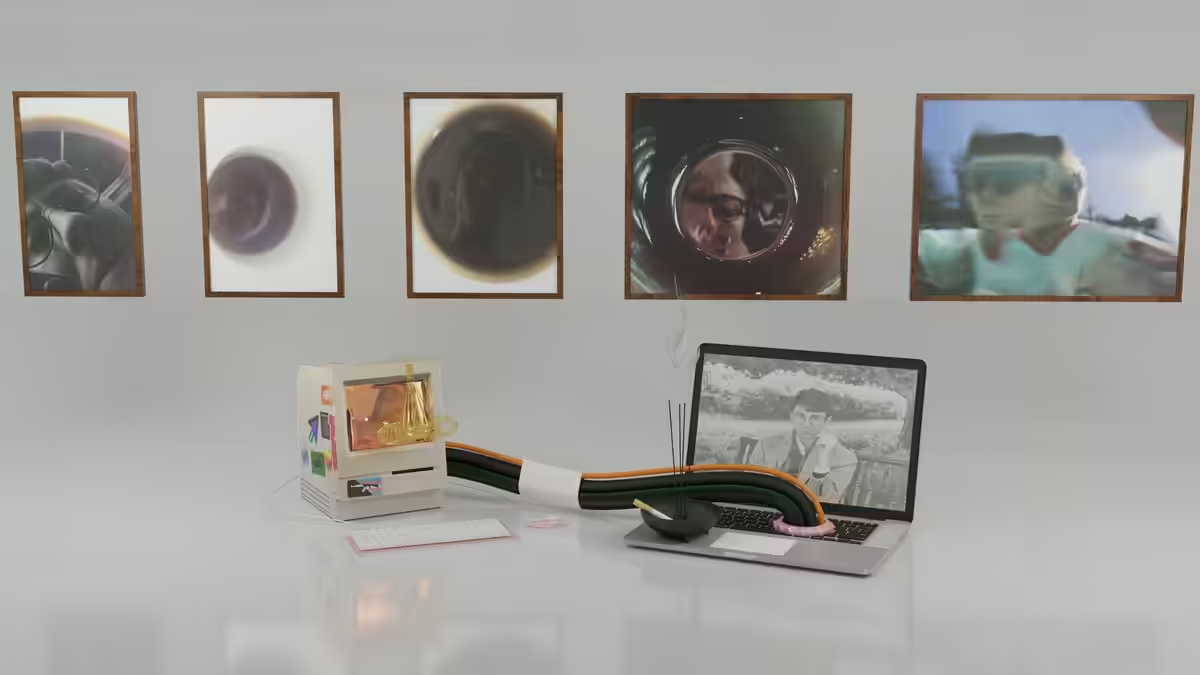
His And Hers Computers is a recurring asset in my work. This union of two local machines by a mass of cables between them symbolizes the digital bond between myself and my late husband, Tvordis. On the left, my avatar floats out of the glowing translucent screen of a Macintosh covered in the stickers that adorn my current computer. On the right, a replica of Tvordis’s personal computer, Theseus, depicts a portrait of him on the screen.
This artifact is spun off from A Time Capsule Or A Grave: a hybrid performance project initially commissioned by the Tezos Foundation for Octobre Numérique Faire Monde in Arles, France in October 2022. It connects a series of IRL performances with a persistent virtual environment on New Art City, each of which evolve between every iteration. Audio recordings of each performance are broken into clips and installed in the virtual environment at each place where they were spoken, forming an ever expanding dialogue between versions of myself across time.
A central conceit of the work is my grief ritual and preservation practice with Tvordis’s digital archive. There is more to preservation than storage. Digital artifacts only perform their objecthood when accessed. They always point back to an invisible original. We must not confuse information for memory. Information exists in the machine. Memory is constituted in the body. I would rather the piece live in your mind than die in a hard drive where it lies in suspended animation.
A Time Capsule Or A Grave is an ongoing process and this edition is a snapshot of a single state of its existence. Once minted, His And Hers Computers will be immutably written and perpetually preserved on the blockchain. If, as Jon Ippolito tells us, new media art can only survive by mutating, what role does immutability play in this process?
Included with this edition are an archival 4K TIFF render, a gLTF 3D file, and a .Blend file of the scene depicted in the image. The TIF format was released in 1996. It is a preferred archival format for digital preservation of images and is not likely to change in the near future. The gLTF format was released in 2015. While much newer, it is quickly becoming the new standard for 3D files in the WebGL era. It is a happy medium between mutability and fixity. Blender is about as old as the TIF, but in terms of longevity, it is the most precarious of the three. The most recent .Blend file version that can be opened by the current long term service version of Blender (3.3) is version 2.8, released in 2015. How long will files made with 3.3 be supported?
While open source projects can in some cases provide more resiliency than corporate platforms, the evolving nature of the software means the original tools for authoring this work will not be here forever. How will you preserve these artifacts? What does preservation mean to you? What role do humans have in this preservation process that entrusts the task of storage to a so called trustless system?
Format: PNG + Unlockable TIF, gLTF, .blend Resolution: 3840 x 2160