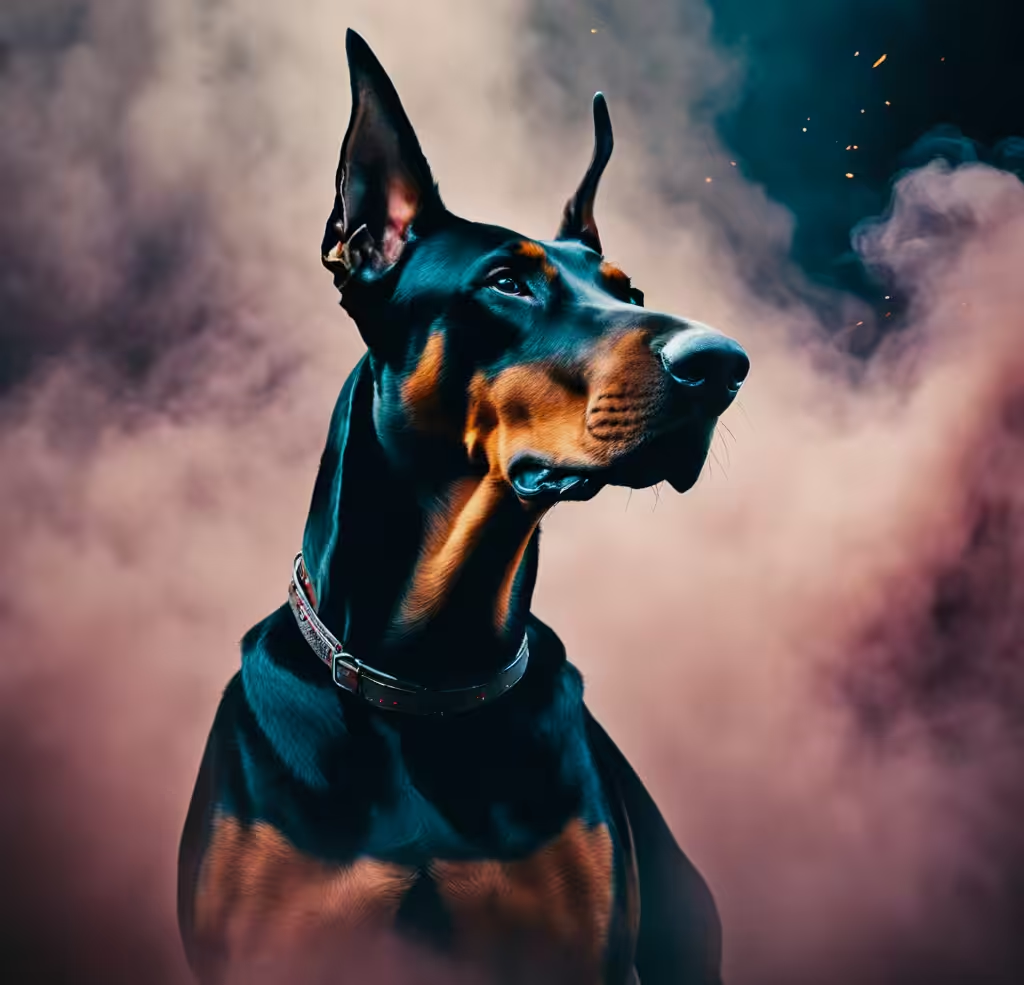
Best Friend (Collection in progress): Doberman 2
The Dobermann is a breed of short-haired working dog, bred in the city of Apolda (Thuringia, Germany) at the end of the 19th century by Karl Friedrich Louis Dobermann, named after its creator. Dobermans were created as a purposeful breed and were shaped through careful selection. Work on the Doberman breed began in 1870. German pinschers were chosen as the founders of the breed; they were hired by the creator of the breed for their courageous and rather aggressive character. Subsequently, they were infused with the blood of Rottweilers, Belgian and Thuringian Shepherds, as well as Weimar hounds. For the first time, Karl Doberman's dogs were presented as an independent breed at an exhibition in 1897. A year later, this breed received its first official recognition. In Stanley Coren's book, The Intelligence of Dogs, the Doberman is included in the group of breeds with the best training abilities. The Doberman is a large dog with a muscular but slender build, giving the impression of a collected, dynamic, active animal. In the judge's exhibition evaluation, an important role is played by the harmony of the animal's build and the clarity of the silhouette lines. The color of Doberman Pinschers is most often black or dark brown with bright and clearly defined tan markings of different shades of red. During exhibition evaluation, preference is given to dogs whose markings are located symmetrically. The rare blue and isabella colors are also acceptable in the breed. Dobermans have an active, energetic character and are prone to aggression. They have a pronounced protective instinct, both territorial and aimed at protecting humans[2]. Moreover, in the family where this dog lives, Dobermans are friendly and not aggressive towards their family, including children. With proper socialization, these dogs are distinguished by loyalty and obedience towards all family members. Dobermans are not aggressive towards other types of animals and are suitable for sharing with both cats and other pets. These dogs are also not aggressive towards representatives of their species with whom they live in the same territory. The aggression that is often noted in the description of this breed is aimed specifically at people, and at strangers. In general, Dobermans tend to adapt very strongly to the owner and convey in their behavior the behavior and mood of the owners. When conflicts arise within the family, Dobermans can become actively involved in this conflict, even to the point of being ready to aggressively defend the person who is the actual owner of the dog. When trained, Dobermans show intelligence and the ability to quickly master commands, both simple and complex. At the same time, due to the rapid assimilation of skills, it is important for the owner to avoid mistakes when forming the desired behavior, since an erroneous skill will be established as quickly as the one desired by the person. During training, it is important to remain consistent in your command requirements and actively provide positive reinforcement for correctly executed commands. Because of this, Dobermans are not recommended for novice dog owners. They show high interest and passion in their work. In terms of grooming, the Doberman is a fairly undemanding breed. It is enough to comb the fur with a fine brush from time to time and wipe it free of dirt with a damp cloth. Seasonal shedding is not typical for these dogs. Walks for dogs of this breed should be long, containing high stress, both physical and intellectual. During long walks in cold weather, Dobermans need to be walked in special clothing, since these dogs do not have an undercoat and with prolonged exposure to negative temperatures they freeze, which can lead to diseases.