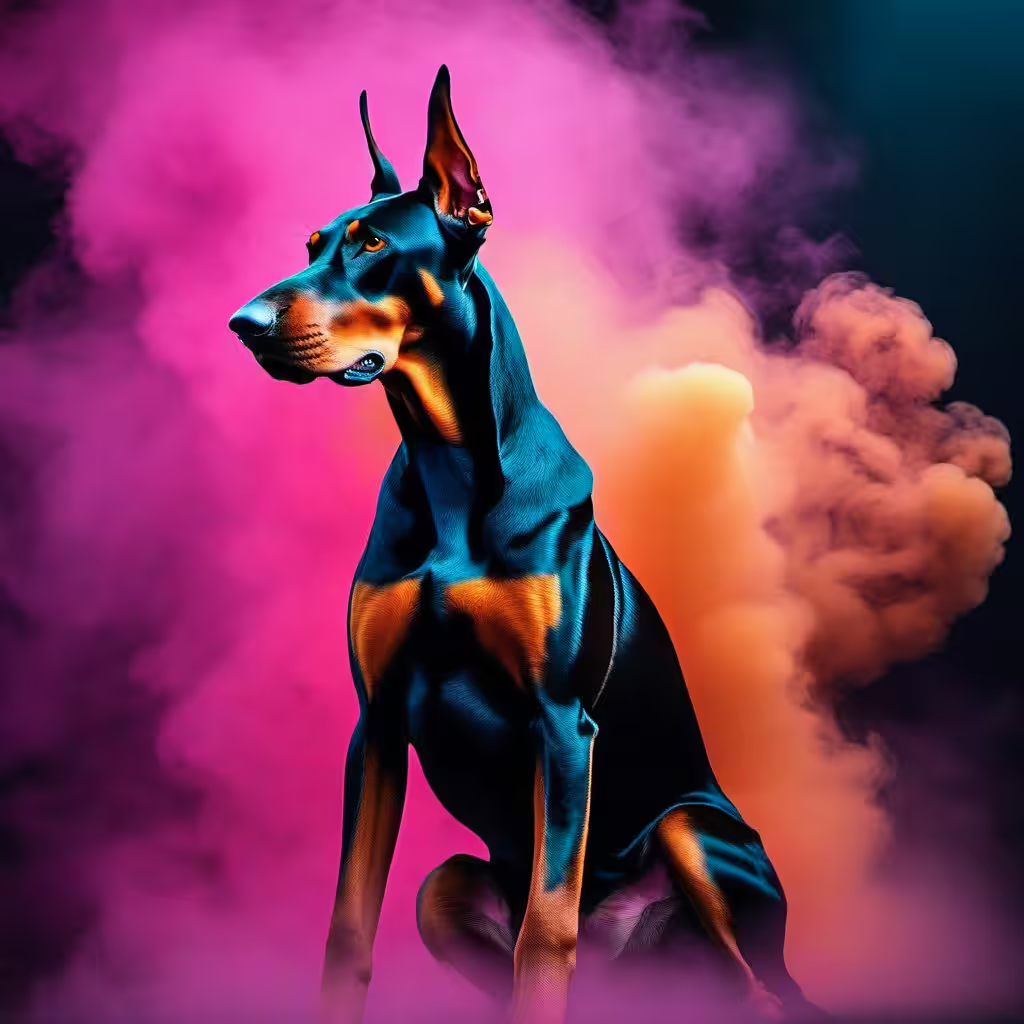
Best Friend (Collection in progress): Doberman
The Doberman is a large dog with a muscular but slender build, giving the impression of a collected, dynamic, active animal. In the judge's exhibition evaluation, an important role is played by the harmony of the animal's build and the clarity of the silhouette lines. Dogs of this breed are characterized by pronounced sexual dimorphism - males are much larger than females and have an almost square body format with a pronounced back slope, while females have a more elongated format, a lighter and drier build, and a weakly expressed back slope. The head gives the impression of being in proportion to the body and should not be too heavy or too light. When viewed from above, the head of dogs of this breed is shaped like a wedge. The length of the frontal part and nose are equal. The transition from the forehead to the muzzle is well defined and has a pronounced frontal groove. The brow ridges are well developed. The jaw muscles and cheek bones are well defined, but should not be pronounced. The mouth is distinguished by a very wide opening, up to the possibility of seeing the molars from the observer. This functional feature of the structure of the Doberman's mouth provides the possibility of a deep and strong grip with the teeth and high pressure of the jaws when maintaining a grip. The nose has a well-formed lobe with large, noticeably open nostrils. The color of the nose and lips is in harmony with the color. The lips themselves are fleshy, dense, tightly fitting to the jaws in front. In the corners of the mouth they form an elastic fold, which allows Dobermans to open their mouths wide. The eyes are medium in size, slightly slanted or oval. The eyelids are tight-fitting, with a clearly defined contour. A slight sagging of the lower eyelid is allowed. The color of the eyes is in harmony with the color - the lighter the color of the coat, the lighter the pigmentation of the eye. The neck is long, set high, looks harmonious in combination with the body and head, forming a smooth curve from the occipital protuberance to the withers. A small leathery dewlap may be observed on the neck (usually in males). The withers are prominent and strongly developed. The back is short, straight with an inclination towards the lower back, well muscled. The croup is wide, continuing the line of the inclination of the back, and has no rise. The chest is deep, well developed, with a pronounced sternum and relief of the ribs[2]. The abdomen is tucked, but the transition from the ribs to the abdomen does not form sharp angles. The tail is set high and well muscled at the base. Both short docking of two or three caudal vertebrae and a natural appearance of the tail are allowed. If docking has not been carried out, the tail of dogs of this breed is saber-shaped, set high, and should be free of knots and sharp bends. The limbs are strong, with prominent muscles and noticeably pronounced joints. The shoulder girdle has highly developed relief muscles, the elbows fit tightly to the body. The forelimbs are set perpendicular to the ground, parallel to each other. The pasterns on them are highly developed and stand with a slight slope. The hind limbs are slightly extended from under the body, parallel to each other. The hips and pelvis are well muscled. The stifle and hock joints of the hind limbs form pronounced angles, ensuring good forward movement of the dog. The toes are short, strongly arched, and tightly packed. The pads are well developed and have a color that matches the coat color of the dog. The coat is short, medium hard, thick, and lies close to the body. Visually, due to the specific structure of the coat, it seems even shorter than it actually is. There is practically no undercoat. The color of Doberman Pinschers is most often black or dark brown with bright and clearly defined tan markings of different shades of red. During exhibition evaluation, preference is given to dogs whose markings are located symmetrically. The rare blue and isabella colors are also acceptable in the breed. Dobermans were bred as a service dog breed, designed from the very beginning for police work. The main tasks assigned to dogs of this breed have always been search service and protection. In this capacity, Dobermans are used in law enforcement agencies of different countries to this day. Also, due to their high sense of smell, Dobermans are used in search and rescue services. In addition, Dobermans are suitable for some dog sports and can also be kept as companion dogs (provided the owner has sufficient experience in raising dogs).