East of Childhood: The Cold Came from Within
This poem collection, East of Childhood, was born out of silence and survival. Each piece is a fragment of memory, drawn from the raw edges of growing up in a world where warmth was scarce, and quiet was mistaken for strength. The poems move between languages and voices, sometimes whispering, sometimes burning, but always carrying the weight of what was never said. They are not written to invite pity—they are written to give form to what was endured, and to show how beauty can still emerge from the coldest places.
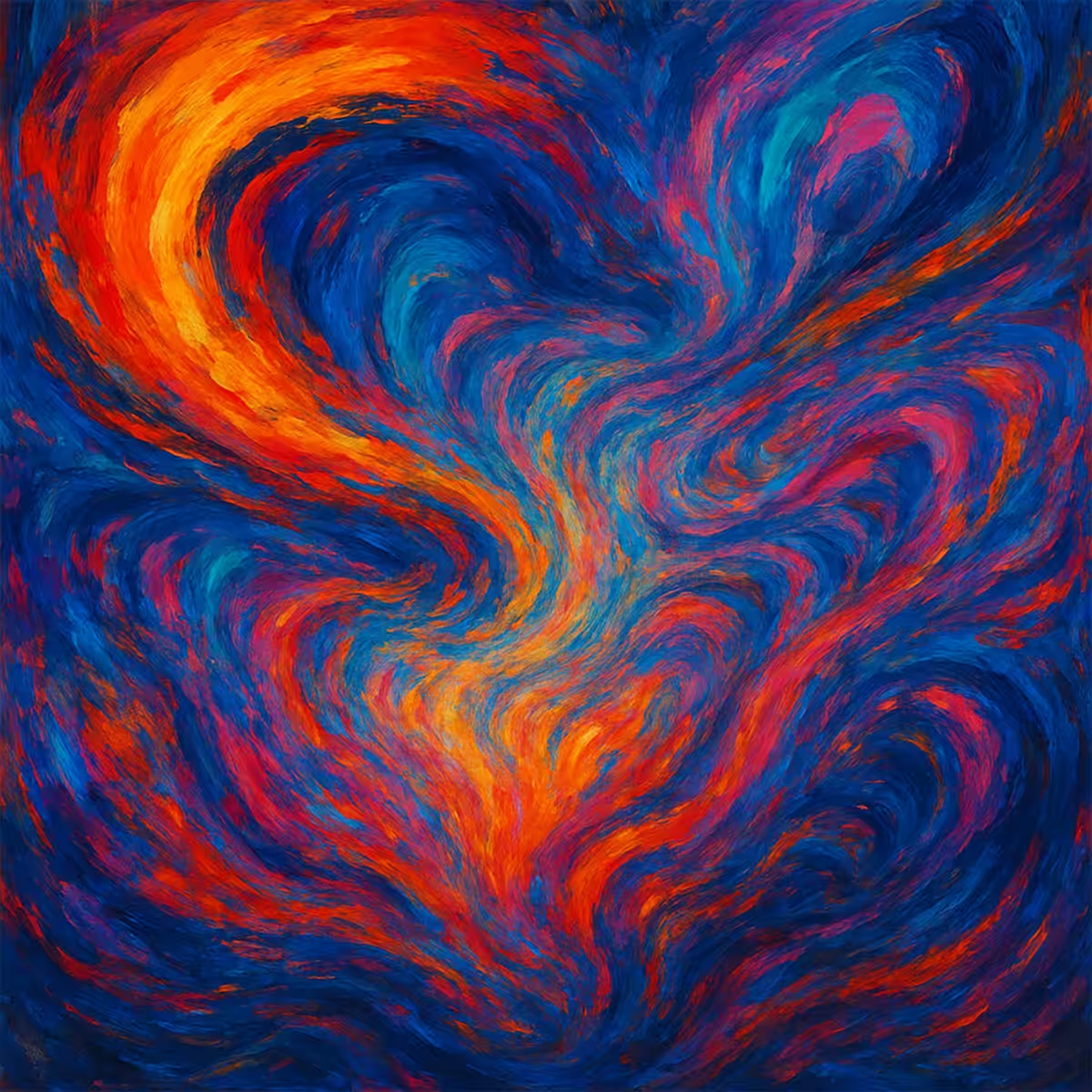
The artwork for The Cold Came from Within is my attempt to translate that silence and buried longing into color and movement. Where words describe endurance, paint reveals energy. The swirling layers of vibrant orange, red, and blue reflect the inner conflict between warmth and cold, between dreams that flicker and the weight that extinguishes them. For me, this piece is not just abstract—it is a portrait of resilience. The cold is present, but so is the fire. And in the dance between the two, I find the truth of these poems: that survival itself is a kind of art.
Poem: The Cold Came from Within
She once said she wanted to be a photographer. Not as a plan, but as a whisper in the middle of something else, in the middle of everyday noise, in the middle of a glance that suddenly softened.
I don’t know why she said it, because she never said things like that. Never anything about herself only practical matters: food, bills, rules.
But that day she said it, that she had once dreamed of catching light, of freezing moments, of seeing something no one else saw and making it beautiful.
But it never happened. She was never allowed to dream long enough to believe in it. Right after primary school she was sent to work, just as her mother had been before her, just as girls were where she grew up girls who had to do what they were told, girls who had to be proper, quiet, useful.
And the boys? They were allowed to choose, to fail, to find themselves.
She learned instead to sew stitches that held, to sew wounds that mustn’t burst, for ten years, with her head bent, and the needle as her only conversation partner.
When she was finished with that, she was sent to clean. Not the kind of cleaning where you push a vacuum across a neat carpet and feel useful, but the kind that corrodes the body from the inside, that smashes your shoulders and eats away at your knees.
The kind where you wake at night from pain in your joints and get up to go to work anyway.
Where you don’t say anything to anyone, because who the hell wants to listen to a woman who cleans, complaining about pain? Who would take her seriously, when she hadn’t even been taken seriously as a child?
I didn’t understand it then, but now I do: that when your body hurts every day, and no one asks how you are, you begin to believe that pain is normal, that silence is necessary, that cold is easier to bear than warmth.
Because warmth demands something of you and you have nothing left to give.
She always opened the window in the morning, and I thought it was just to let in fresh air. But now I know it was to dampen something, to cool something down maybe in herself, maybe in us, maybe just in the world.
And I remember how she looked at me when I came home late. Not angry—just heavy. As if I was yet another thing she had to drag along with her.
There was no warmth in that look, no understanding, no gentleness. Only demands. Only expectations. Only that kind of love that feels like a burden.
And I learned to be quiet, to be good, to manage on my own, to hide my wounds the way she hid hers.