GRID SPACE: Topological Horizon
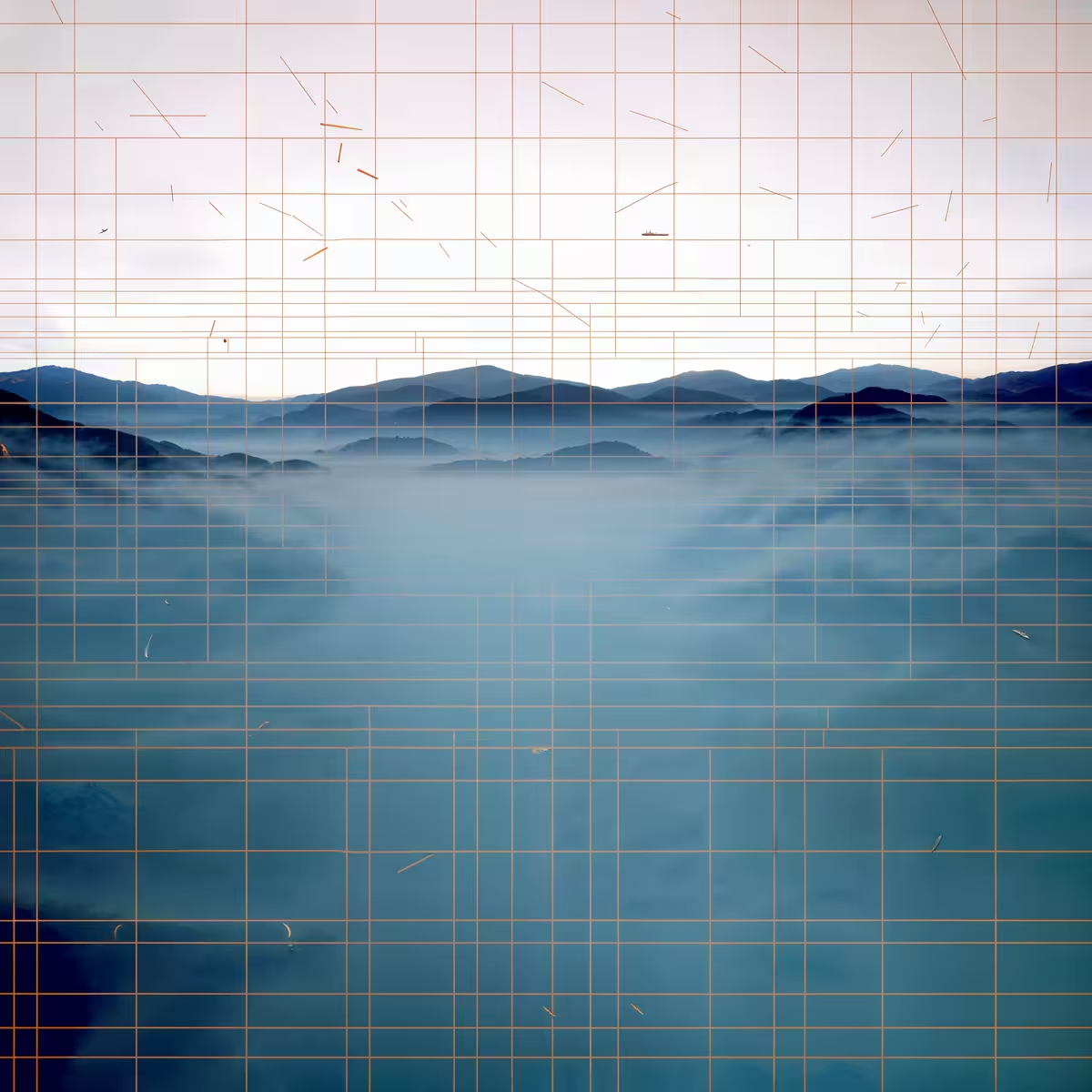
A suspended landscape unfolds between visibility and abstraction — a chain of distant mountains dissolving into a sea of mist, overlaid with a fragile, algorithmic grid. The image operates at the intersection of natural perception and computational structuring: the horizon becomes not only a geographical boundary, but a field of encoded space.
The grid does not dominate the landscape but quietly negotiates with it — mapping, fragmenting, and reinterpreting atmospheric depth. Thin, almost incidental linear disruptions suggest data noise, interference, or the residue of a system attempting to stabilize what is inherently fluid.
This work explores the tension between organic continuity and digital discretization. The fog acts as a buffer — a soft medium where topology replaces geography, and where space is no longer measured in distance, but in relations, density, and transformation.
The horizon, traditionally a symbol of infinity, is redefined here as a constructed interface — a place where nature is not simply observed, but processed.