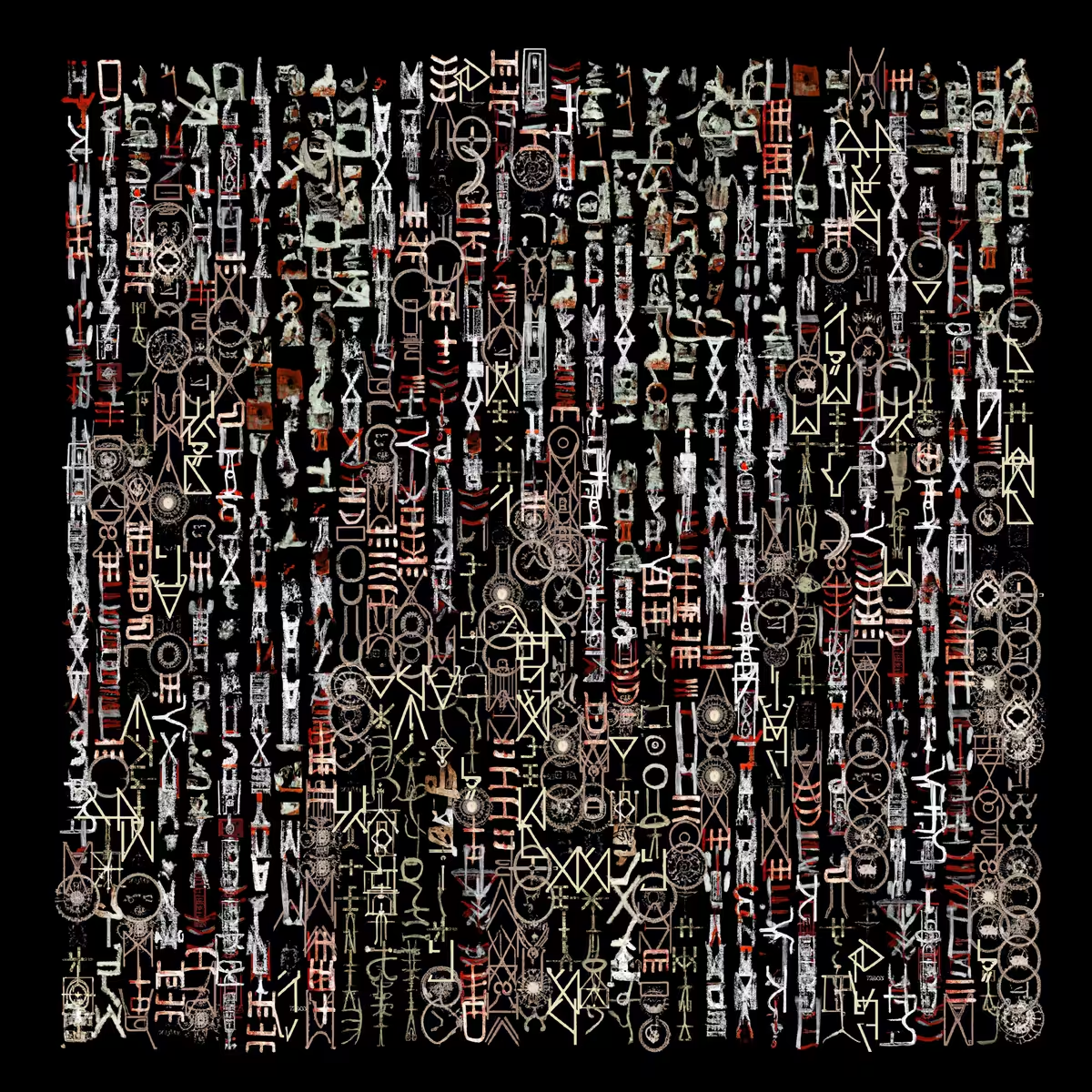
Première connexion: Panel A5
From a series of 3*16+3 panels. Primary buyer can claim a unique physical edition (20cm aluminum laser print). 2022 Caza d'Oro , Le Mas d'Azil, France.
--
Human digital composition made from visual materials generated by so-called intelligent diffusion models. Work on visual noise as an intermediate stage of this type of generation and as a symbol of the emergence of language.
This series is a fictional representation of the process behind the images generated by artificial intelligence. Here, DALL-E 2 by openAI was used, although the raw outputs are not the final result.
It was important that the final result offered a higher degree of detail and complexity than what the artificial intelligence itself was capable of providing at the time, while also evoking the genesis of the process in its chaotic and random dimension.
The initial individual elements (bones and alphabetic glyphs) were generated using simple text prompts, (extra-bold futuristic asemic alphabet glyphs, black background, scifi, hud, asset, geometric, graphic design / shamanic futuristic asemic script alphabet, hud, rows, columns, black background / various isolated futuristic metallic bones, pure black background / various isolated sacred scifi metallic bones, black background / etc.)
To generate such images from commands as simple as these, the machine always starts with an image made of pure noise (a square of entirely random pixels, comparable to the static visible on a cathode-ray screen without signal). This visual noise can be seen as a symbol of initial chaos, entropy, death, or the primordial abyss from which the ordered world emerges.
The algorithm then seeks to make this purely chaotic image clearer, to discern what lies beneath by reorganizing the pixels step by step, guided in this process by the keywords and syntax it was given. This is possible thanks to a long prior training process, during which it analyzed billions of texts and images to learn what corresponds to what.
The process is therefore one of progressive reorganization of raw chaotic "matter" through language. The act of creating these images becomes a form of writing, close to minimalist poetry, enabled by the replacement of computer code with natural human language, which is now increasingly understood and interpreted by these programs.
Several hundred of these alphabetic and skeletal sheets were generated, organized, sorted, and then the individual elements they contained were manually isolated, classified according to a subjective chronology, and sequenced into videos: one scrolling through all the glyphs, the other through the bones. A digital composition scrolling through these two sequences, arranged into a single block by duplications and time shifts, was then manually created using video editing software. The printed images are screenshots from this animation.
These final images thus seek to suggest both the initial visual noise from which the elements they contain emerged, symbolizing the cycle of life, the entropic process of degradation, and the inevitable return to dust, but they also evoke the optical gray of a text page or a block of code, also a fundamental raw material in the process at the heart of the synthetic intelligence in question.
The bones also symbolize raw data, the billions of "dead" images still online but no longer viewed by any living person, yet which constitute the food, the raw material for these intelligent networks. Furthermore, bones are the internal structure of humans, but also their first graphic tools, musical instruments, and artistic supports, from which emerged the written language that now enables the emergence of synthetic minds.