Ambivalence: Pleasure and Vigilance
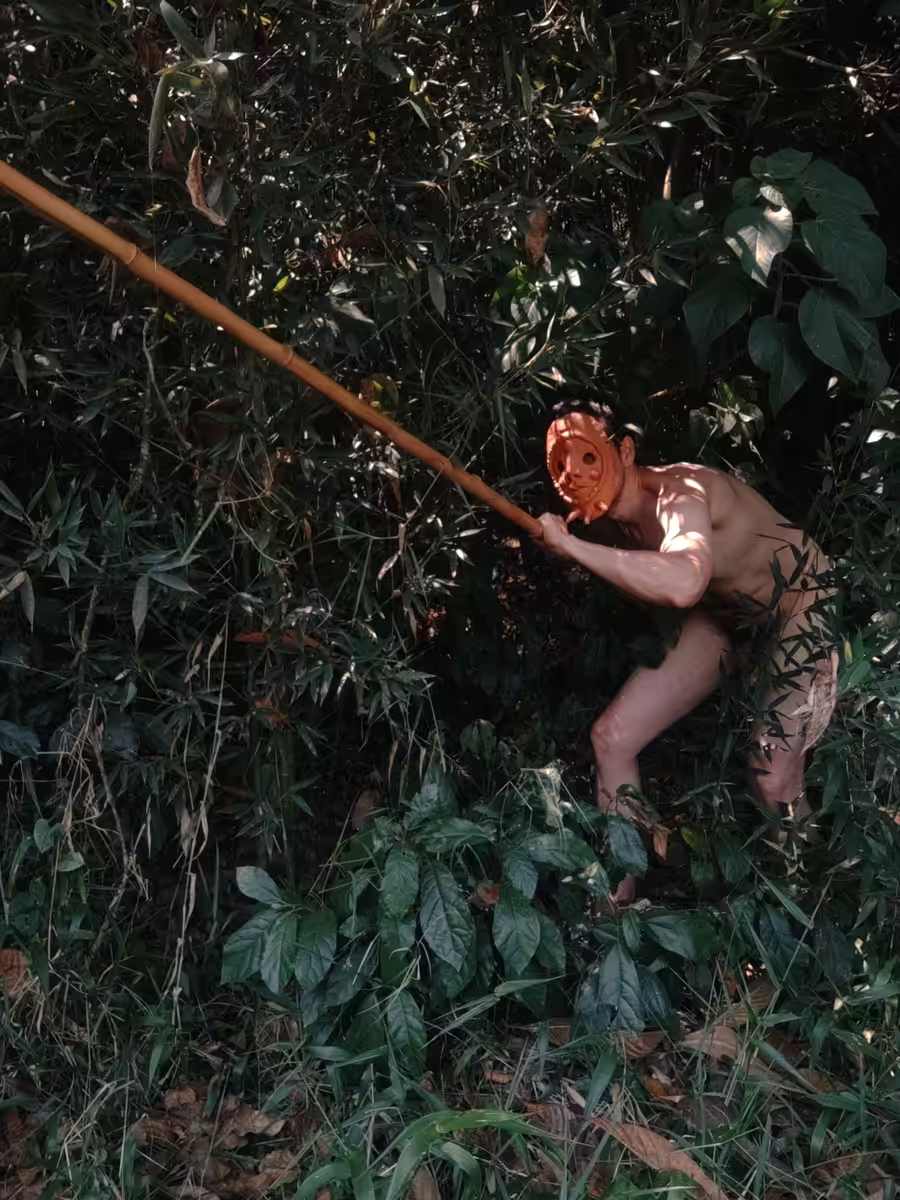
The idealization of nature confronts its raw and wild reality. Here, a human body, naked yet partially covered by a mask, emerges from the dense vegetation, armed with a long bamboo stick. This act of "stripping down" in the midst of the natural environment seems, at first glance, like a romantic return to a primordial state, an attempt to merge with nature in its purest, most essential form. However, the scene reveals something more complex: the duality between the enjoyment of nature and the need to defend oneself from its inhospitable aspects.
The naked body, vulnerable and exposed, represents that deep yearning to connect with nature, to feel its beauty directly on the skin, to experience its fullness without the barriers of civilization. Yet, the presence of the mask and the stick is no accident; they are symbols of the awareness that nature, although idealized, is not merely a place of harmony and delight but also of danger and untamed force. The mask, far from being a mere accessory, serves as a protective barrier, a reminder that when we immerse ourselves in nature, we must also be prepared for its challenges, its risks, its capacity to wound as much as to nourish.
This reflection leads us to consider nature as a dual entity, capable of inspiring both love and fear. The mask and the stick symbolize our need for mediation between our idealization of nature and its tangible reality. They show us that approaching nature is not an act of total submission, but of conscious interaction, where enjoyment is blended with caution. Nature, in its purest state, is not there simply to be passively admired; it is a space that requires respect, preparation, and sometimes, defense.
The act of stripping down, then, is not just a surrender to nature, but also a way of being alert, of recognizing that in the process of idealizing it, we cannot forget its power, its ability to inflict pain, to remind us of our fragility. It is an act of balance between surrender and self-preservation, a dance between vulnerability and protection.
Ultimately, the image captures not only the beauty of the natural world but also its complexity. It reminds us that while nature can be a refuge of peace and wonder, it is also an environment in which we must move cautiously. It is a space that invites us to connect deeply with it, but also demands that we respect it in its entirety, never losing sight of the fact that the idealized and the real are two sides of the same coin.