Ambivalence: I Am Nature
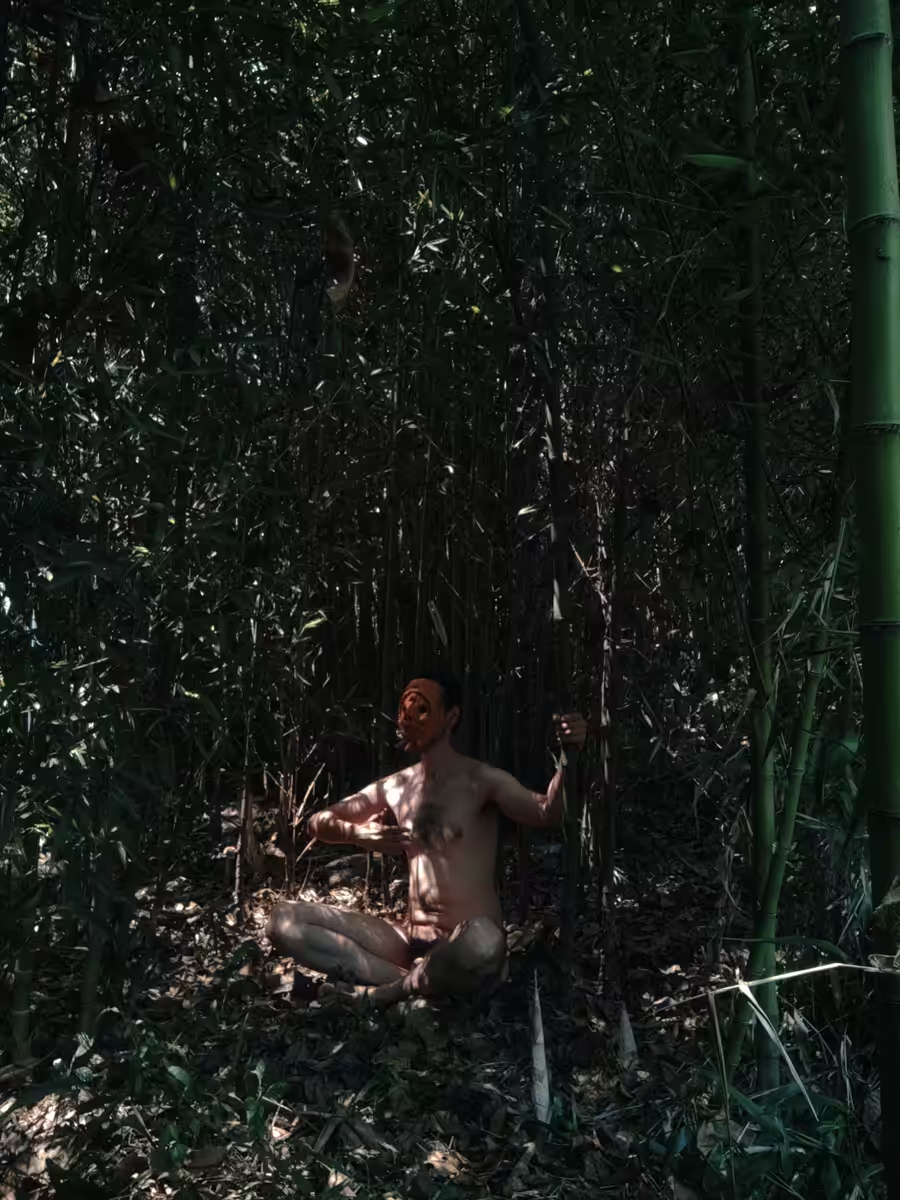
A reflection on the dissolution of boundaries between the self and the environment. In this work, Pollock's famous phrase, "I am nature," transforms into a statement that transcends the individual, revealing the intrinsic connection between the human being and the whole. The photograph captures a moment of total communion, where the boundary between the interior and the exterior fades away, evoking the idea that everything is nature, from forests to technology. Here, the naked body, vulnerable and exposed, merges with the landscape, illustrating the ambivalence between inside and outside, the self and the other.
The work confronts us with the complexity of understanding nature as a totality. If everything is nature, then how do we name what we usually call nature: the forests, the oceans, the deserts? This question becomes essential for understanding our relationship with the world and the constructs we have created to separate the human from the natural. The image also evokes the Buddhist philosophy of being a drop in the ocean, a small part of a vast and incomprehensible whole, where the singular dissolves into the immensity, and in that dissolution, a profound form of connection is found.
Ambivalence here is manifested in the perception of boundaries, in the constant tension between the internal and the external, and in the understanding that this boundary is, in the end, permeable and mutable. This dialogue between the self and the environment invites us to question the separation we assume between ourselves and the world, proposing an experience of total belonging to that vast totality that is nature.
- Egon MonsivAIs