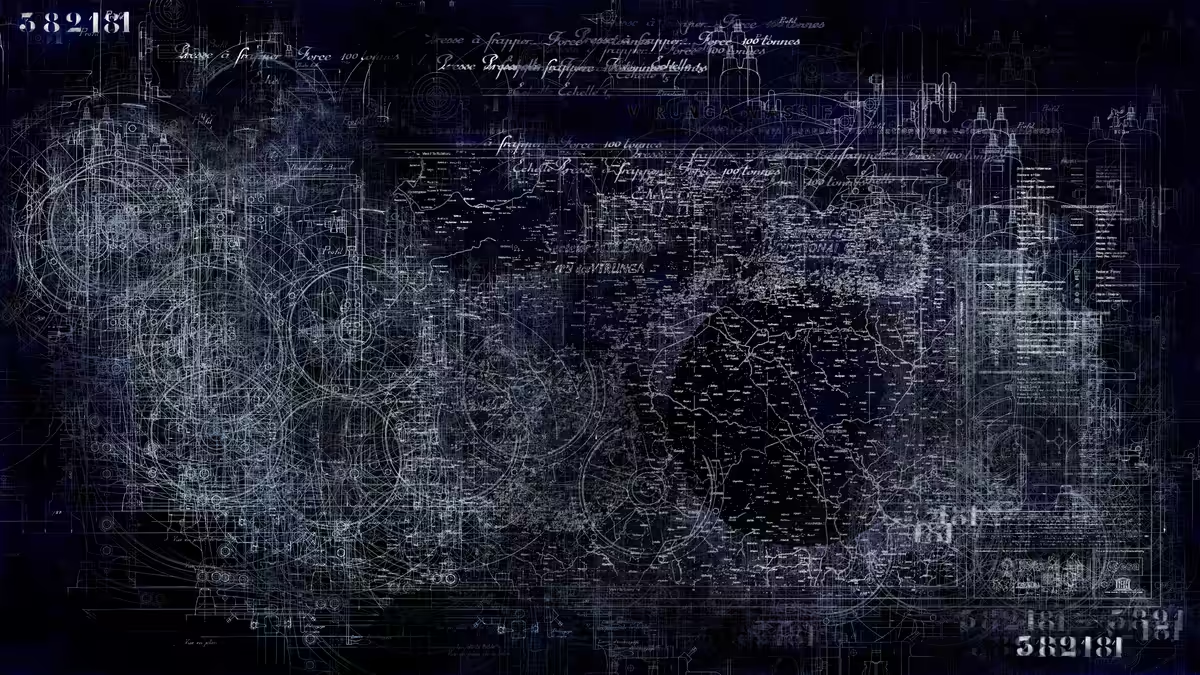
ROBERT ALICE: 382181_Virunga
//////// ARTWORK SITE //////// https://6nxotb3u2uumdnrmiw7perkxq57e4hro3cocfjles6nwns7hivnq.arweave.net/827ph3TVKMG2LEW-8kVXh35OHi7YnCKlZJebZsvnRVs/
//////// ABOUT 382181_Virunga ////////
"“The universe (which others call the Library) is composed of an indefinite and perhaps infinite number of hexagonal galleries, with vast air shafts between, surrounded by very low railings. From any of the hexagons one can see, interminably, the upper and lower floors. The distribution of the galleries is invariable. Twenty shelves, five long shelves per side, cover all the sides except two; their height, which is the distance from floor to ceiling, scarcely exceeds that of a normal bookcase” Jorge Luis Borges, Library of Babel, 1944
A new body of work made in direct response to the French national collection of the Monnaie de Paris, the Blueprints hijack original blueprints and architectural drawing from the museum’s collections and rework them into large scale abstractions.
Taking these drawings as a starting point, they have been interwoven with diagrams, patents, network maps, literature and digital aesthetics taken from the history of blockchains to present imagined structures that present the collision of these two at time competing systems of thought - the centralised and the decentralised.
The resultant works speak to the cultural and philosophical rewiring of value systems in the age of blockchain while also forging aesthetic and conceptual links with the past. The works reference art history as diverse as seminal neuron drawings of Santiago Ramón y Cajal (1852-1934) to early ASCII graffiti on the blockchain such as Len Sassaman’s ASCII Bernanke.
The each work commences with an AI ASCII background trained on a database as blueprints assembled by Robert Alice. Using this as the basis for a compositional structure, the original blueprints from the Monnaie de Paris are fragmented and fractured into decentralised rewirings or territories before being layered again with a further ASCII encoding based on the final image.
Using the letters ‘MCV’ as the encoding for the ASCII encryption, Alice refers a key text for their practice and thinking about the philosophy of blockchains, Jorge Luis Borges’ short story ‘The Library of Babel’ (1944). Centering around the concept of an yet ultimately finite library made of infinite interconnected hexagon rooms each with a set about of shelves and books that number those shelves, Borges’ short story recounts a book within this infinite library that holds only variations of the letters MCV. The encryption ‘MCV’ in all the mutations of both Borges’ short story and now in Alice’s digital paintings stand as a link to conceptual ideas around the blockchain as decentralised and encrypted public archive.
A dynamically generative NFT, the digital side to '382181_Every Path in Vain' plays directly on the blockchain with the idea of the infinite library. Alice has created a large library of literature that relates to the histories of blockchain, anonymity, privacy, hacking culture and libertarianism, before using this as an archive and data source through which to pull new text.The result are endlessly changing artworks in both form and content, as the words continually change forever, tied to the creation of new blocks on the blockchain. The NFT calls the block height of Ethereum and updates itself every 12 number of blocks, tying the very essence and experience of the work with the blockchain as the world’s first truly decentralised library.
This work was first exhibited at the French national museum, the Monnaie de Paris, 29 June to 22 October 2023.
ABOUT BABEL
Taking its title from Jorge Luis Borges’ 1941 short story ‘Library of Babel’ (1941), this new exhibition by Robert Alice investigates blockchains through the lens of Borges’ infinite library. Centred around an infinite library made of discrete rooms filled with every possible text - meaningful and nonsense combined, Borges’ Library of Babel is both a premonition of blockchain structures and post-truth landscapes in the age of AI. The project is a collaboration with LaCollection and marks the first time NFTs were exhibited France's oldest institution (f.864AD).