Compliments To Conway
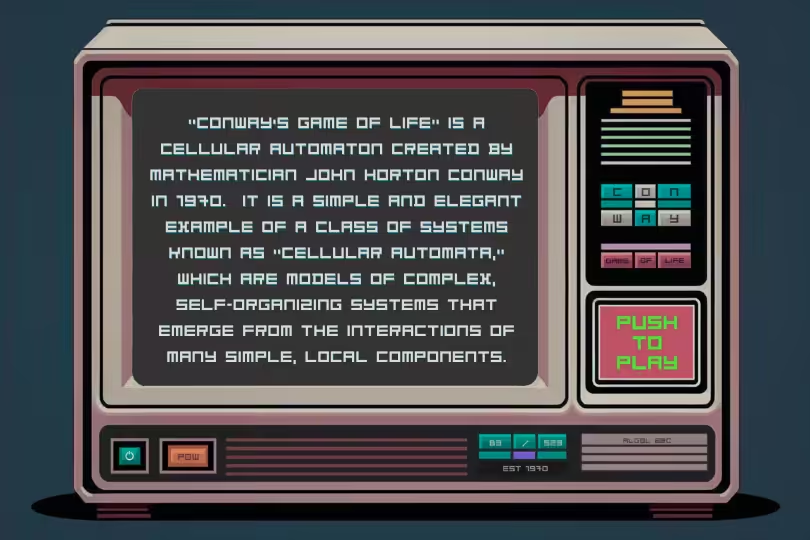
Conway's Game of Life is a cellular automaton created by mathematician John Horton Conway in 1970. It is a simple and elegant example of a class of systems known as "cellular automata," which are models of complex, self-organizing systems that emerge from the interactions of many simple, local components.
The game is played on a two-dimensional grid, where each cell can be either "alive" or "dead." The state of each cell is determined by its eight neighbors, according to a set of rules:
Any live cell with fewer than two live neighbors dies, as if by underpopulation.
Any live cell with two or three live neighbors lives on to the next generation.
Any live cell with more than three live neighbors dies, as if by overpopulation.
Any dead cell with exactly three live neighbors becomes a live cell, as if by reproduction.
These rules are applied simultaneously to all cells on the grid, creating a new generation of cells. The process is repeated over and over, with each new generation depending on the state of the previous one.
Despite its simple rules, the Game of Life can produce a wide variety of complex and unpredictable patterns, including gliders, spaceships, oscillators, and even self-replicating structures. The game has been studied extensively by mathematicians, computer scientists, and physicists as a model for the behavior of complex systems and for the emergence of patterns and structure in nature.
Sound provided by opengameart.org
All music used is cc0.