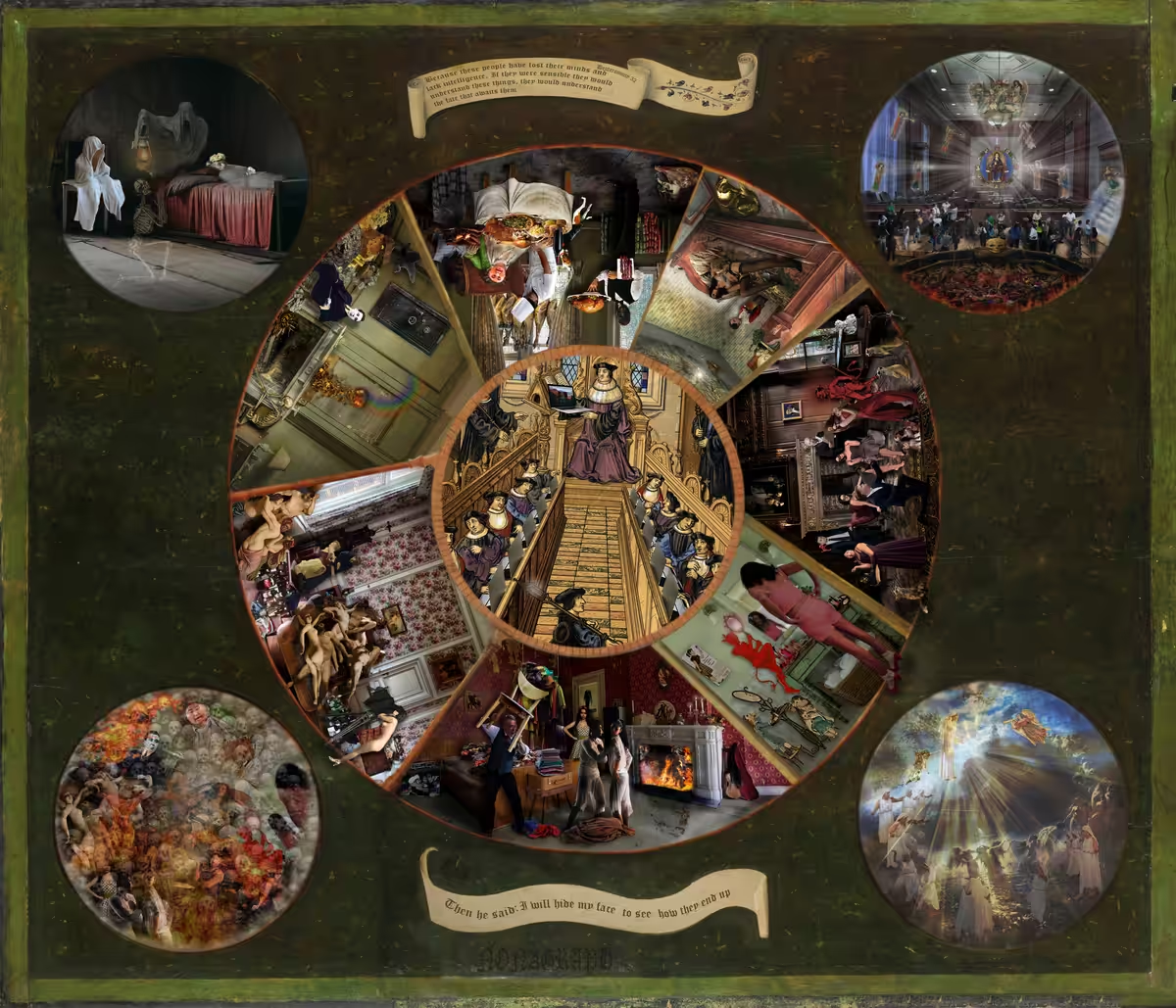
The table of sins capitals (hieronymus bosch)
The table of the seven deadly sins is a reinterpretation of the work of the same name by Iheronimus Bosch (El Bosco, ca 1500, Oil on poplar wood. Prado Museum. Madrid) which I have not tried for any reason that had the religious character of the original work. It is a more or less secular version, more or less anarchic but which in turn follows the original structure given by Bosch. In this case, the Eye of God at the center of the work has been replaced by a group of wise doctors who, with their corresponding laptops, believe they see everything. The circle that surrounds it is divided into seven parts, each of which corresponds to a specific sin, and have the same external shape proposed by Bosch. These sins are: Anger, Pride, Lust, Sloth, Gluttony, Greed and Envy. While Bosch represents the different deadly sins in scenes of daily life in Flanders of his time, my interpretation is a modern adaptation to current customs and uses, between which angels and demons move as they please. In the four corners the "last days" are represented, each one framed in a circle, these are "Death", "The Last Judgment", "Hell", and "The Glory", which of course do not exactly fit the image. traditional iconography in medieval painting. In the original of El Bosco there are two inscriptions in Latin, above and below, which come from Deuteronomy, chapter 32, which have been translated and placed in two different versions, in English and in Spanish: "20 Then he said: I will hide my face from them, to see what they end up with" (bottom) “28 Because those people have lost their minds and lack intelligence. 29 If they were sensible they would understand these things, they would understand the fate that awaits them.” (top) Bosch's signature has been replaced by mine: NONAGRAPH