EQUATIONS: Newton's Ethereal Dance
Newton's Second Law of Motion: F = ma
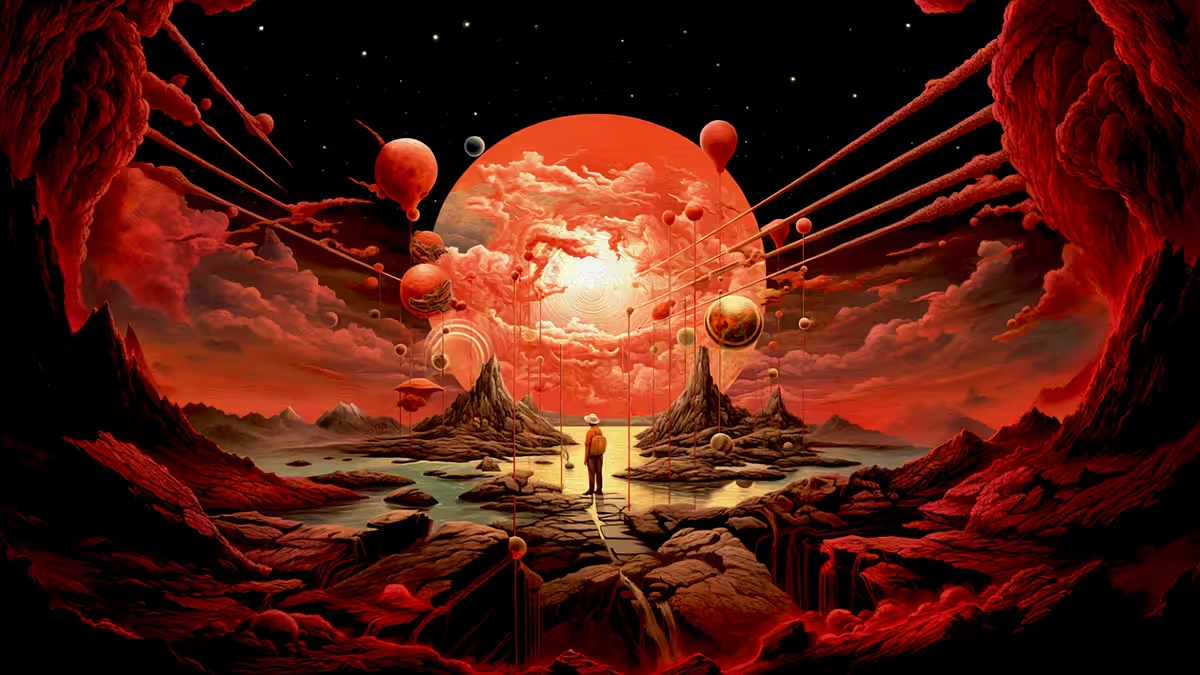
A kinetic display of energy and motion graces the artwork, inspired by Newton's Second Law of Motion. Elegantly swirling trajectories illustrate the balance between force and acceleration, revealing the captivating dance of physical laws.
Proposed by Sir Isaac Newton in his monumental work "Philosophiæ Naturalis Principia Mathematica" (Mathematical Principles of Natural Philosophy) in 1687, this equation states that the force applied to an object is equal to the mass of the object multiplied by its acceleration. Newton's Second Law is one of the fundamental principles of classical mechanics and has revolutionized our understanding of motion, inertia, and forces. It forms the basis for classical mechanics and underpins much of modern engineering and physics, from designing bridges to launching spacecraft.