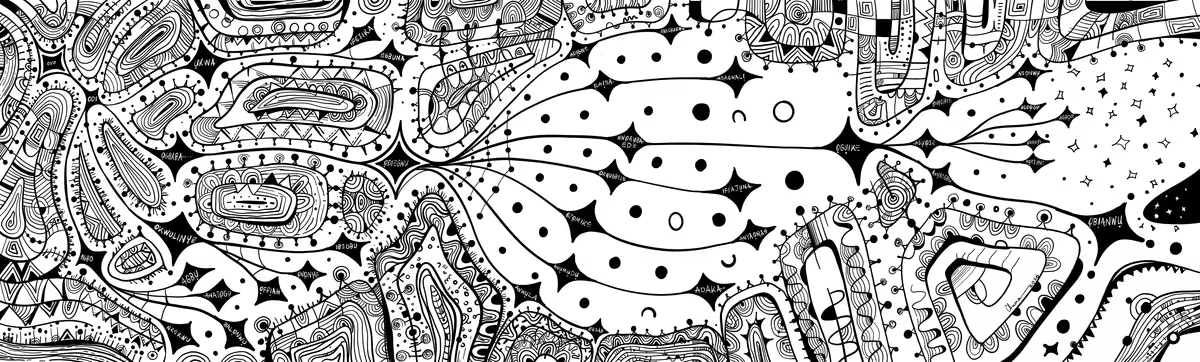
Chuma: Asele Obodo Dike’
‘Asele Obodo Dike’ features an intricate chart of the ‘Umu Ase’ family. At the core of the composition is a web of connected ‘Isi Oji’ motifs - each representing one ancestor of the family. The motif itself is derived from the meeting point of four (4) Oji (Kola) cotyledons, a nut that is revered across Alaigbo. It represents life and is also symbolic of the four (4) days of the week - Eke, Orie, Afo and Nkwo. All the ancestors are connected by unbroken lines symbolising a one lineage flow across seven (7) generations starting from Ndiichie Ovo, the family's progenitor to William A. N. Obianwu, the patriarch of the Obianwu family.
The composition features a tight network of black-and-white imagery created by maximising and balancing negative & positive spaces, a technique characteristic of the traditional Igbo Uli artform in a style innovated by Chuma Anagbado. The left segment of the artwork is line-heavy, representing times past and becomes lighter as the lineage flows to the right segment. Asele Obodo Dike is richly populated with symbolisms, motifs and icons intertwined with the family tree in a delicate balance indicative of the society, complexities and happenings of life over the centuries. Each segment is surrounded by motifs representing extended relatives and people associated with the family through the ages.
By including the name of each ancestor in each Isi Oji motif, the work is fully centred on the family member, their offsprings and how they are linked.
Sized 10ft x 3ft, ‘Asele Obodo Dike’ presents the 'family’ tree in a monochrome and intriguing visual of the family ancestors - all connected to an updateable digital layer logged permanently as a record on the ethereum blockchain.