SCALES WITHOUT WEIGHT: THEMIS
Themis does not wear the blindfold.
She sees everything.
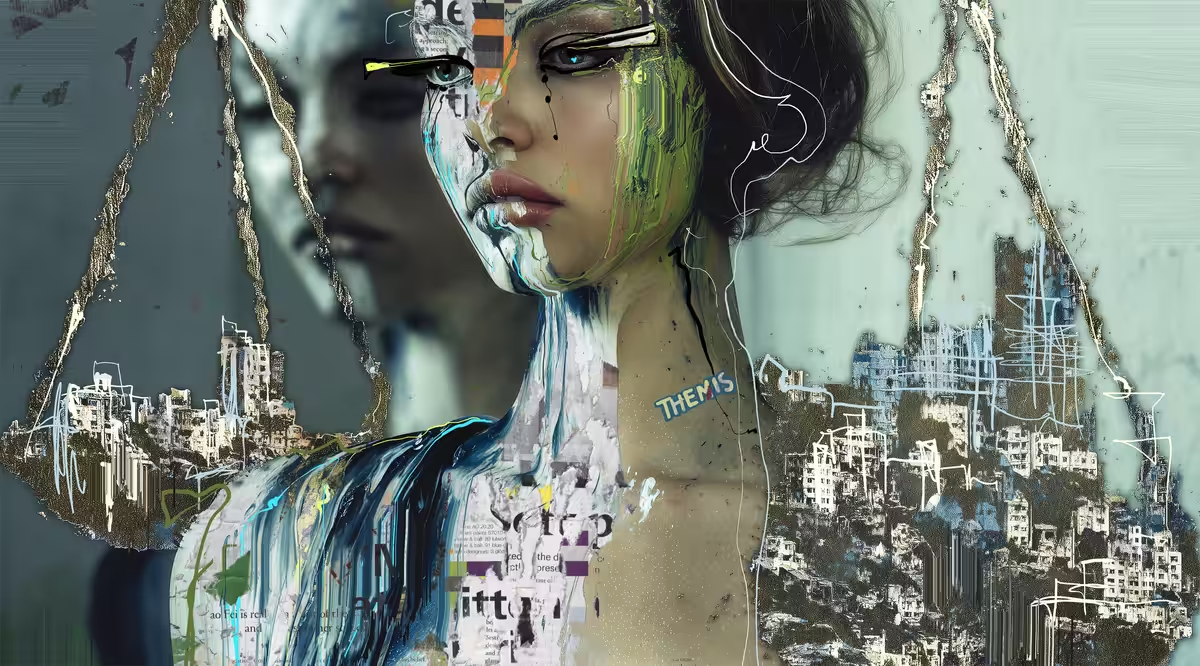
In this work, justice is no longer marble and myth. She is flesh, circuitry, skyline. A goddess dragged from the courthouse steps and pressed against the glass of a modern city.
Her face is split between clarity and erosion. Paint tears down her skin like evidence melting under heat. Acid greens and bruised blues carve through her features. This is not decoration. It is corrosion. It is the slow burn of systems under strain.
Behind her, a second face hovers. Not a shadow. Not a twin. A memory. Perhaps the classical Themis. Perhaps the law as it once imagined itself: balanced, austere, distant. That ghost watches the present version with quiet disbelief.
Gold fractures frame the skyline around her shoulders, but the city bleeds through the cracks. Towers jitter in white lines like unstable data. Buildings smear downward into glitch. Civilization is still standing, but its foundation flickers.
On her collarbone, her own name is written: THEMIS. As if identity now requires annotation. As if divinity must label itself to be believed.
There are no scales visible here. That absence is intentional. When weight disappears, symbols become cosmetic. What remains is gaze.
Her eyes are sharp, unblinking, lined in molten light. She is not impartial. She is awake.
This Themis belongs to the era where law collides with media, where justice is streamed, memed, politicised, and pixelated. She carries the skyline inside her skin. The city is not outside her. It is embedded.
She is no longer carved in stone.
She is rewritten in ink.
And she is watching.