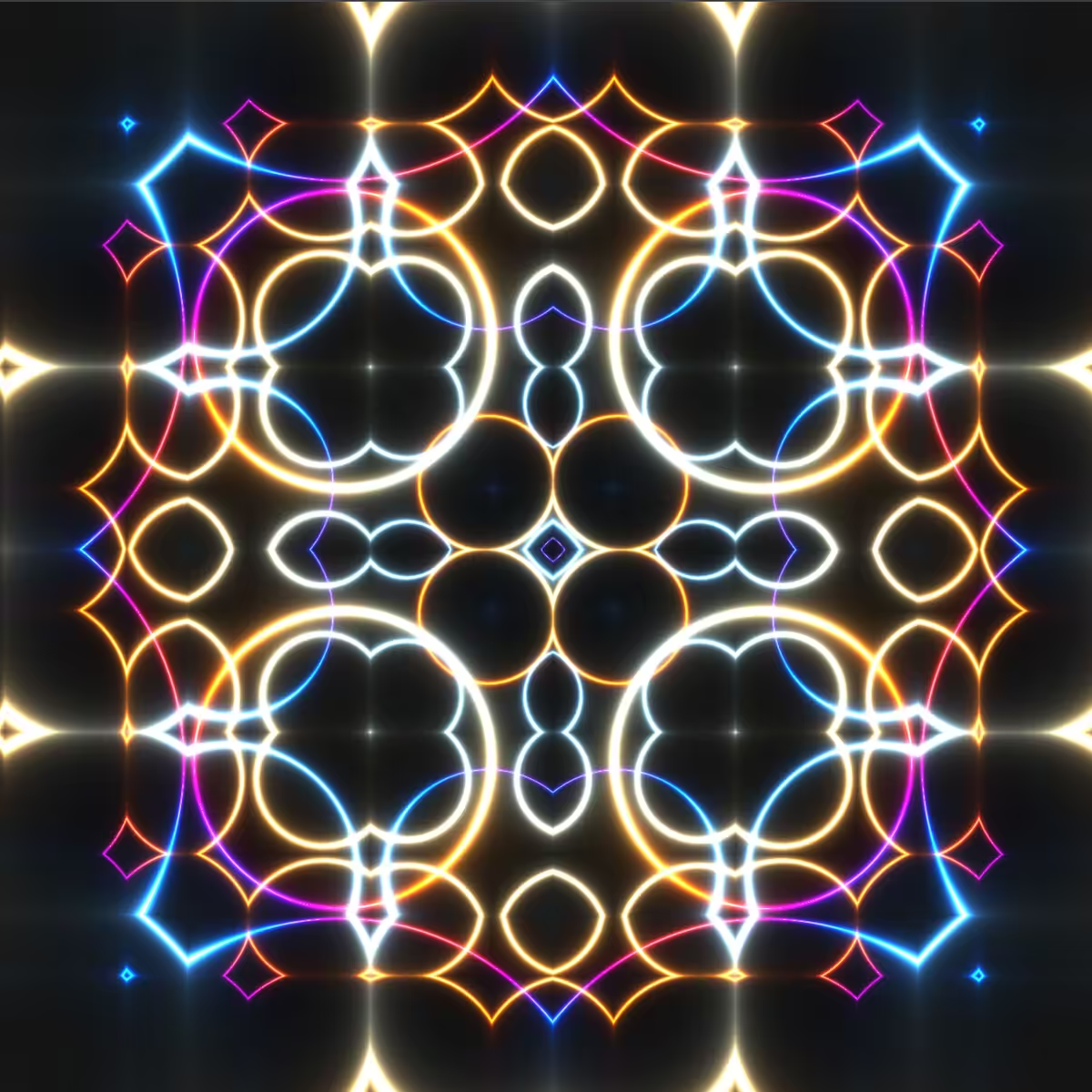
THE_VOID #7 :: Fluid Cymatics
THE_VOID #7 is a synesthetic engine. It breaks down the barrier between math, light, and sound, forcing them to dance together in real-time, all based on your live interaction, never producing the same experience twice...
- It’s "Liquid Math" (Domain Warping)
Most computer graphics are made of triangles and rigid shapes. This is different.
The Technique: It uses a technique called Domain Warping.
The Vibe: Imagine dropping ink into water, but then you stir the water with a mathematical formula.
The shader code takes a coordinate (a pixel), twists it using a sine wave, then twists that result with another sine wave, and repeats the process. This creates those oil-slick, psychedelic patterns that look like they are folding into themselves infinitely. It feels organic, almost like a living alien tissue.
- The Audio is "Procedural," Not Recorded
There is no MP3 file hidden in that code. The sound is being generated live by the CPU of your device.
FM Synthesis: It uses Frequency Modulation (FM) synthesis—the same method used by the Sega Genesis and 80s synthesizers.
The Growl: We have a "Carrier" wave (the hum) and a "Modulator" wave (the texture). By mashing them together, you get that gritty, sci-fi "growl."
Because it's generated in real-time, it creates a feedback loop with your brain. You aren't just listening to a track; you are "playing" the mathematics of sound.
- "God Mode" Interactivity
The piece taps into a primal satisfaction called tight feedback loops.
X-Axis (Filter): Moving your mouse left/right acts like a DJ's Low-Pass Filter. It mimics the sensation of an object emerging from underwater (muffled) to the surface (crisp).
Y-Axis (Detune): Moving up/down literally "bends" the physics. It detunes the oscillators, creating tension and dissonance that makes the visual feel more "stressful" or energetic.
The Drop (Clicking): When you click, the code inverts the color palette (from cool Blue to hot Fire) and ramps up the audio modulation speed. It triggers a "fight or flight" response in the audio-visual system instantly.
- The "Neon" Aesthetic (Inverse Functions)
That glowing, laser-like look isn't a texture. It’s a mathematical trick. The code calculates the distance to the "waves" and then divides 1 by that distance (1.0 / distance).
In math, as you get closer to zero, the number explodes towards infinity. Visually, this translates to infinite brightness right at the core of the wave. That’s why it looks like a lightsaber or a neon sign—it uses the limits of the math to burn the pixels white-hot.
- It fits in a pocket (The 14KB Universe)
Perhaps the best part is the efficiency. High-end video games need 100GB of space to look this trippy. This entire experience—the physics, the light transport, the sound engine, the interactivity—is just a few kilobytes of text.
It proves you don't need massive assets to create a massive world; you just need the right equations.