PANTER XHITA: ATLAS
Instructions:
Please allow the work a few moments to load fully before you begin.
Move your cursor across the painting. Each red marker opens a chapter of this novel. To return, look for the marker again.
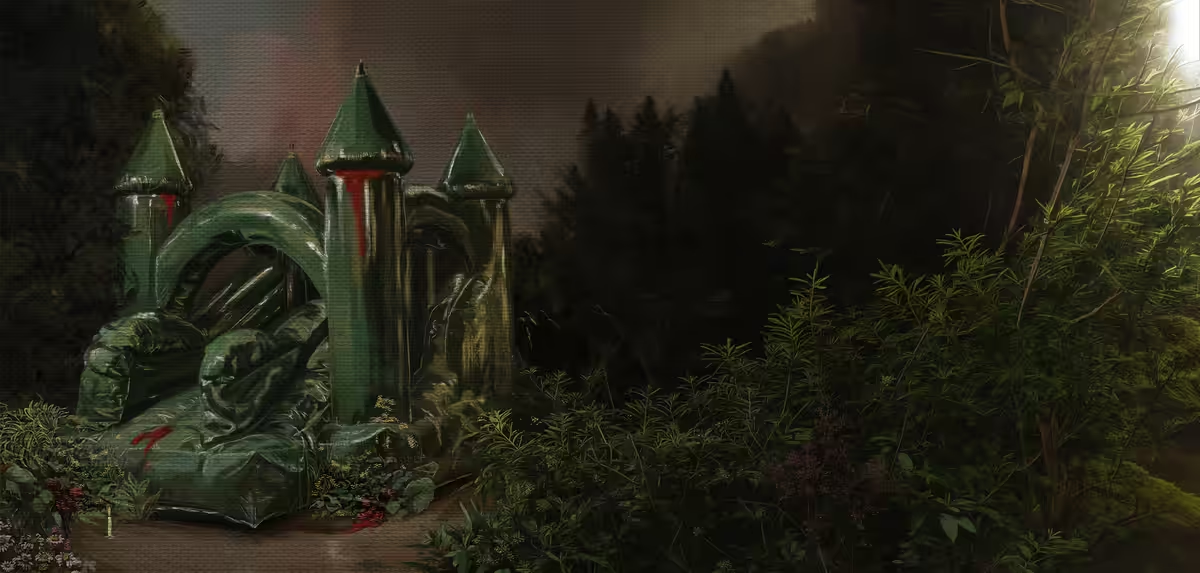
Chroma is not a color: it is a technical surface of substitution, the place where an image is about to appear or to be erased. The castle is the object that culturally names the permanent, the fortified, that which endures. To build it out of the exact material of disappearance is the thesis of the entire piece.
A forest advances over its columns. A lit candle marks that someone was here, that someone keeps vigil over it. It holds itself up only as long as someone breathes air into it from within. The castle lives on a single breath.
This central painting, intervened with artificial intelligence, I understand as a matrix-image, a field of potency in which another fourteen pieces exist. They do not descend from it as copies of an original; rather, they unfold as a rhizome, without hierarchy. This matrix-image takes on the logic of halves that neither fuse into a single surface nor disguise the passage from one to the other. The painted half holds the index of a body, the tremor of the hand, the time of the craft; the other is an image without body and without origin. I leave the machine's errors uncorrected, exhibiting their seam.
It is, also, an archive-map in which the fourteen pieces describe what is happening inside that universe. They function as the chapters of a novel written not with words but with creatures on the threshold. Birds in full metamorphosis, animals with several faces and more eyes than they are due, women run through by their context, a living and aching nature that bears fruit that looks back at us.
I think of them through becoming: none is fixed in its species or its form; all are halfway to being something else. They do not illustrate the castle's universe; they are that universe in a state of transformation.
This piece brings The Twelve 2025/2026 to a close.
The Twelve is, before anything else, a structure of patronage: a pact with fourteen people. For this reason, this closing piece is not a work to be contemplated passively in front of a wall, but an archive-map to be traversed, understanding that it is exactly that: a living, participatory organism, made to be entered and to get lost in.