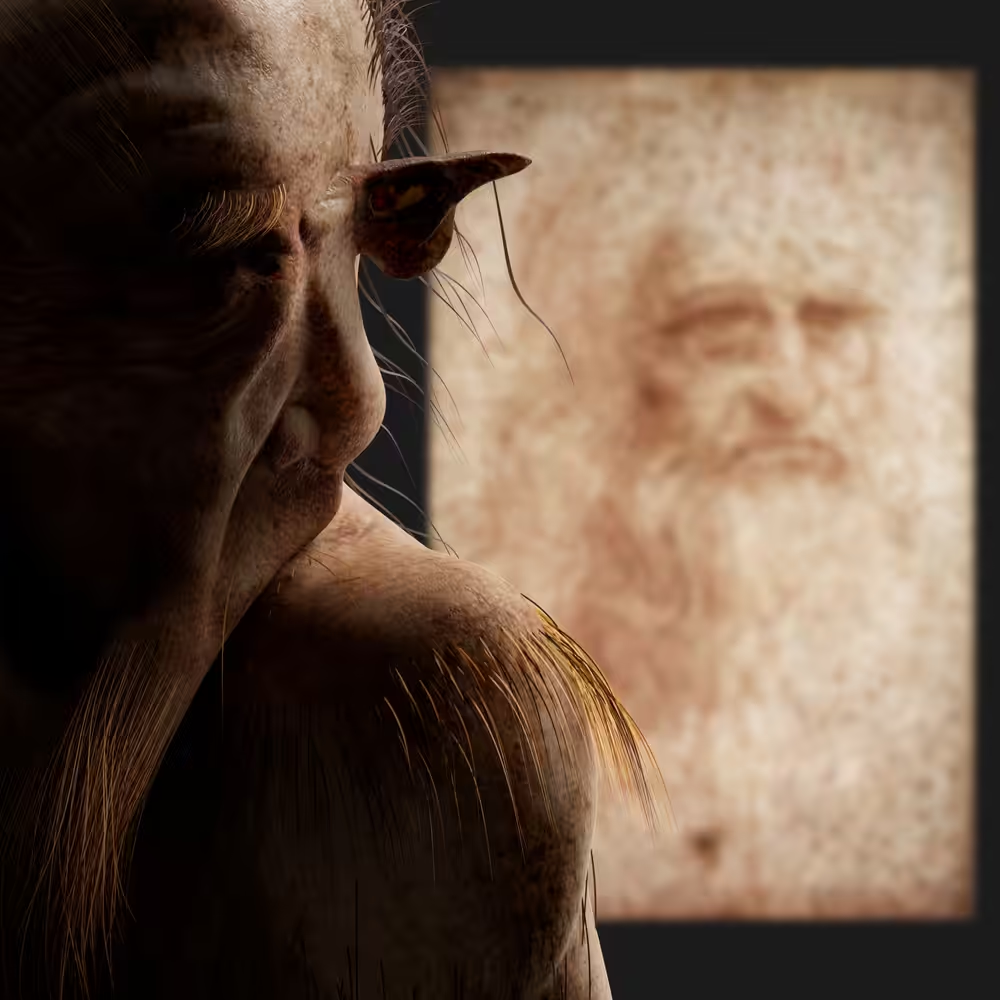
Leonardo Da Vinci Werewolf #Selfportrait
It should not therefore be unsettling to learn that looking at the portrait in the Royal Library from a different angle, the lower lip where the beard falls turns into the lateral representation of a shoulder, the dent below the cheekbone widens to become an unsettling open mouth, and the left eye stretches out into a pointed ear. The down and the dotting of the paper – which cannot be fully attributed to wearing and oxidation – produce a three-dimensional space.
Paola Salvi’s theory affirming that the man is looking into a mirror cannot be dismissed in full, although she does not see the anamorphic presence; it is in fact possible that he is revealing a side of himself through his reflection. The anamorphosis generates an oxymoronic image, shows us a dual personality, a psychologically complex character fast forwarding us to Dr Jekyll and Mr Hyde; showing the hidden nature of the individual, his alter ego, what Freud defined “the perturbing”, on which Leonardo had found himself to reflect upon. Among the authors of the books held in his library and inherited by Melzi, the name of Cecco d’Ascoli appears, for example, renowned for a heated debate with Dante on the relationship between nature and upbringing. According to Alighieri upbringing would be able to subdue instinct, whereas Cecco believed nature is always bound to emerge. And there the temperament of the staid man portrayed in sanguine unveils itself, taking the shape of a demonic figure. Leonardo thereby proves not only to prefigure modernity, but more notably to be a man of his times, when the use of analogy, partly due to the impulse of new philosophical movements, becomes significant, taking the shape, as far as painting is concerned, of optical illusions and anamorphosis. A hermetic conception of man ensues for the modern viewer, understandable only through a synchronic analysis of its plurality. The features taken by the face in the anamorphic distortion can be assimilated to those of a lupus hominarius or lycanthrope, a figure whose literary origins can be traced no less than in the Epic of Gilgamesh.The best known example of the classic period is undoubtedly Lycaon, whose story is told by Ovid in Book I of the Metamorphoses: becoming aware of the impiety of men, Jupiter descends on the Earth from the Olympus and dwells at the tyrant of Arcadia. He puts to test his divine nature, offering him the limbs of a hostage as food. The father of the gods, appalled, destroys the house and the Penates, while Lycaon. “territus ipse fugit nactusque silentia ruris exululat frustraque loqui conatur; ab ipso colligit os rabiem solitaeque cupidine caedis utitur in pecudes et nunc quoque sanguine gaudet. In villos abeunt vestes, in crura lacerti: fit lupus et veteris servat vestigia formae; canities eadem est, eadem violentia vultus, idem oculi lucent, eadem feritatis imago est” Metamorphosis – P. Ouidii Translation “He himself ran in terror, and reaching the silent fields howled aloud, frustrated of speech. Foaming at the mouth, and greedy as ever for killing, he turned against the sheep, still delighting in blood. His clothes became bristling hair, his arms became legs. He was a wolf, but kept some vestige of his former shape. There were the same grey hairs, the same violent face, the same glittering eyes, the same savage image. (vv.232-239) Leonardo undoubtedly knew the Metamorphoses: as testified by the Codex Trivulzianus, he owned a copy; his relations with Poggio Bracciolini, scholar and translator of Latin texts are documented as well; it is therefore very likely that we are in front of the Arcadian king’s portrait, depicting his twofold nature. Lycanthropes can be also encountered in the works of other Latin authors back in vogue during the Renaissance. Standing out among them Petronius, with his Satyricon. In chapter 61, one of Trimalchio’s guests, Niceros, recounts in a flash-back a turbulent night journey to meet his lover, when one of the soldiers accompanying him, after a weird ritual, reveals himself as a lupus versipellis (the fur would grow under his clothes, to be revealed during the animal transformation). “et subito lupus factus est. Nolite me iocari putare; ut mentiar, nullius patrimonium tanti facio. Sed, quod coeperam dicere, postquam lupus factus est, ululare coepit et in silvas fugit” Satyricon – Petronius Translation: "and suddenly turned into a wolf. Please do not think I am joking; I would not lie about this for any fortune in the world. But as I was saying, after he had turned into a wolf, he began to howl, and ran off into the woods.”. Claudius Galenus in his “De Locis Affectis” (Book III) defines lycanthropy a “Speciem Malinconiae”; his works more strictly on medicine describe this ailment more realistically, with the prescription of some remedies: «Those caught by the wolfish or canine disease leave their homes at night in the month of February and imitate wolves or dogs in all respects; they prefer to open graves until the raise of dawn. They can be recognized by these symptoms. They are pale and look sickly, their eyes are dry and lack teardrops. Their eyes are also sunken and the tongue is parched, they do not secrete any saliva at all. They are also thirsting, their shinbones are hopelessly wounded because of repeated falls and dog bites; these are the symptoms. It is worth knowing indeed that this ailment is of the melancholic species: it can be cured incising the vein during the abscess allowing the blood to pour until the loss of senses, the infirm will then be nourished with very succulent foods. Fresh water baths can be also beneficial: then buttermilk for a period of three days, for the same length of time purging with Rufus’ or Archigenes’ or Justus’ colocynth, taken repeatedly at intervals. After the purgation theriac extracted from vipers and the other medicaments previously mentioned for melancholia can be used as well»
Read more on https://rinascimento.io/2021/07/20/deconstructing-leonardo-english/