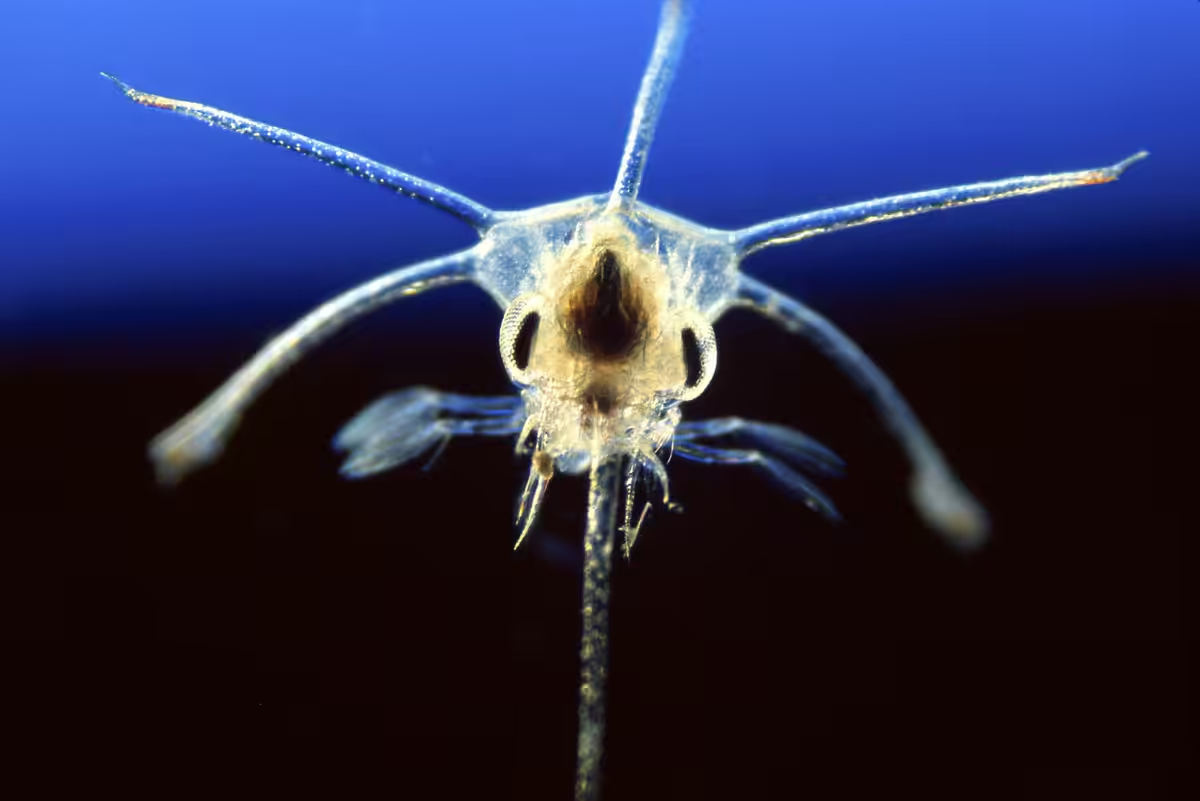
Invisible Oceans Founder's Collection: Invisible Oceans #15: Zoea I
Not only do all crustacea shed their skins in order to grow, because their exoskeletons do not permit expansion, but they also pass through several distinct design phases as they do so with each phase given a new name to describe it. Hence, the young crab is referred to as a late zoea stage of what may one day be a Mitten Crab. At this time of its life, these tiny, pin-head-sized creatures have two abiding concerns. First they need to find food, and second they need to avoid being eaten! This second concern is catered for, in part, by the zoea having very strong spines sticking out of its exoskeleton 'shell' in all directions, good as protection against other plankton, not a lot of protection against shoaling fish that will simply shoal in, mouths agape and sweep up all before them of this sort of size. The two dark spots are this small animal's compound eyes, probably not able to detect a lot more than light and dark, so as to assist with their timing for vertical migration by day and night. Indeed, we know so little of just how these life forms exist, survive, behave, sense, feed and live. We used to call this tiny creature the 'Caltraps' crab, because of its similarity to the Roman device for maiming the enemy's horses' hooves.
Lizard Island, Australia (2002)
Nikon F3 | Custom Optics | Fuji Velvia