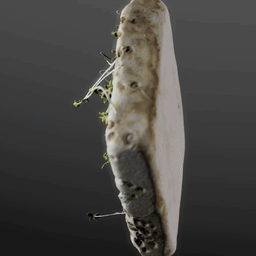
Unruly Objects 01
This GIF is part of a project called “Unruly Objects” exploring the preservation of BioArt works and antiquities through blockchain technologies.
GIF’s are a historic file format but are still pervasive and as such can relate to notions of digital preservation.
This artwork is based on a 3D photogrammetry scan of an experimental physical sculptural ‘sketch’, by internationally renowned BioArtist Anna Dumitriu. It explores the conservation of antiquities, and how researchers are now looking into ways to augment the microbiomes of antiquities with bacteria to prevent or arrest their decay. It additionally reflects on the potential collection and conservation of contemporary living biological sculptures by museums and the use of blockchain /Web3 technologies to store conservation data such as the artist’s documentation, in the form of her ideas, materials, and process. Museums are often reticent to collect BioArt works due to an incorrect kneejerk belief that they will somehow ‘contaminate’ their collections.
This sketch was developed, as part of a series of carved pieces of reclaimed sea-washed marble. The carvings are based on scanning electron microscope images of the micro-organisms that eat away at antiquities and images of the damaged stone. The holes are carved because conservators told the artist that these, bacteria, and plant roots are the greatest challenges the preservation ancient Greek antiquities. The painting references how ancient statues were originally brightly painted and looked nothing like our modern notion of classical art. When the colour (or some other aspect) disappears from a modern artwork, due to decay, that work is usually retired to the archive.
The sketch also included biological materials including mud from a bacterial ecosystem known as a Winogradsky Column, plant seeds, and SARS-CoV-2 RNA (coronavirus) from a plasmid construct (a timestamp to mark the creation of the works during the Covid-19 pandemic. This last element is a safe, non-infectious reagent for SARS-CoV-2 research obtained from the National Institute for Biological Standards and Control, UK. SARS-CoV-2 RNA was supplied by researchers Dr Ines Moura and Dr Jane Freeman at the University of Leeds who are working with the SARS-CoV-2 primers and the RNA construct in the development and use of a RT-PCR assay for SARS-CoV-2 detection in faeces.
It is one of three physical sketches that have been split up and will experience different fates: the first (the one featured in this GIF) remains in the care of the artist who will observe its changes and try to capture and preserve its decay at the most beautiful point. The second sketch has been embedded in a bacterial ecosystem called a Winogradsky Column where anaerobic bacteria will protect it, and the third sketch has been sent to the University of Western Attica to be professionally cared for by conservators, where it remains. To learn more about the project, research paper, and collaborators please see the website link below:
https://annadumitriu.co.uk/portfolio/unruly-objects/