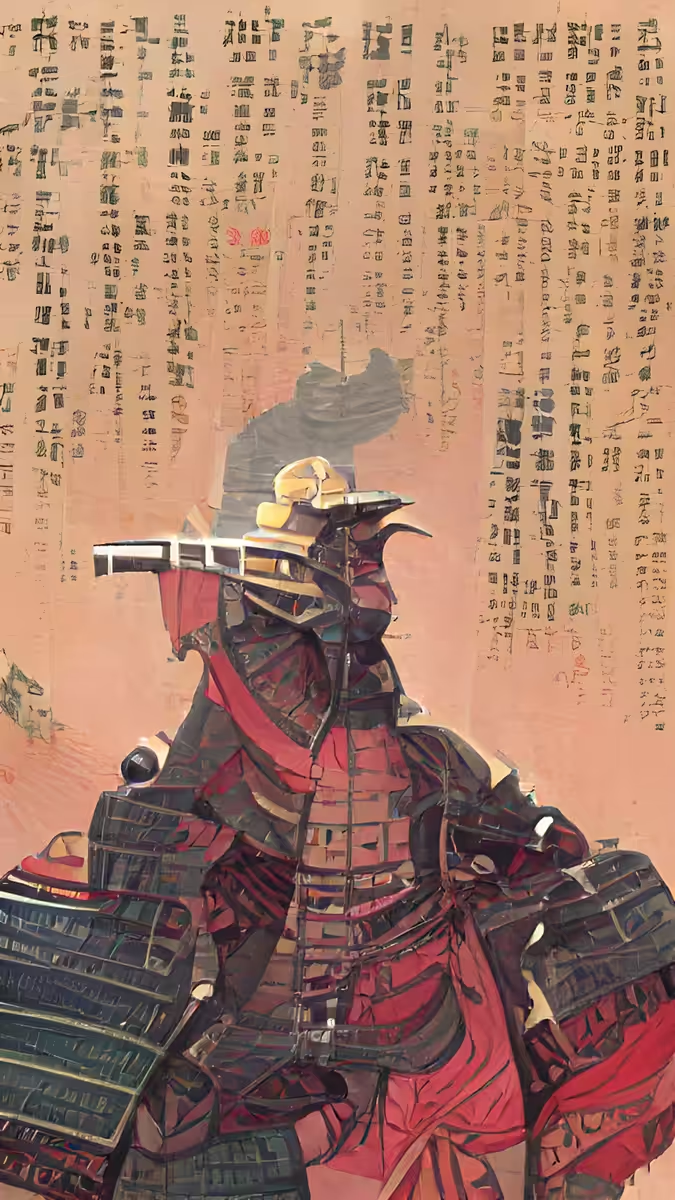
Ukiyo-e A.I. : "Samurai"
With "Ukiyo-e A.I." I tried to recreate the spirit that pervades Ukiyo-e painting, the sensations, the colours, the flavours that these paintings evokes me, integrating it with traditional Japanese music and Haiku poetry. For the Ukiyo-e A.I. project I used a neural networks GANs (Generative Adversarial Networks ) integrating VQGAN (Vector Quantized Generative Adversarial Network) and CLIP (Contrastive Language-Image Pre-Training ) . CLIP provides feedback to VQGAN on the best way to match the image to the text prompt. VQGAN adjusts the image accordingly and feeds it back to CLIP to check if it fits well with the text. This process is repeated a few hundred times, resulting in the generated images.
In the VQGAN and CLIP neural network for Ukiyo-e A.I. project I inserted:
- Images of Ukiyo-e paintings created by the great Japanese masters representing Samurai, Geishas, Kabuki Actors and Animals
- Traditional Japanese musical for Shamisen, Shakuhachi, Koto and Kabuki orchestra music , transformed into Spectrogram, linked to images -Haiku: traditional Japanese short poetry compositions .
"Samurai"
Haiku: MATSUO BASHO "Suma Temple. I listen a flute that nobody plays in the dark forest of shadows"
Music : Shakuhachi
Painting : Samurai , Shogun and Ronin
Ukiyo-e : "picture of the floating world" is a genre of Japanese art which flourished from the 17th ( Edo period ). Masters like Moronobu , Utamaro , Sharaku Hokusai, Hiroshige and Kuniyoshi painting subjects as female beauties , kabuki actors , sumo wrestlers , scenes from history and folk tales , travel scenes and landscapes, flora and fauna .
Music : traditional music instruments like koto (plucked half-tube zither) , shakuhachi ( end-blown flute made of bamboo ) , shamisen ( three-stringed instrument played with a plectrum ) and Kabuki orchestra ( with all these instruments and different percussion).
Haiku : is a type of short form poetry that consist of three phrases composed of 17 phonetic units . Famous poetries were : Moritake, Bashō, Shiki and Kyoshi .
For more information on the project, please visit : https://sites.google.com/view/robertomusci/a-i-generative-art