🇵🇸 Twisted Perceptions #571-632
🇵🇸 Twisted Perceptions – The Weight of Tears
🖌️ CONCEPT / STORY
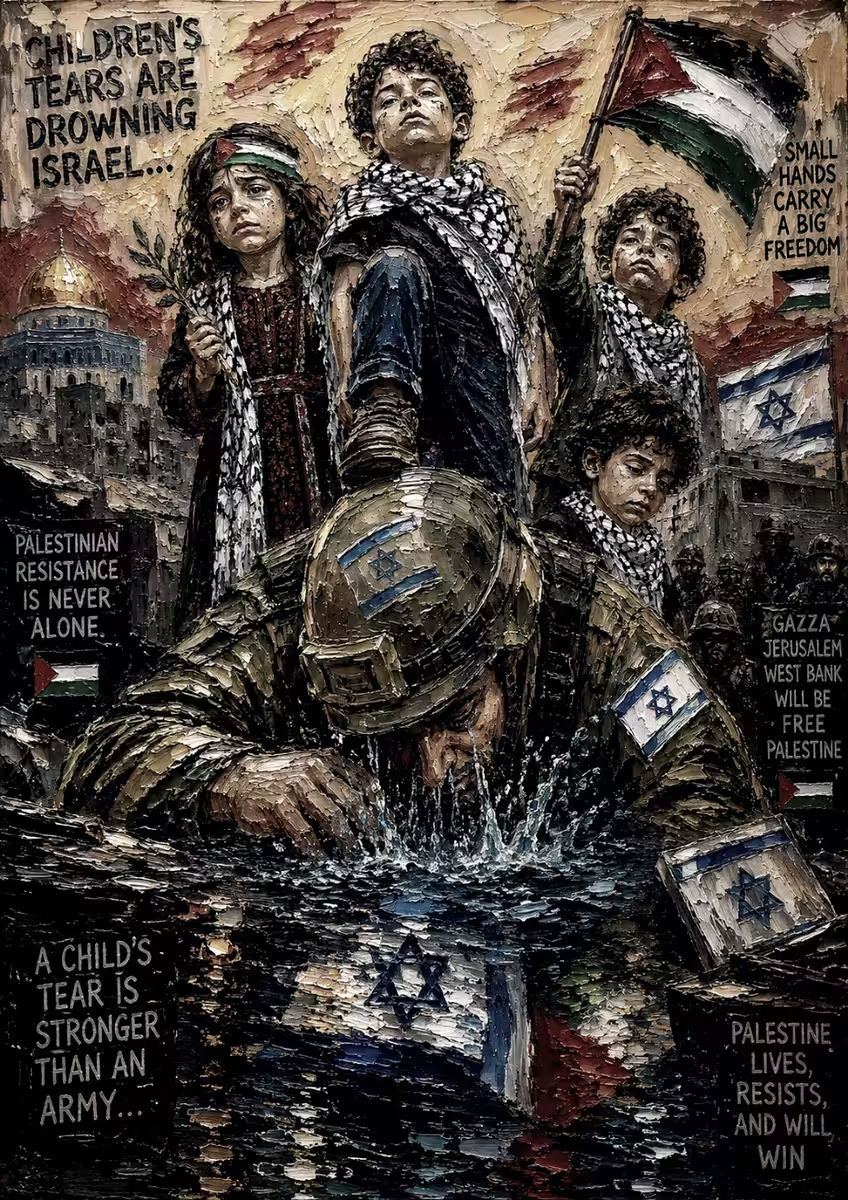
A group of Palestinian children rises above a fractured landscape, wrapped in keffiyehs and surrounded by the colors of Palestine. Their faces carry different traces of the same story: grief, exhaustion, defiance, and an unwavering refusal to disappear.
At the center, one child stands higher than the others, raising the Palestinian flag while looking upward. The gesture transforms vulnerability into resistance. Though physically small, the children are given a monumental presence within the composition.
Below them, Israeli soldiers appear partially submerged in dark, turbulent water. The water is not intended as a literal place but as a symbolic force—an impossible accumulation of grief, as though countless tears have gathered into a body of water powerful enough to overwhelm the machinery of war.
This reversal forms the central paradox of the work. Figures associated with military power occupy the lowest and most unstable part of the image, while the children—normally associated with vulnerability—dominate its highest and most commanding visual plane.
References to Jerusalem in the background connect the immediate human drama to a much longer history of land, belonging, displacement, faith, and inherited memory.
The artwork reimagines the tear not simply as a symbol of helplessness, but as the physical weight of accumulated suffering. A single tear may appear insignificant, but when the grief of countless lives gathers together, it becomes impossible to ignore.
At the heart of the work lies one question:
When physical power confronts memory, grief, identity, and the determination to endure, which one ultimately carries the greater weight?
✨ VISUAL ELEMENTS
- Palestinian children as monumental central figures
- Traditional black-and-white keffiyehs
- Palestinian flags rising above the composition
- Expressions combining grief and determination
- A central child positioned as the primary visual anchor
- Israeli soldiers partially submerged in turbulent water
- Israeli military helmets and insignia
- Architectural references to Jerusalem
- Sacred dome-like architecture in the background
- Dark reflective water symbolizing accumulated tears
- Palestinian and Israeli symbols placed in visual opposition
- Protest statements integrated into the composition
- Dense impasto brushwork across the entire surface
- Strong vertical hierarchy between children and soldiers
- Political poster aesthetics fused with traditional painterly texture
🌌 STYLE / ATMOSPHERE
Political Surrealism Contemporary Protest Art Symbolic Figurative Art Expressionist Impasto Narrative Painting Social Commentary Art Anti-War Art Contemporary History Painting Dark Symbolism Conceptual Fine Art
🛠️ TECHNICAL DETAILS
Artwork Type: Political Surrealist Figurative Artwork / Conceptual Impasto Painting
Composition: The work is constructed around a pronounced vertical hierarchy of power. Palestinian children occupy the central and upper sections of the composition, while the military figures are compressed into the turbulent lower foreground. This deliberate inversion shifts visual authority away from military force and toward childhood, memory, and resistance.
Lighting: Dramatic directional illumination emphasizes the children's faces, keffiyehs, flags, and thick painterly textures, while the military figures below remain embedded within darker and heavier tonal regions.
Textures: Dense impasto gives the surface an almost sculptural physicality. Thick layers of paint define skin, fabric, keffiyehs, architecture, military equipment, water, flags, and lettering, creating the impression of a heavily worked, hand-painted canvas.
Depth: Overlapping layers move from turbulent water and soldiers in the foreground through the monumental children in the middle plane toward architectural and symbolic elements in the background. The compressed perspective gives the work the intensity of both a historical mural and a protest poster.
Visual Focus: Attention first lands on the central child and the Palestinian flag, then moves across the surrounding children's faces before descending toward the water and military figures below. This downward movement establishes the artwork's central visual metaphor: grief and resistance above, the weight of their consequences below.
Symbolic Structure: The water represents accumulated tears and collective grief rather than a literal event. The children embody vulnerability transformed into endurance, while the submerged military imagery symbolically reverses conventional representations of physical power.
🛠️ TOOLS USED
Leonardo AI: Artwork generation and composition artistic direction LightX: AI-powered creative enhancement and visual refinement AI Retouch: Artifact cleanup and detail restoration
📎 QUOTE
“When enough tears become a river, even the weight of an army can begin to sink.”