Tool-Making Animal
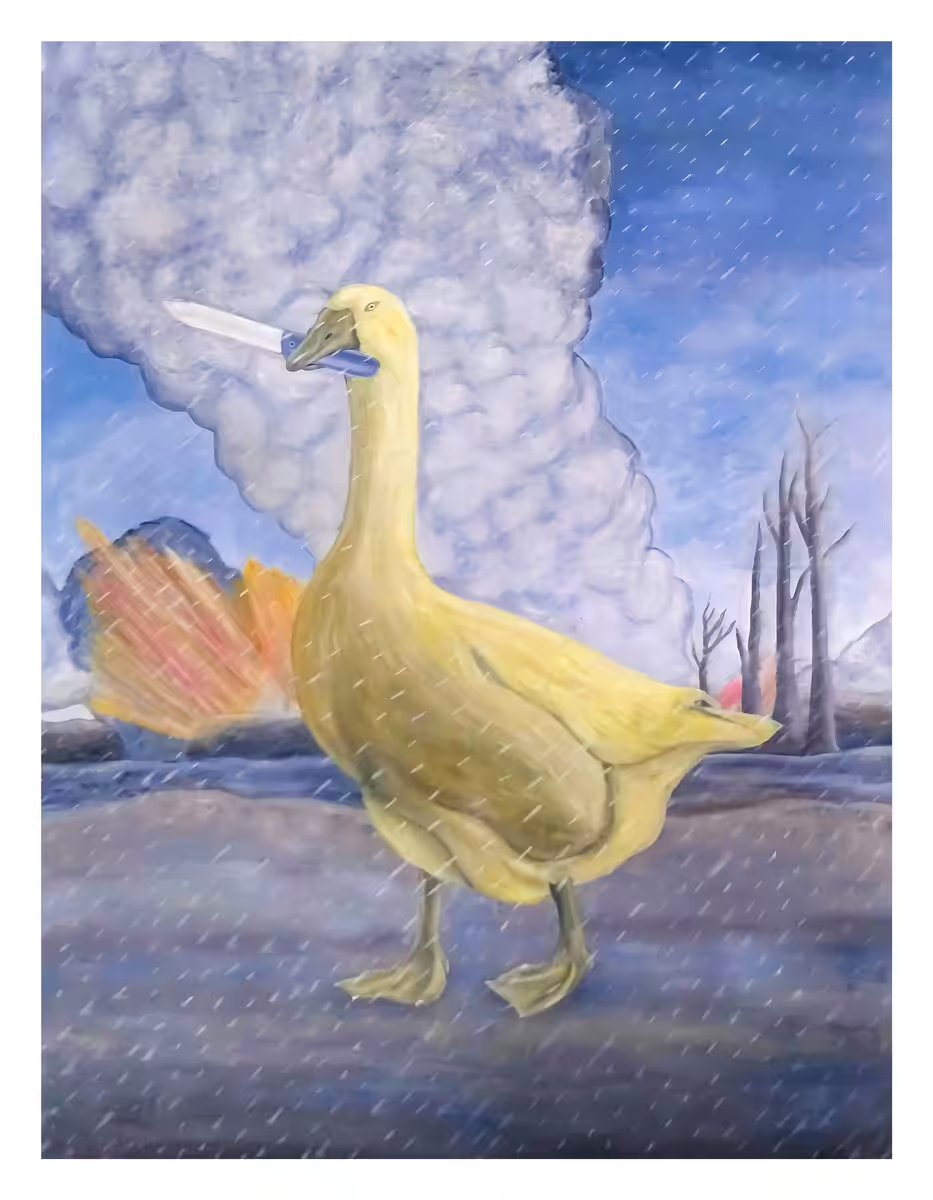
This digital copy is taken from physical work, which is an oil painting on canvas measuring 100 x 130 cm (39.37 x 51.18 inches), made in 2021. The work, which was later entitled Tool-Making Animal, borrowed a quote from Benjamin Franklin, one of the founding fathers of the United States, “man is tool-making animal”. Because in the history of civilization, humans cannot be separated from the tools they use. The existence of the equipment involves vision, responsibility, work ethic, complexity, resilience, progress, benefits as well as disaster.
The depiction in the image above is a goose biting a knife. As well as the background of a landscape that indicates a war is going on, which is accompanied by smoke and explosions. It appears as an antecedent and consequent relationship of an event that appears—even if it was realized or not. The goose in popular culture is often interpreted as a symbol of love, loyalty and happiness. This is of course an expectation of the existence of a positive ideal of a subject. However, on the other hand, he can be very sensitive and aggressive when someone disturbs its territory.
While the knife object is described as pars-pro-toto (part-to-whole) of the tool. The knife as an object becomes a kind of battlefield of the power-relationship between benefit and harm. It can be useful when used for cooking in the kitchen, or vice versa, it can bring harm when used to stab people. The relationship between equipment and its users has a paradoxical nature, on the one hand the equipment can make daily life easier, but on the other hand the equipment can bring dangers due to incompetence, carelessness and errors in its use. In essence, tools or technology—the term is often used interchangeably—is an extension of the physical body of the universe, including humans. It should be used on the principle of mutual benefit and interest. Not to fulfill an ego of the particularity of the subject. We with critical and speculative awareness must be able to overcome such paradoxical problems.