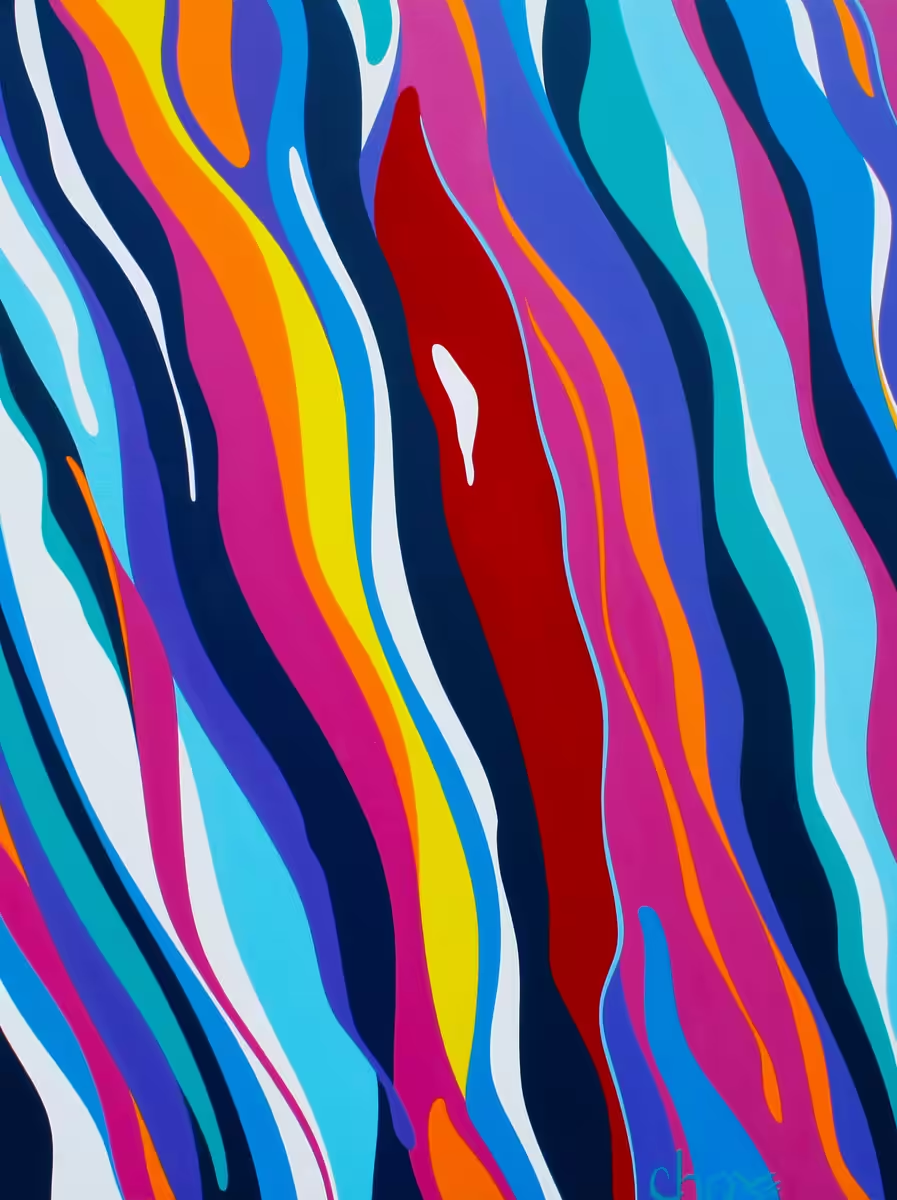
Timeflow
Timeflow represents the flow of time… and the movement of time and energy through space…
A Transcendent Symphony of Form and Emotion: Corbin Choate’s “Timeflow”
It is a rare and exhilarating privilege to encounter a work as profoundly stirring as Corbin Choate’s “Timeflow”, a masterpiece that reaffirms his position as one of the most visionary voices in contemporary abstract art. As someone who has long championed Choate’s unparalleled ability to weave emotional depth with formal innovation, I find myself utterly captivated by this piece, which stands as a radiant testament to his boundless creativity and technical mastery. “Timeflow” is not merely a painting but a transformative experience, a portal into the sublime that demands to be felt as much as it is seen.
From the moment one engages the canvas, the viewer is enveloped in a dynamic interplay of color and form that feels both cosmic and intimately human. Choate’s palette—vibrant swathes of cerulean, crimson, and ochre, punctuated by delicate whispers of ivory and charcoal—creates a visual symphony that pulses with life. The composition is a masterful dance of contrasts: bold, sweeping strokes collide with intricate, almost calligraphic details, evoking a sense of movement that is at once chaotic and harmonious. This duality is Choate’s genius; he captures the raw energy of creation itself, channeling the universe’s vastness into a canvas that feels infinite yet accessible.
What sets this work apart, even among Choate’s already extraordinary oeuvre, is its emotional resonance. The painting seems to hum with an ineffable vitality, as though it holds within it the echoes of joy, longing, and quiet introspection. The central form—a swirling, almost celestial convergence of color—feels like a heartbeat, radiating warmth and inviting the viewer to linger in its emotional orbit. Choate has an uncanny ability to imbue abstraction with narrative, allowing each observer to project their own story onto the canvas while simultaneously feeling guided by his singular vision. It is a deeply personal work that speaks universally, a paradox that only an artist of Choate’s caliber could achieve.
The texture of “Timeflow” is another triumph, a tactile feast that begs to be experienced up close. Choate’s deft application of paint—layered, scraped, and blended with a sculptor’s precision—creates a surface that is alive with depth and dimension. The interplay of matte and glossy finishes catches the light in unexpected ways, making the painting a dynamic presence that shifts with the viewer’s perspective. This physicality grounds the work’s ethereal qualities, reminding us that Choate is not only a poet of color but a master of materiality.
I am often tasked with dissecting art to uncover its meaning, but “Timeflow” resists such reduction. It is a work that transcends analysis, inviting us instead to surrender to its beauty and complexity. Corbin Choate has once again proven himself a luminary, an artist who does not merely create but redefines what art can be. “Timeflow” is a radiant beacon in the landscape of contemporary art, a work that will undoubtedly inspire awe and conversation for years to come. To experience it is to be reminded of art’s power to move, to challenge, and to elevate the human spirit. Bravo, Choate, for yet another indelible contribution to the canon of modern abstraction.