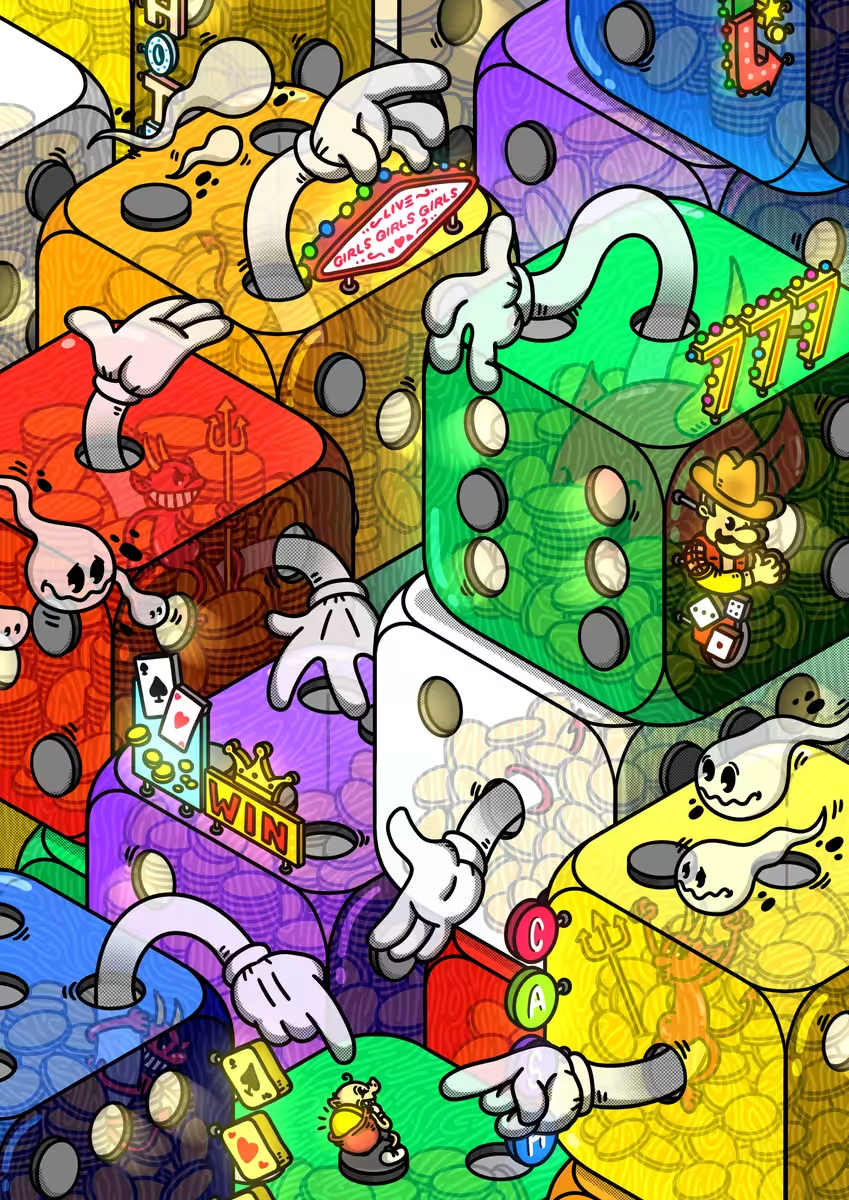
'The House Always Win' is a satirical exploration of gambling addiction and the illusion of control in systems built to exploit.
Its a city constructed by dice — a literal foundation of chance — to reflect the architecture of casinos and betting houses. Each die symbolizes not only the game itself, but the seduction of possibility: the hope that maybe, just maybe, this time you’ll win.
Neon signs, cheerful lights, and welcoming hands beckon players deeper into the maze — symbols of how the environments designed to pull us in, overstimulate, to keep us gambling.
A lone pig (symbolizes greed) navigates this city knowingly but unable to resist, dragged along by the invisible grip of addiction.
The insides of the dice are overflowing with coins — a cumulative losses — hoarded wealth collected from every failed bet. The devils stand watch, hinting at gambling’s long-held moral implications.
There are also ghostly figures linger: reminisence of past players who have lost everything, but remain, trapped in cycles of false hope.
The choice of a 1930s cartoon aesthetic is deliberate. With its rubber hose limbs, exaggerated expressions, and cheerful innocence, the style evokes nostalgia — a contrast that sharpens the satire. These characters, once symbols of joy and simpler times, now animate a world of excess and despair, reminding us how easily charm can mask corruption.
This piece is both a cautionary tale and a mirror — of cities built not just on luck, but on loss.
At what point do we stop mistaking hope for luck, and entertainment for entrapment?
How many more souls must walk these halls before we realize — the game was never meant to be won?
3510 x 4964 px 300 dpi 2025