The Hanged Man
About the Card
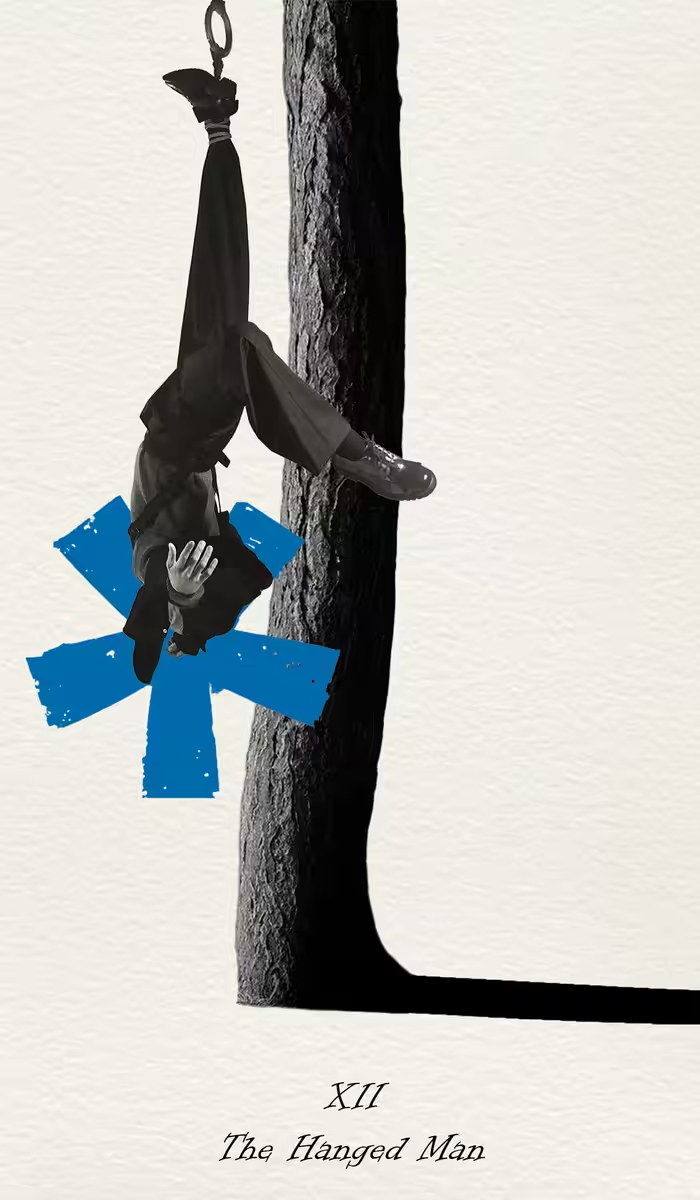
The Hanged Man is the most inspiring card in the Tarot. He hangs upside down from a cross, but this crucifixion is not imposed upon him. It is a voluntary and conscious suspension—a deliberate departure from conventional patterns in order to see the world from another perspective. The yellow halo around his head represents his insight and spiritual awakening. You can view his depiction through the link below. https://steve-p.org/cards/pixe/RWSa-T-12_7450.png
The Hanged Man marks the turning point in my reinterpretation of the Tarot. In my view, the journey toward understanding existence and the self brings nothing but the experience of suffering and the realization of difficult truths. In the previous cards, I have tried to portray some of these forms of suffering.
But at this stage, the seeker of the modern Tarot sees only one way to bear this unbearable burden: to look at the world from another perspective. And who better than an artist to see the world from another perspective?
This voluntary suspension is not undertaken to understand the world with a different kind of wisdom. Its purpose is to experience it differently, on an emotional level. And for this reason, yellow gives way to blue in my reinterpretation.
About the Collection
Interpreting a collection of Tarot cards created with an emphasis on reinterpretation and conceptual transformation is extremely difficult without an initial understanding of the Tarot tradition and its narrative, psychological, and mystical interpretations.
Among the many Tarot traditions, at least three systems of visual representation deserve special attention: the Marseille Tarot, the Thoth Tarot, and the Rider–Waite–Smith Tarot. While the Marseille tradition is more focused on social and symbolic aspects, the Thoth tradition is deeply connected with mysticism and Kabbalah, and the Rider–Waite–Smith tradition places greater emphasis on narrative symbolism. Despite their differences, all three traditions represent the underlying conceptual system of Tarot, which has remained largely intact throughout history.
The imagery of these traditions is highly maximalist, filled with colors, symbols, and visual details. This collection follows a different approach. By limiting visual elements and adopting a minimalist design, each component is given the opportunity to become a point of focus, encouraging self-reflection and introspection.
The conceptual framework of these designs has been significantly transformed and is based on my personal understanding and perception of the world. Since directly explaining the meaning of each card can reduce the viewer’s role in discovering and interpreting the artwork, I have chosen to provide only a brief description of the traditional visual elements of each card and their meanings, along with references to the aspects that have been transformed within this collection.
To acquire the complete collection at once instead of purchasing the cards individually, you can purchase the available ticket. By purchasing this ticket, all 22 cards of the collection will be transferred to the collector’s wallet.
Ticket Link: https://teia.art/objkt/884010