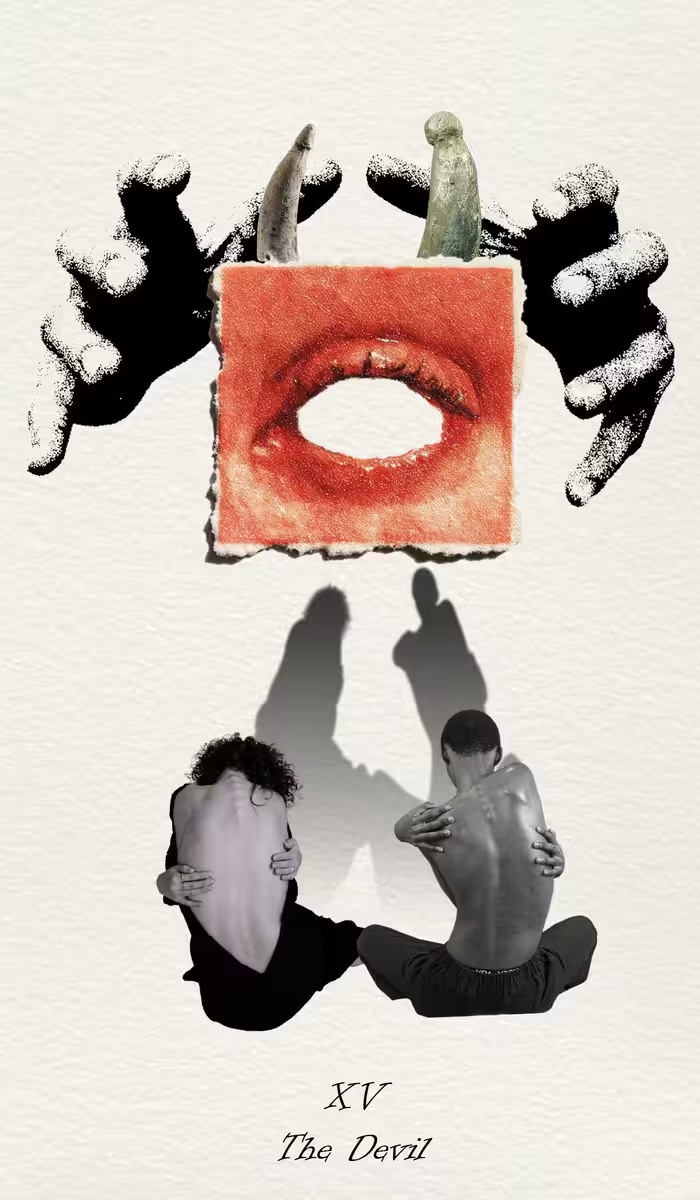
The Devil
About the Card
The imagery of this card differs considerably across the three traditions. In the Marseille tradition, The Devil is portrayed as a hybrid creature with two faces or multiple limbs; in the Rider–Waite–Smith tradition, two semi-naked human figures are bound to him by relatively loose chains; and in the Thoth tradition, The Devil is far more complex, placing a clear emphasis on instinct, fertility, and vital energy.
The Devil is not simply the opposite of “good.” He represents attachment, desire, matter, and the forces that bind human beings to the physical world. The two chained figures in the Rider–Waite–Smith tradition appear to be prisoners, yet the chains rest loosely around their necks—suggesting that part of their bondage is the result of their own choice, or perhaps their own unawareness.
The Devil is a force of attraction, drawing even the shadows into himself. His wings portray the desire for transcendence. Yet this transcendence arises from within, and through, the material world.
His initial role in the story of creation and the temptation of Adam has been depicted in many different ways. But can he truly be regarded as a benevolent force toward humanity?
Art, too, possesses a force of attraction. It calls human beings toward itself and offers them happiness not in another world, but here, within this material one.
You can view the Rider–Waite–Smith depiction of The Devil through the link below. https://steve-p.org/cards/pixe/RWSa-T-15_5299.png
About the Collection
Interpreting a collection of Tarot cards created with an emphasis on reinterpretation and conceptual transformation is extremely difficult without an initial understanding of the Tarot tradition and its narrative, psychological, and mystical interpretations.
Among the many Tarot traditions, at least three systems of visual representation deserve special attention: the Marseille Tarot, the Thoth Tarot, and the Rider–Waite–Smith Tarot. While the Marseille tradition is more focused on social and symbolic aspects, the Thoth tradition is deeply connected with mysticism and Kabbalah, and the Rider–Waite–Smith tradition places greater emphasis on narrative symbolism. Despite their differences, all three traditions represent the underlying conceptual system of Tarot, which has remained largely intact throughout history.
The imagery of these traditions is highly maximalist, filled with colors, symbols, and visual details. This collection follows a different approach. By limiting visual elements and adopting a minimalist design, each component is given the opportunity to become a point of focus, encouraging self-reflection and introspection.
The conceptual framework of these designs has been significantly transformed and is based on my personal understanding and perception of the world. Since directly explaining the meaning of each card can reduce the viewer’s role in discovering and interpreting the artwork, I have chosen to provide only a brief description of the traditional visual elements of each card and their meanings, along with references to the aspects that have been transformed within this collection.
To acquire the complete collection at once instead of purchasing the cards individually, you can purchase the available ticket. By purchasing this ticket, all 22 cards of the collection will be transferred to the collector’s wallet.
Ticket Link: https://teia.art/objkt/884010