The Cycle
This NFT contains an unlockable - a high resolution version of this image.
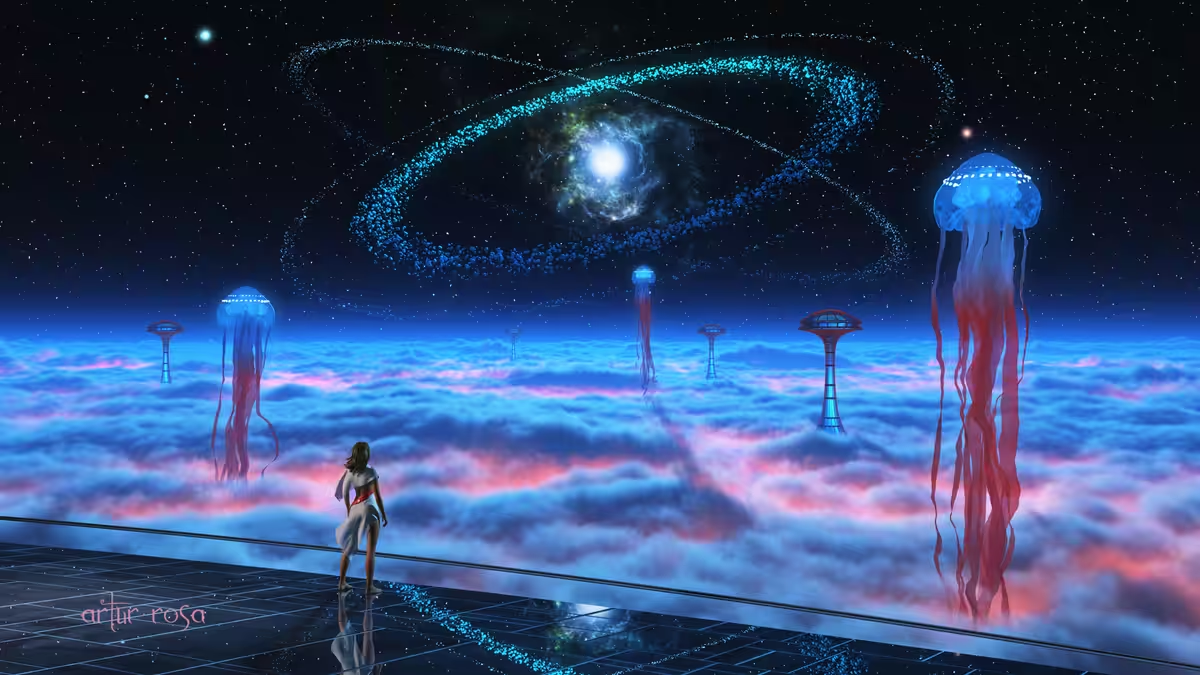
These are just the first three. We call them "stellamedusa". Many more will come in the next days and will patiently travel the imense distance to the blue star. During their very long journey the eggs inside will mature and, as they near the star, their bodies will explode with the heat. This will disperse their eggs in all directions. Most of these eggs will burn in the intense heat, some will directly hit the star or will be captured in an orbit around it, but a few will eventually escape and arrive to some other planet, in this or in another system, where the sequence will begin once more.
A fascinating element to this cycle is that the radiation from the star will alter the DNA of some of the eggs, creating a countless number of mutations. Some will fail, others will prevail.
In the meantime, the remains of the dead stellamedusa will forever orbit the star, creating an ethereal cloud-like shape around it, an eternal reminder of this fascinating cycle of life and death.
This was the first real example we found of actual panspermia in our voyages across the galaxy.
In the meantime, we are also witness to another cycle: the debris around the star are either the remains of old planets that for some reason were desintegrated, or the start of future planets that will eventually be formed. Or both simultaneously. Again, it's hard to say where the cycle starts or where it ends.