Subjektive Information
Herbert W. Franke's book "Phänomen Kunst - Die Grundlagen der kybernetischen Ästhetik" (1974) has been most influential in my thinking about art and the ways we perceive it. To my knowledge it was never translated in English. In this book Franke explains very concisely "how art works" based on Claude Shannon's information theory and Norbert Wiener's "Cybernetics".
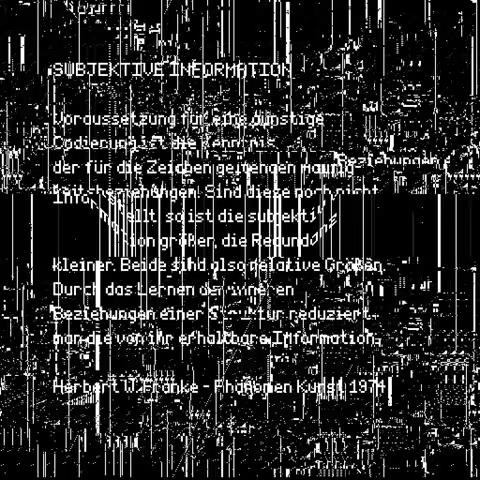
My tribute is based on the introduction to chapter 16 of the book: "Subjective Information - A prerequisite for a favorable coding is knowledge of the frequency relationships applicable to the signs. If these have not yet been determined, the subjectively conveyed information is greater and the redundancy smaller. Meaning that both are relative quantities. By learning the inner relationships of a structure one reduces the information obtainable from it."
This work is a real-time view into a functional operating system in which multiple agents use a limited set of assembler instructions that change the state of the system itself. Unlike its appearance there are no random number generators used inside the code, the entire behavior of the system is deterministic apart from the starting conditions which get slightly altered upon every restart. Anything that appears "random" to us is just a result of the complex interplay of the agents that share the same memory space which allows them to alter their initial instructions leading to unpredictable behavior that maintains a promise of potentially new information even after we believe that we have understood the inner workings and recurring patterns.
Released on the occasion of the Tribute to Herbert W. Franke. 50% of the sales will be donated to the Foundation Herbert W. Franke which is dedicated to preserve and document his work.