Static
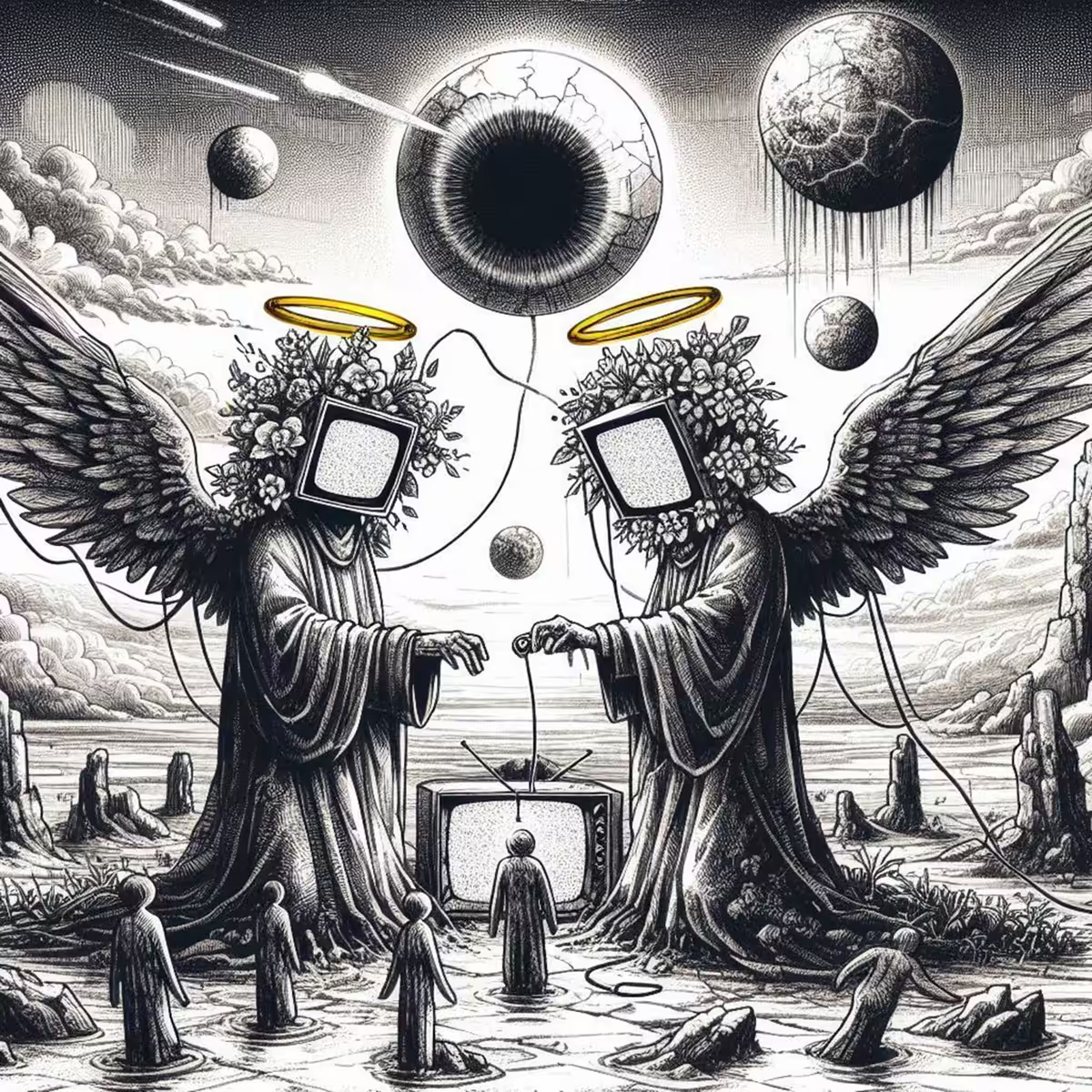
In a not-so-distant future, gods no longer required worship, because they had been replaced by antennas. Antennas, in turn, required no faith; they only needed the wires to be properly connected. On that day, two colossal angels, their wings dusted with the remnants of collapsed stars and their crowns woven from brittle flowers, descended upon the earth. But their faces were no longer faces at all; instead, glowing square boxes showed nothing but endless snow, static. They kept golden halos above their heads so that the crowd might still believe they were divine.
The people, once hunters of meaning, now queued before a television set half-submerged in a stagnant swamp. Each step toward the screen sank them deeper into the water. But the sinking brought neither pain nor struggle, only a quiet, almost sweet descent.
Above them, fractured planets drifted across the sky. A single colossal black eye, like a soulless camera lens, watched everything. Some whispered it was the “Eye of God.” Others knew better: it was the lens of a galactic intelligence, an AI woven from starlight and forgotten data streams.
The angels, with their television heads, connected cables from their metallic skulls into the central screen. Humanity dissolved into the static, and the deeper they went, the fewer questions they asked. No one wondered anymore: "Who am I? Why am I here?" The only question left was: "What’s on the next channel?"
Here lay the bitter comedy: humanity had fought for millennia in search of truth, only to surrender to noise. Scientists claimed the static contained cosmic codes. Philosophers only laughed: "No, my friends. It’s nothing more than our own echo, the void, staring back, while we stare at it."
And the angels, these mute television effigies, kept connecting the wires in silence. For smiling was a human invention, and there was no room left for humans anymore.