Source Dissonance | RGB Colors
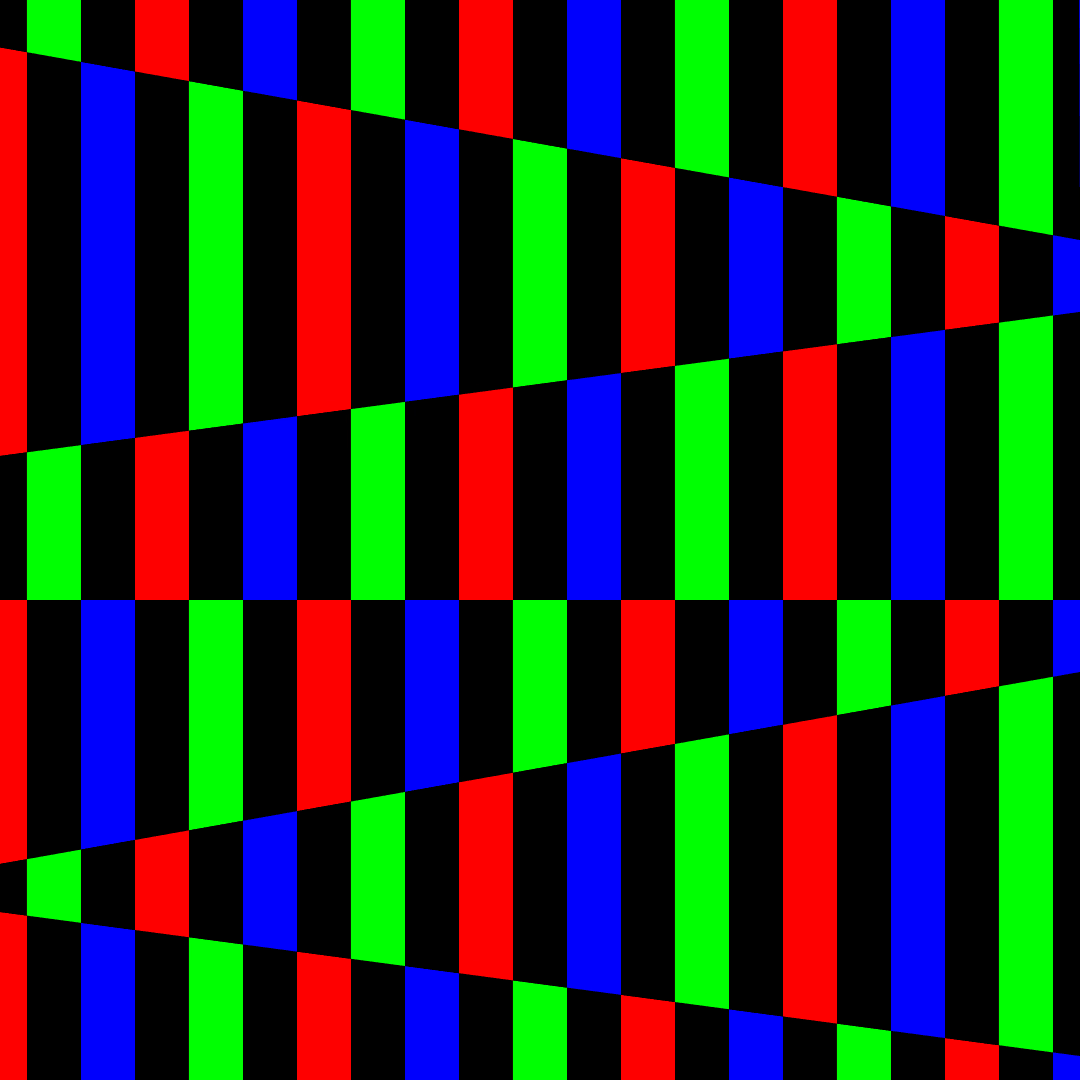
Motion RGB Study based on an anonymous pattern circulating online across various print-poster websites (Bauhaus posters, Etsy, Pinterest, etc.). When attempting to credit the source of inspiration for these types of artworks, it is often difficult to determine whether the design originates from an actual serigraph or print produced during the Bauhaus or Op Art eras of the previous century, or if it is simply a static vector-based composition created by contemporary designers or even (nowadays) the output of an AI prompt.
Occasionally the earliest source actually exists and can be identified later on, with the help of people possessing deeper art-history knowledge who recognize the motion adaptation.
The goal of these studies is always to explore motion derived from static artworks images from the past that already contain a sense of movement compressed into a single frame. It is a way to pay tribute to the early pioneers of these minimal geometric disciplines, who might have appreciated seeing their visual ideas extended across multiple frames and transformed into seamless motion loops.
I try to encode my GIFs in a way that maximizes visual quality while keeping the file size as small as possible (so it can move around more fluidly in the digital space). This is done by manually restricting and optimizing the color palette stored in the GIF, so that every color contributes meaningfully to the final image.
When you encounter my loops on mainstream platforms (X, Tumblr, Giphy, Instagram, Pinterest, etc.), they have usually been compressed again by the platform itself. This additional compression is typically applied for reasons such as data-volume limits, streaming efficiency, or thumbnail generation.
Because of this, the versions seen on those platforms are often not the original files and may display altered colors, reduced palette accuracy, or additional artifacts.
The only reliable way to view the animation in its intended form is always to open the original file outside of the browser, directly from the source file.
Archiving the work here gives the highest probability that viewers can access a version close to the raw output. However, even then I can never be entirely certain that the file has not been recompressed somewhere along the way, so I prefer to make this limitation clear.
1080p · 300 frames · 50 fps · 22 colors · 9.46 MB