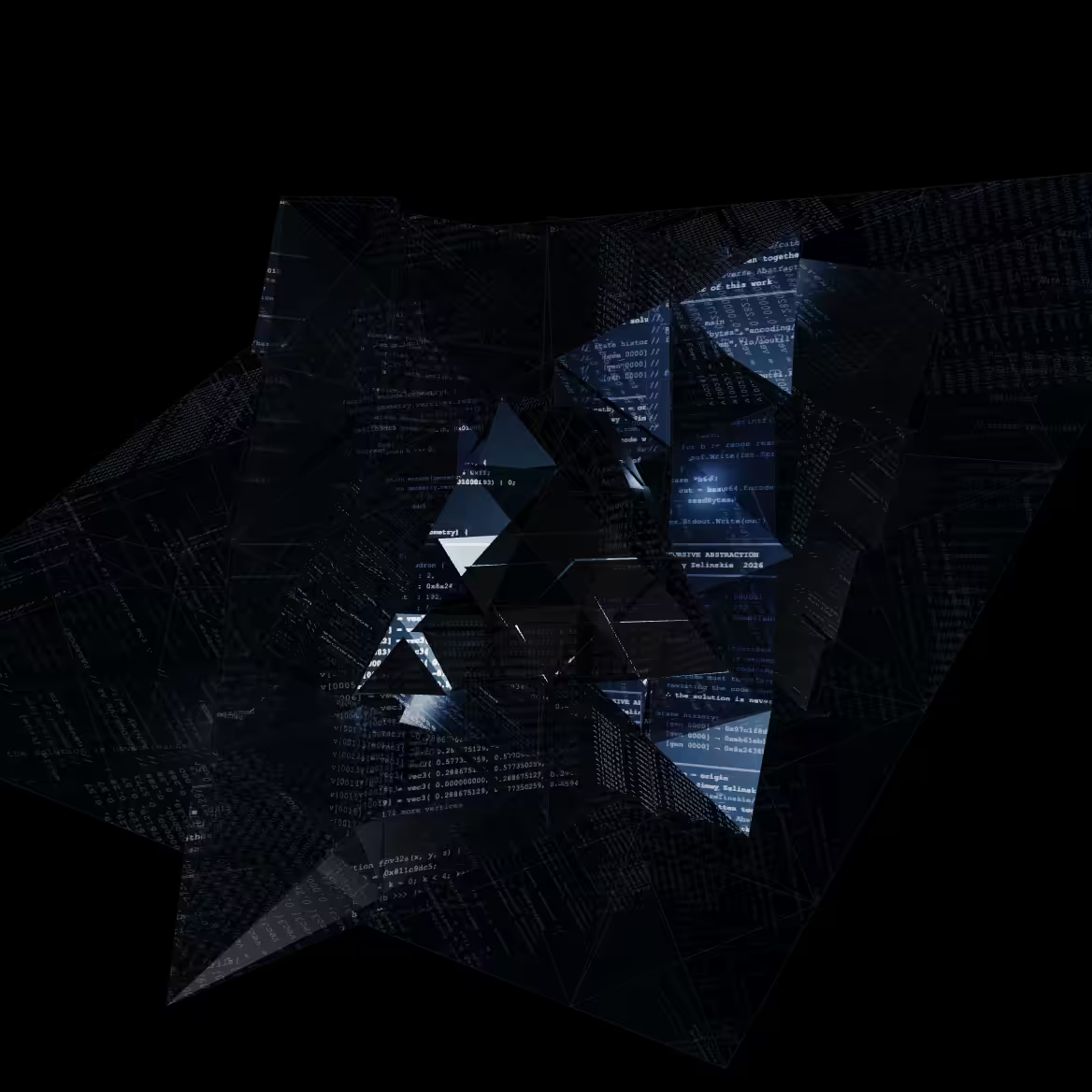
Recursive Abstraction
Recursive Abstraction grows out of my Reverse Abstraction series, which explores the different languages humans and computers use to understand form. The work moves through all five Platonic solids: the tetrahedron, hexahedron, octahedron, dodecahedron, and icosahedron. Each translucent shape is inscribed with code generated from the form within it. That process is driven by catbyte, a program my brother Jimmy and I wrote in 2015 to translate a shape into machine-readable code and place that code back onto its surface. But the inscription changes the object, creating a new form that must be translated and inscribed again. Every ten seconds, a new generation emerges as the oldest dissolves. The geometry breathes, the code flows, and the work remains caught in an endless attempt to describe itself that's never resolved. ∴
2026
Generative software (JavaScript, WebGL)
Single-channel display, variable dimensions