Project 596 16.10.1964
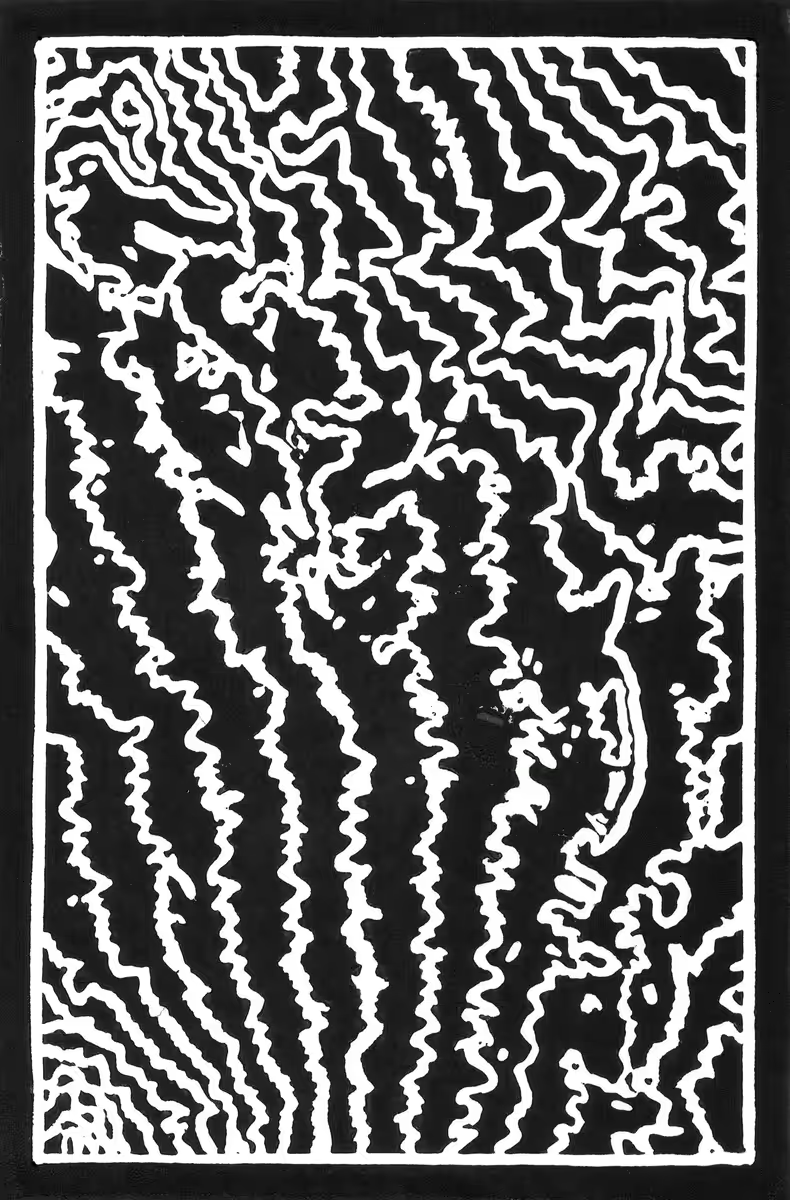
On 16 October 1964, 60 years ago today, China tested its first nuclear weapon codenamed Project 596 atop a 102 metre high tower at the Lop Nur site at 40.8125°N 89.7901°E in the Xinjiang autonomous territory. The bomb was a 22 kiloton uranium implosion design, and made China the 5th nuclear armed state together with the US, USSR, UK and France. The test was conducted six days into the Tokyo Olympics, prompting widespread concern about radiation exposure to people in Japan. . The Chinese nuclear weapons program was launched by Chairman Mao in the 1950s, in direct response to regional geopolitical tensions and confrontations with the US. These tensions included the Taiwan Straits crisis and both the Korean and Vietnam wars which, according to Chomsky, were imperial wars fought because of "the perceived significance of Southeast Asia for the integrated global system that was to be organised by American power – and, under reasonable assumptions, dominated by American power for the primary benefit of those who possess that power." How right he was. . As Mao bluntly put it in 1956 when launching the Chinese nuclear weapons program, "In today's world, if we don't want to be bullied, we have to have this thing." And so it goes. . China collaborated with the USSR under the auspices of the newly set-up 'Third Ministry of Machinery Building', to develop the 'thing', with the exchange of over a thousand scientists and specialists, and the transfer of gaseous diffusion technology for enriching uranium. The first bomb development was taken over by the Second Ministry of Machinery Building in 1959 when the USSR pulled out of the collaboration. . After the test, Taiwan tried to launch its own nuclear weapons program, but was dissuaded from doing so by the US to avoid exacerbating tensions with China. The international community quickly shifted its recognition to the nuclear-armed mainland. Within a decade, Taiwan had lost to China both its recognition as the seat of the Chinese government and its permanent seat in the UN Security Council. . Lop Nur eventually became by far the largest nuclear testing site in the world, covering 100,000 square kilometers. The site is located in Xinjiang, the East Turkistan home to the Uyghur and other indigenous people - needless to say, environmental and health impacts were neglected, despite widespread contamination, desertification and sustained reports of excess cancer incidence in the local populace over decades. The testing of Chinese nuclear weapons continued at the site until 1996, with 22 underground and 23 atmospheric tests, and included a 3 megaton thermonuclear bomb. . China has carried out 45 nuclear weapons tests, and possesses an estimated 500 nuclear warheads. . . . This 10x15 cm hand-cut linocut print of the topography of the region was made from a pen plot using AxiDraw SE/A3.