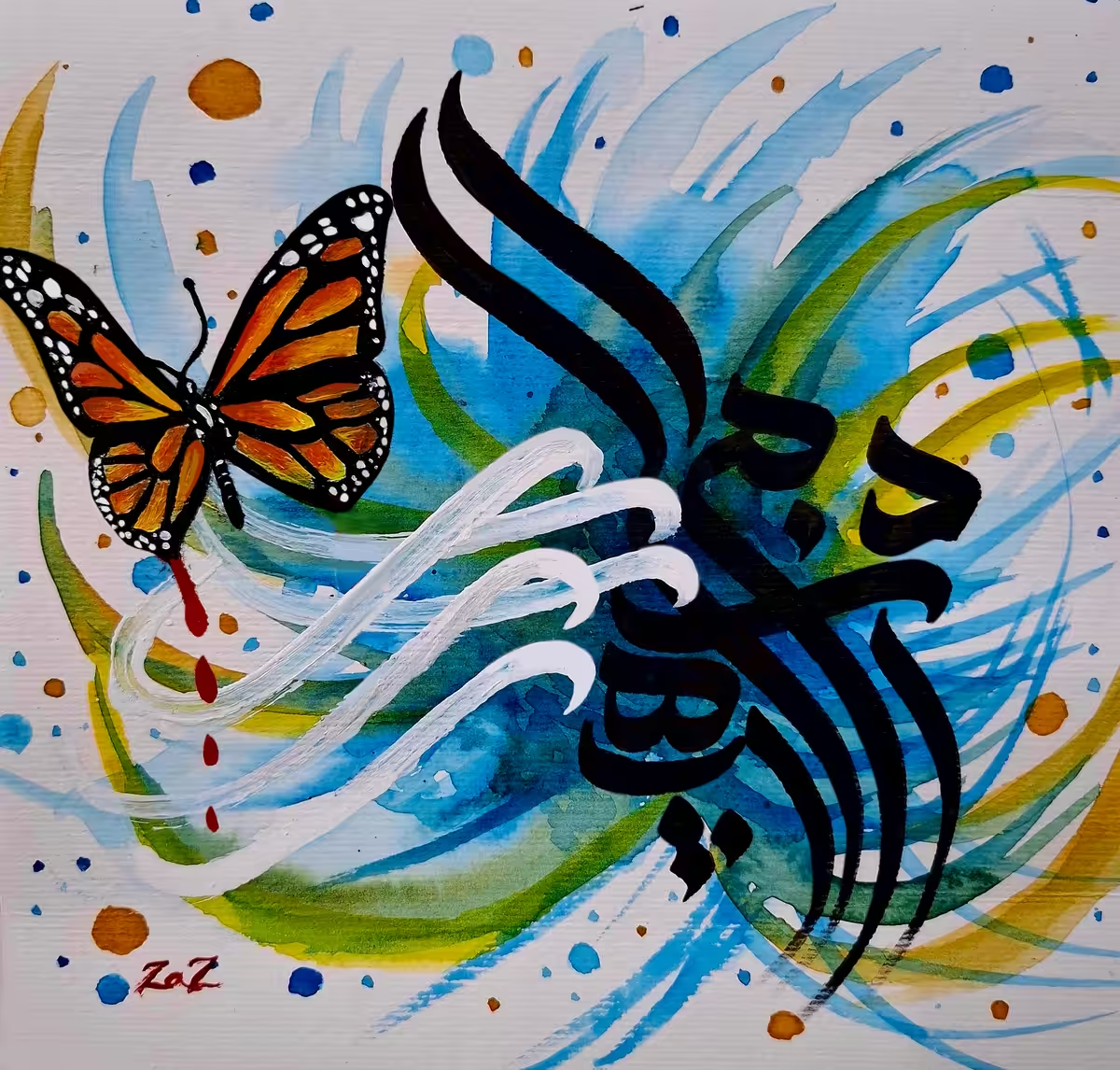
I painted this myself with hands that were trembling and a heart that had run out of space. I let the watercolors go free, washing into one another like waves: blues and greens, like a hope that still dares to breathe in this land, and the black of calligraphy, heavy and screaming, settling onto the paper.
I didn’t write the words. I let them wound themselves bend, fracture, lose their balance… just like us.
I painted the butterfly as if it had just passed through fire. Its beauty is still there, but blood drips from its body. This butterfly is Iran: delicate, freedom seeking, and every time it tries to fly, a bullet or a blade finds it. Those red drops are not metaphorical. They are the memory of young lives whose names still hover on our lips while their bodies lie on the ground.
The black script is both elegy and testimony. Like a lament stuck in the throat. I wanted the calligraphy not to be read, but to be felt to weigh down the chest, to steal the breath. Because the grief of Iran today is not an ordinary grief. It is vast, historic, collective.
As I painted, a line from Rumi kept circling my mind not a direct verse, but the soul of it: that pain, unless it reaches the marrow, cannot awaken us; that suffering is the very place where transformation begins. It was as if Rumi was whispering to me that it is only through burning that flight becomes meaningful. (از جمادی مردم و نامی شدم وز نما مردم به حیوان برزدم مردم از حیوانی و آدم شدم پس چه ترسم؟ کی ز مردن کم شدم I died as mineral and became a plant, I died as plant and rose to animal. I died as animal and became human So why should I fear? When did dying ever make me less?)
This painting is not a dirge. It is not surrender. It is the recording of a moment the moment when sorrow grows so large it can no longer be ignored. I painted it to say: we still see, we still remember, and despite all the wounds, we have not forgotten how to be a butterfly."