Manifesto
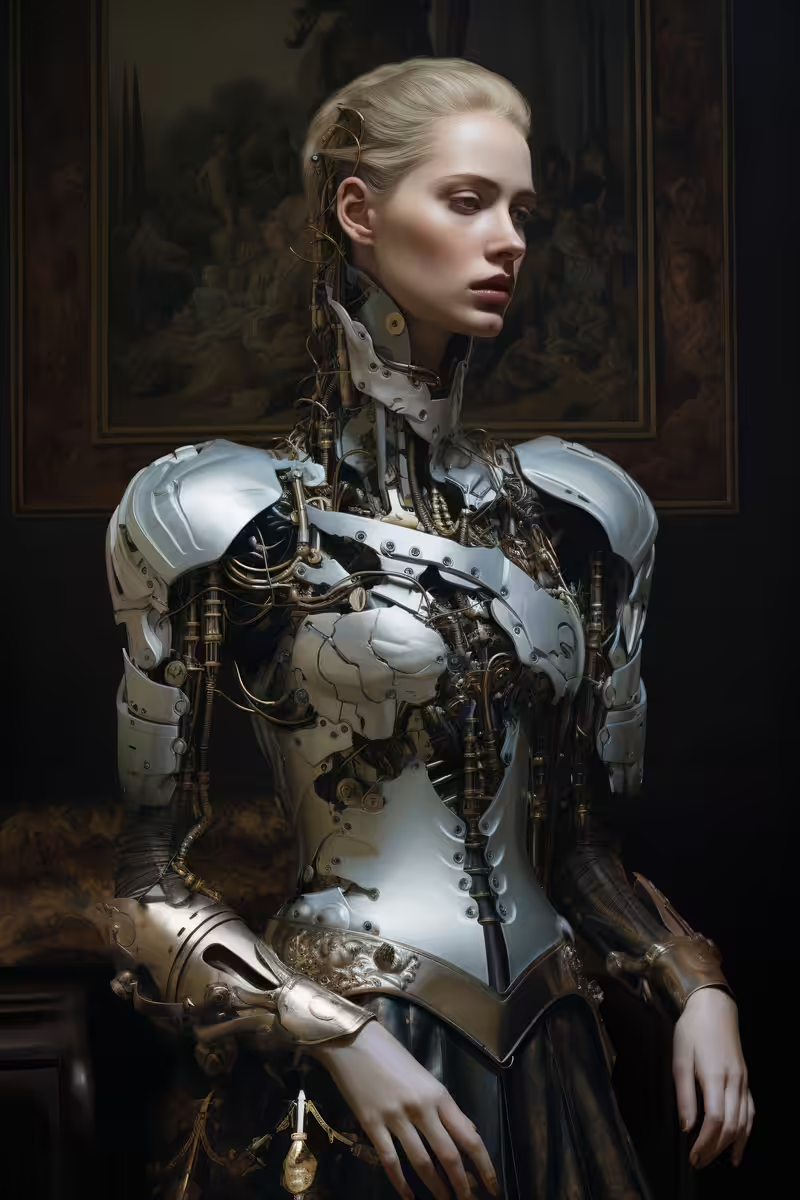
"Cyborg Manifesto" is a series that delves into the intersection of the human and the technological, where the past intertwines with the present, and the future unfolds before our eyes.
Donna Haraway, in her influential "A Cyborg Manifesto," challenged us to reconsider our conventional notions of identity, gender, and power in an increasingly technological world. In this series, we embrace this invitation and take it further, exploring how the fusion of the human and the technological, embodied in the figure of the cyborg, becomes a powerful metaphor that allows us to better understand not only who we are but also who we can become.
Nostalgia for the past, like a guiding thread, leads us through this odyssey. The Baroque fashion, which once adorned the halls of history, returns with a futuristic elegance, reminding us that we often yearn for what we left behind. But nostalgia is not just a reminder of the past; it echoes in our future actions and decisions.
This series carries a profound reflection on the nostalgia for the past and how it can influence the direction we take in the future. Longing for the aesthetics and elegance of the Baroque represents how cultural concepts from the past can lead us to repeat patterns and stereotypes, even as we move into the unknown. This duality between the human and the technological then becomes a constant reminder that our identity and our history are intricately connected but also destined to evolve.
In this way, we can see how, even though the series is set in a distant future, these cyborg figures maintain an appearance that resembles traditional beauty stereotypes associated with the present. This symbolic element highlights a fundamental question about how AI and technology can be influenced by images and stereotypes from the past.
Even in a world where technology has reached a high level of sophistication, images and stereotypes can persist and affect our perception of the surrounding world and the AIs themselves. This leads us to reflect on the importance of recognizing and questioning these stereotypes in the development and interaction with future technology, especially when nostalgia for the past can lead to the repetition of patterns that may not be the most suitable or equitable for the society of the future.
For all these reasons, this series invites us to question, reflect, and explore the world around us and the world we are heading towards, leading to the questioning of those ideas that are imposed, allowing us to understand how AI itself can continue to perpetuate patterns or stereotypes that exist in society, with this very AI simply being a reflection of what we truly are.