LM24.PCX
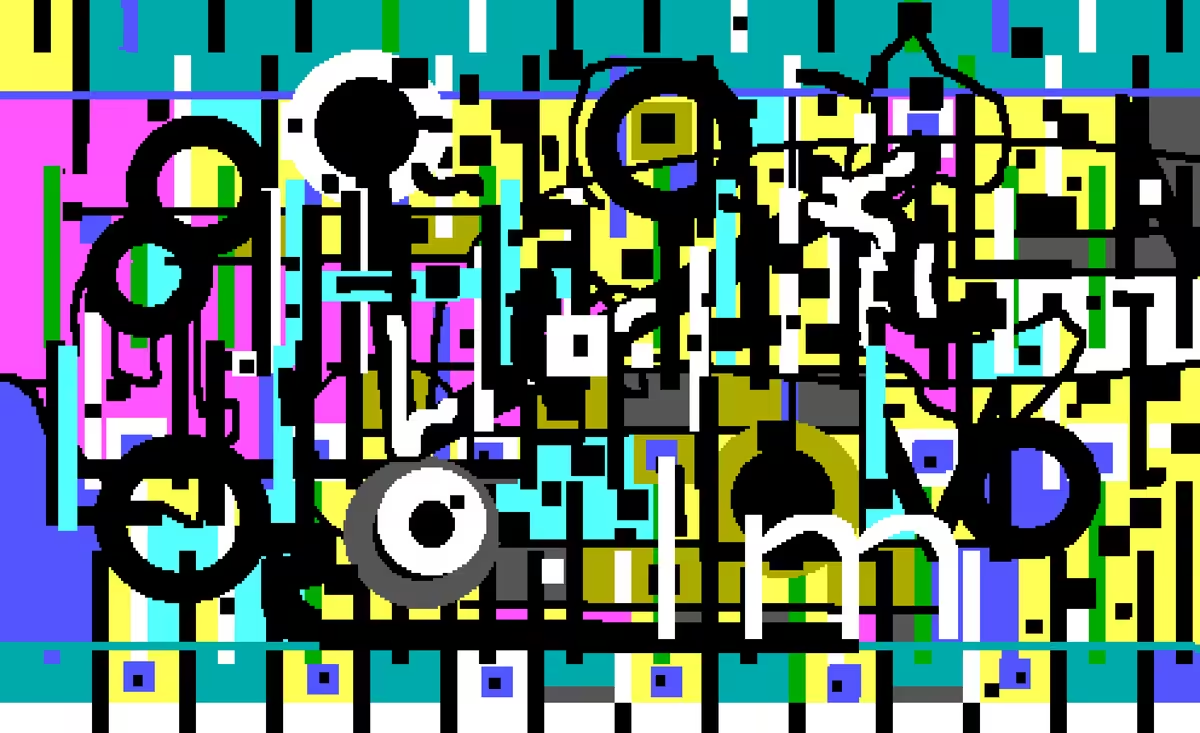
In the fall of 1986, Lee Mullican began participation in UCLA’s Advanced Design Research Center’s Program for Technology in the Arts. The program allowed the then 66-year-old artist to expand his vast oeuvre to the digital. He found inspiration in the similarities between his painting style and a computerized matrix. Replacing his brush and signature palette knife striations with a clickable mouse and pen-like stylus, Mullican merged the late Surrealist method of automatism with the computer’s instant and precise replication of marks, stating; “I found that beyond what one thought, the computer as being hard-lined, analytical, and predictable, it was indeed a medium fueled with the automatic, enabled by chance, and accident, discovery of new ways of making imagery.”
This artwork was originally created in PC Paintbrush and saved as PCX files. PCX stands for “Picture Exchange”, which is a Paintbrush Bitmap image format developed by ZSoft Corporation. It was developed as one of the initial bitmap image formats for DOS and Windows, supporting 24-bit true color images, 1-bit black and white images, 8-bit grayscale and indexed color images. Widely used as the imaging standard on the DOS platform, this raster image format also served as the native file format for PC Paintbrush. Although PCX image format has been replaced by newer formats like PNG and BMP, it’s still used by fax and scanning applications.
Lee Mullican was born in 1919 in Chickasha, Oklahoma and died in Los Angeles in 1998. Upon his graduation from the Kansas City Art Institute in 1942, Mullican was drafted into the army, serving four years as a topographical draftsman before moving to San Francisco in 1946.
After winning a prestigious Guggenheim Fellowship in 1959, he spent a year painting in Rome before returning to Los Angeles where he joined the UCLA Art Department in 1961, keeping his position for nearly 30 years. He divided the later part of his life between his homes in Los Angeles and Taos, traveling internationally and co-organizing exhibitions at UCLA. A retrospective spanning 50 years of the artist’s work was organized by the Los Angeles County Museum of Art in 2005.
Mullican is in the permanent collections of the Museum of Modern Art, New York; the San Francisco Museum of Art; the Metropolitan Museum of Art; the Museum of Contemporary Art, Los Angeles; and the Los Angeles County Museum of Art, among others.
The initial collector of this piece will also receive a framed 3 1/2 x 5 5/8 inches (8.9 x 14.3 cm) black and white print of the artwork form1987. The print is intended to be exchanged with the NFT in subsequent ownership transfers.