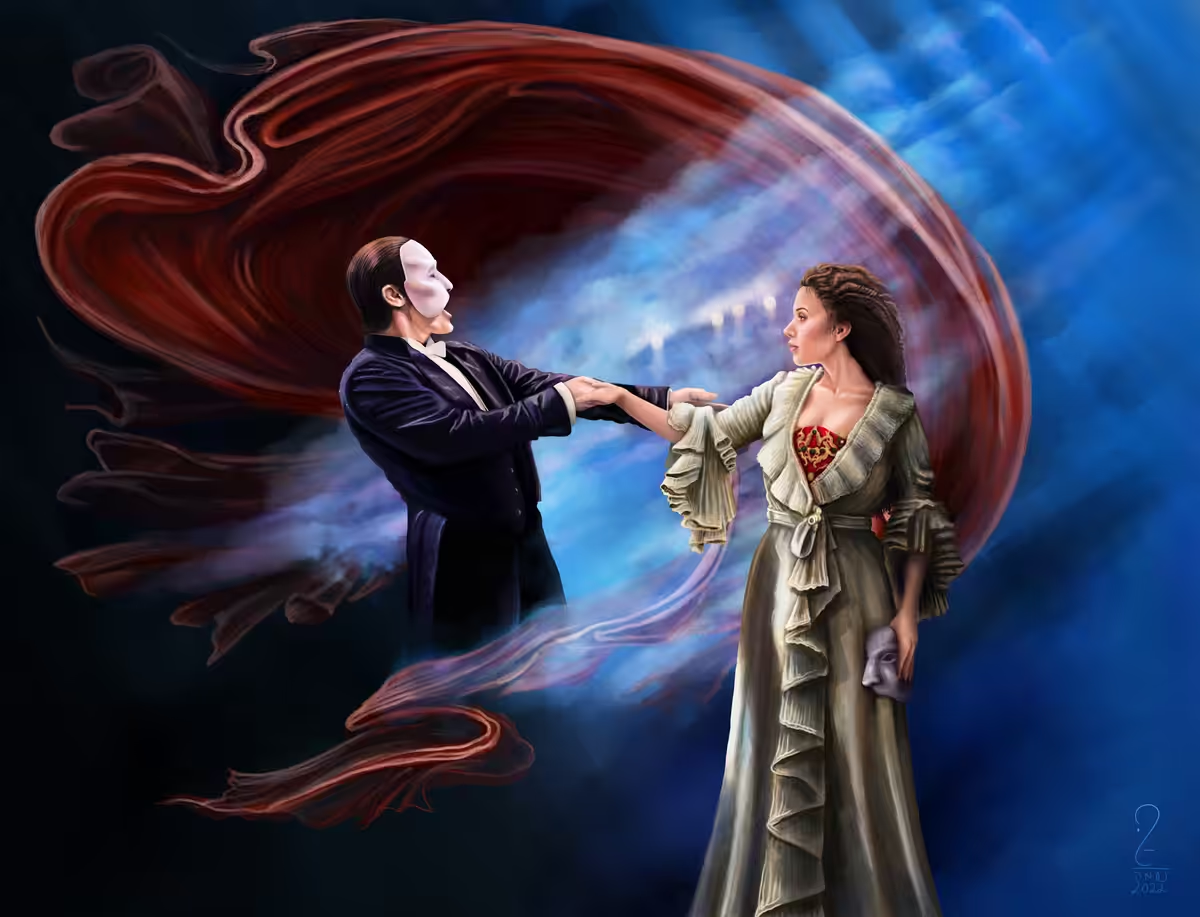
Inside my mind
‘The Phantom of the opera’ by Gaston Leroux was written 113 years ago, after a myth that was talked about all over Paris, about a real Phantom that possesses the Opera house. Leroux used many details that exist in real life - such as the lake under the Opera house, the fall of the chandelier, and the Opera house itself. The fact that the book was written with so many bases, in reality, also supported by the fact that the book was written like a record or evidence of some kind, helped keep the mystery of the Opera ghost alive.
Leroux was clearly inspired by Edgar Alan Poe in his writings, using much gothic writing esthetics in his description of the building, and the characters, especially Erik the Opera ghost whom he gave a Poe-Like appearance and even dressed the Opera Gohst as Poe’s “red death masque”.
The musical premiered 77 years after the book was published, and featured major changes that in my opinion made the story more compelling, and the characters more relatable.
Christine hears the ‘Phantom’s’ voice inside her head for a few months before finally seeing him for the first time, in the mirror. She is following his image into the mirror. This image, combined with the song’s lyrics “The Phantom of the Opera is there Inside my mind”, “I am the mask you wear, It's me they hear” and “Look at your face in the mirror - I am there inside!”, gave me the idea that perhaps the Phantom is nothing but a type of schizophrenia or another mental situation Christine is suffering from.
Artistic choices:
The use of color: This piece is using color in many ways, firstly the use of primary colors (red and blue) throughout the piece, in the background, clothes, and hair holds many meanings: The color red, surrounding the phantom, represents the color of assertion, romance, ambition, impulse, and physical prowess - all traits the Phantom possesses. On the other hand, red can also mean danger or threat, anger, and violence. All traits the Phantom has too.
The color blue has a wider spectrum - all the way from nearly black to light blue. Since blue is often associated with the feeling of sadness and melancholy, which has a wide spectrum as well, and which Christine seems to possess. On the other hand, In the eighteenth century, the blue flower emerged as a central symbol for metaphysical longing, which Erik holds for Christine for the entire story, and Christine holds for Erik for some of it. In ancient Egypt the color blue was associated with old magic, dreams, and truth, it was also the symbol of protection from the ‘evil eye’ bad luck, and jealousy. A superstition that is feared in theater today as well.
Composition: Christine and the Phantom are placed in equal stands. The thirds composition intersection points are touching Christine’s and the Phantom’s heads. Underlining the fact that the Phantom is a fiction of Christine's imagination. The horizontal middle line goes through Christine’s heart, which is the only part of her painted in red, showing that it is not only her mind that is involved in this, but her heart as well. The silver ratio, when applies to this piece, focuses on their hands crossing. The point of no return- when Christine goes with the Phantom through the mirror by giving him her hand, she makes the illusion real, making it so much harder to deny later on.
Symbolism: The phantom has no legs, disappearing into the fog of Christine's mind. Christine is holding the mask because, in effect, she is the Phantom. The viewers having a sharp eye and a critical observation would notice that the mask is a mirror image of the Phantom’s mask because she sees him in the mirror. The references to Michelangelo's Sistine chapel’s ‘The Creation of Adam’ fresco: the creation of Adam, also asks a question: did God create Adam and that is why he is surrounded by a brain? or did Adam create God, and the brain represent his imagination? - just like in this painting, it is unclear who is who’s illusion. God in Michelangelo’s fresco is surrounded by a red fabric, representing an anatomically correct human brain. In this piece, there is a mirror image of this red fabric, to represent another clue for the Phantom being a fiction of Christine’s imagination. Christine is standing where the frontal lobe would be, the frontal lobe is responsible for voluntary movement, expressive language, and managing higher-level executive functions. She is the creator only, not important for more than moving. The ‘phantom’ is the one controlling the rest of Christine's mind. Strengthen by the fact that behind Christine there is a space with nothing, behind the Phantom there is nothing but the brain. When looking closely, the viewer can see that the part of the fabric was painted using more textured brushes, giving it a distinction from the rest of the piece. This is done subtly to make the viewer have to zoom in, or stand closer, and feel closer to Christine in this state of mind.