Hero's Journey
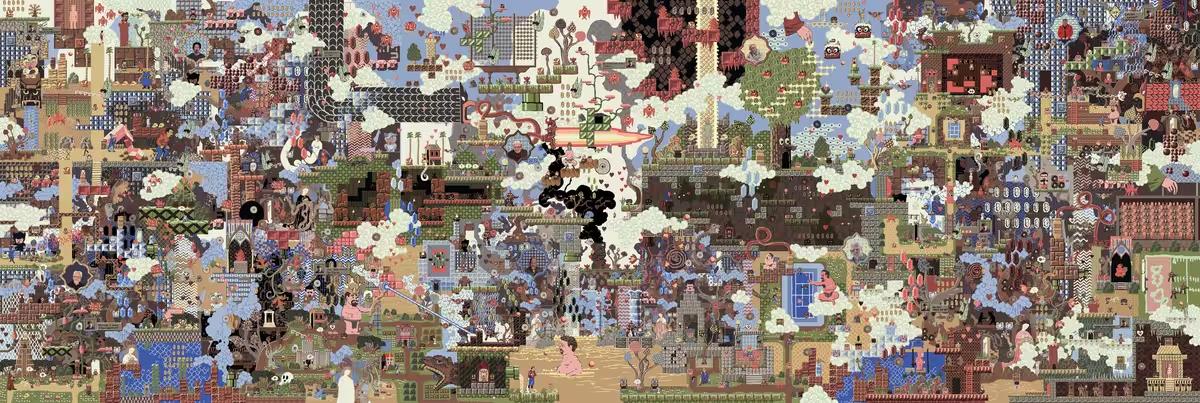
The hero’s journey is a narrative device – a common storytelling arc that describes the trials and coming of age of a hero. The device is a kind of pattern, a system that generates a particular kind of emotion in a story. Within the framework of the device there are infinite possibilities to create stories that are both unique and familiar.
Patterns are an innately human thing. We love their predictability, their symmetry, their regularity. We think in patterns, and see patterns everywhere. Our obsession with pattern is evident in how we operate, how we organize the world, how we decorate our spaces and dress ourselves, and in many forms of art and culture. But our relationship with patterns is also fraught. Patterns often prevent progress. They are difficult to break. Deeply engrained patterns can withstand even the most heroic efforts. The cycle always repeats. We find comfort in the repetition, even if what repeats is slowly killing us. The world created in this work is heavily patterned. The patterns provide comfort in a complex space. They also create a chaotic energy that is constantly competing for attention.
It is common for a hero’s journey narrative to take place in a foreign land. This work is that distant world. It is also a reflection of a contemporary cultural landscape that is highly fragmented. The scenes in this world play out parallel to each other, but in a disconnected way. They relate through style, palette and cast, but there is not a clear linear path upon which the story takes place. The scenes are not intended to construct a tangible narrative. Instead, the narrative is broken. It is an impossible labyrinth, a constantly shifting pattern. There is no beginning, middle or end, no moral of the story, no underlying agenda. There are just events happening, some of which feel significant, symbolic or mysterious. While others feel benign.
The world constructed here draws influence from video games, particularly those of the 8- and 16-bit generation. There are specific call outs in the work to Super Mario, Metroid, Mega Man, The Legend of Zelda, Tetris, Kirby, and other games in this genre. The world is also inspired by contemporary video games like Minecraft, Terraria, Axiom Verge, The Sims, and Hollow Knight. In addition to stylistic choices, there are two important aspects of video games that inform this work. The first is the idea of the open world or sandbox game. In this type of game, the player has autonomy to freely navigate the game world outside of the prescribed narrative. Discovery and exploration are important elements in these games, and the gamer is often rewarded for their efforts with rich detail, expansive maps and beautiful design. The second video game derived concept that is important to this work is the idea of collectables. The collection of items – coins, badges, cards, hearts, seeds, tools, etc. - often expand the game play and create increased risk, challenge and reward. Collectables incentivize the player to explore the game more deeply and take chances they might not otherwise have taken. In Hero’s Journey, you will find a vast open world with much to see and many items to collect.
This piece is also heavily inspired by pre-renaissance European painting like those found in illuminated manuscripts, fresco painting and early Christian painting. It also pulls ideas from Mesoamerican art, Indian miniatures, Japanese block prints and other similar forms of non-perspectival art. These genres share a curiosity and creativity in how they depict narratives and reflect culture. They are not burdened by the need to construct a natural appearance and as such feel more imaginative and mysterious. The Hero’s Journey world embraces the spirit of creativity, freedom and imagination that can be found in these areas of art history. It also points to parallels between the visual language, and narrative approaches, that are used in video game culture and the early cultures that produced the artforms described above.