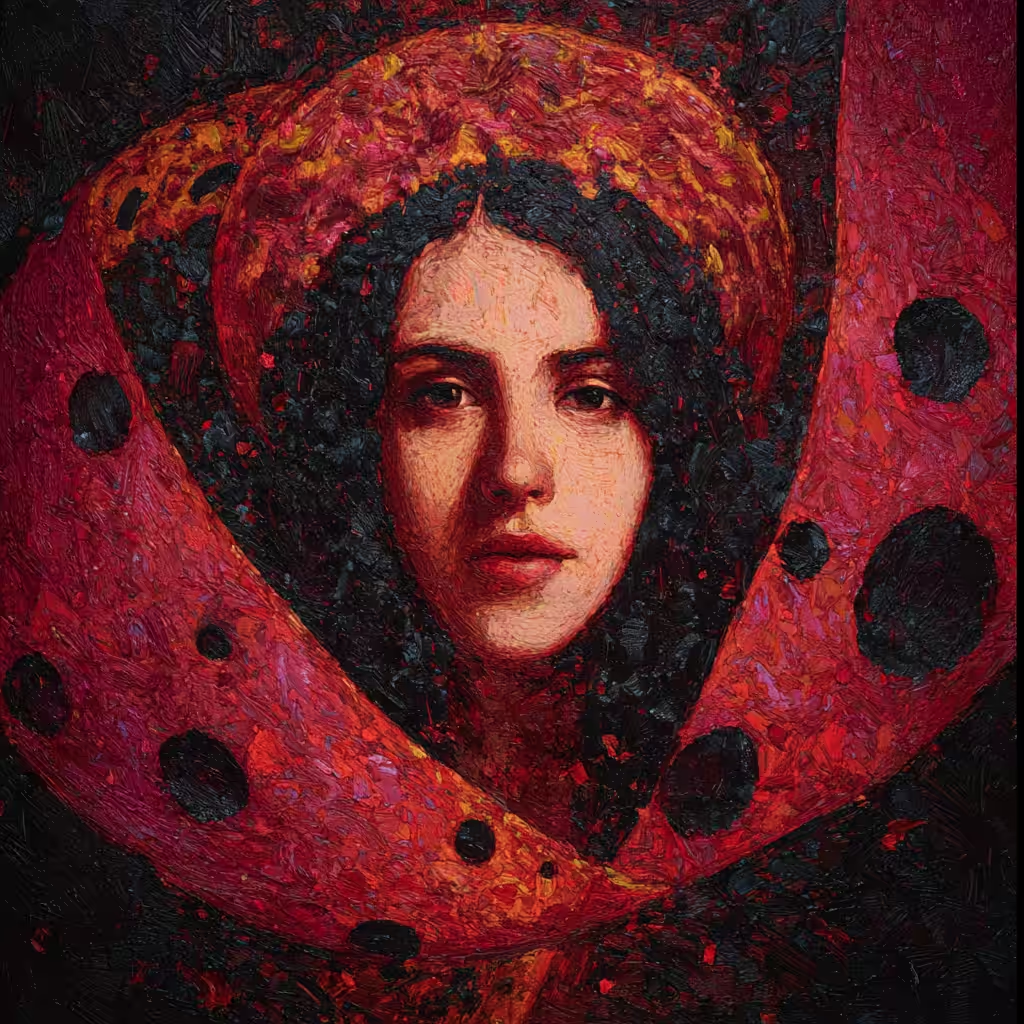
Ember Madonna
In a city whose name had long been forgotten, there lived a woman no one called by her real name. No one remembered the name she was given at birth. Everyone knew her only as Ember Madonna.
They said that on the night the great fire devoured the city— when temples collapsed and darkness refused to leave the sky for weeks— she was the only one who remained.
She did not run. She did not scream. She stood… right at the heart of the flames.
That night, the fire took everything—except her.
When morning finally came, people saw her: a woman with a calm face, deep eyes, and a trace of red that seemed woven not into her clothes, but into her skin itself. She was neither burned nor untouched. She existed somewhere in between.
From that day on, she wrapped herself in a crimson veil. A heavy fabric, stained, marked with dark circular shapes— each one like a memory of burning. They said the veil was woven from the remnants of the temple curtains, from cloths that had witnessed prayers, heard screams, and were now reduced to ash.
Ember Madonna rarely spoke. Yet when you passed by her, you felt something stir inside you. Not fear. Not peace. But something closer to remembrance.
Every evening, she stood at the very place where the fire had begun. Not to pray. Not to mourn. She simply stood and looked.
People said she was the guardian of pain. They said that if suffering were ever forgotten, the city would burn again.
Years passed. Generations changed. The fire turned into legend. But Ember Madonna remained.
One day, a child asked her, “Who are you?”
For the first time, her lips moved. Her voice was soft, like an ember that still holds warmth:
“I am the memory of what must not go out.”
The child did not understand. But years later— when loss was first felt, when pain revealed its destructive silence if left unseen— the memory of her gaze returned.
Ember Madonna was neither a saint nor a victim. She was the symbol of something deeper: that a human being can burn and yet not be destroyed.
They say that if one day she disappears, it will mean the world can no longer bear to face the truth.
Until that day, within the crimson, a woman stood— with eyes still burning, and a gaze that would never fade.