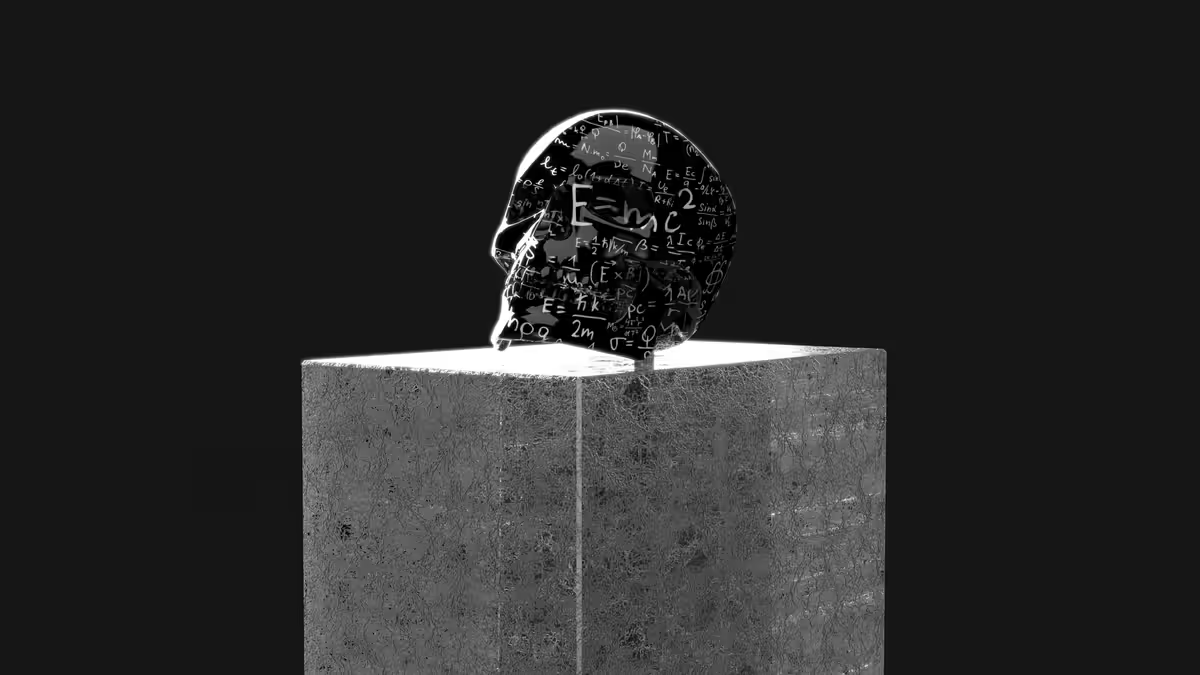
Einstein E = mc^2
Albert Einstein (1879-1955) is widely regarded as one of the greatest scientists in history. He was a German-born theoretical physicist who made groundbreaking contributions to the field of physics.
Einstein is best known for his theory of relativity, which includes both the special theory of relativity and the general theory of relativity. The special theory of relativity, published in 1905, introduced revolutionary concepts such as the constancy of the speed of light, time dilation, and length contraction. It established that the laws of physics are the same for all observers in uniform motion relative to each other.
The general theory of relativity, published in 1915, extended the principles of the special theory of relativity to include the effect of gravity. It proposed that gravity arises due to the curvature of spacetime caused by mass and energy. This theory provided a new understanding of gravitation and successfully explained various phenomena, such as the bending of light around massive objects.
In addition to his work on relativity, Einstein made significant contributions to quantum mechanics, statistical mechanics, and the understanding of the photoelectric effect, for which he received the Nobel Prize in Physics in 1921.
Einstein's work revolutionized our understanding of the physical world and had a profound impact on the development of modern physics. He is also known for his famous equation, E = mc^2, which expresses the equivalence of mass and energy.
Beyond his scientific achievements, Einstein was also an advocate for civil rights, pacifism, and international cooperation. His writings and philosophies continue to inspire scientists and thinkers worldwide. Einstein's name has become synonymous with genius and is a symbol of intellectual curiosity and imagination.