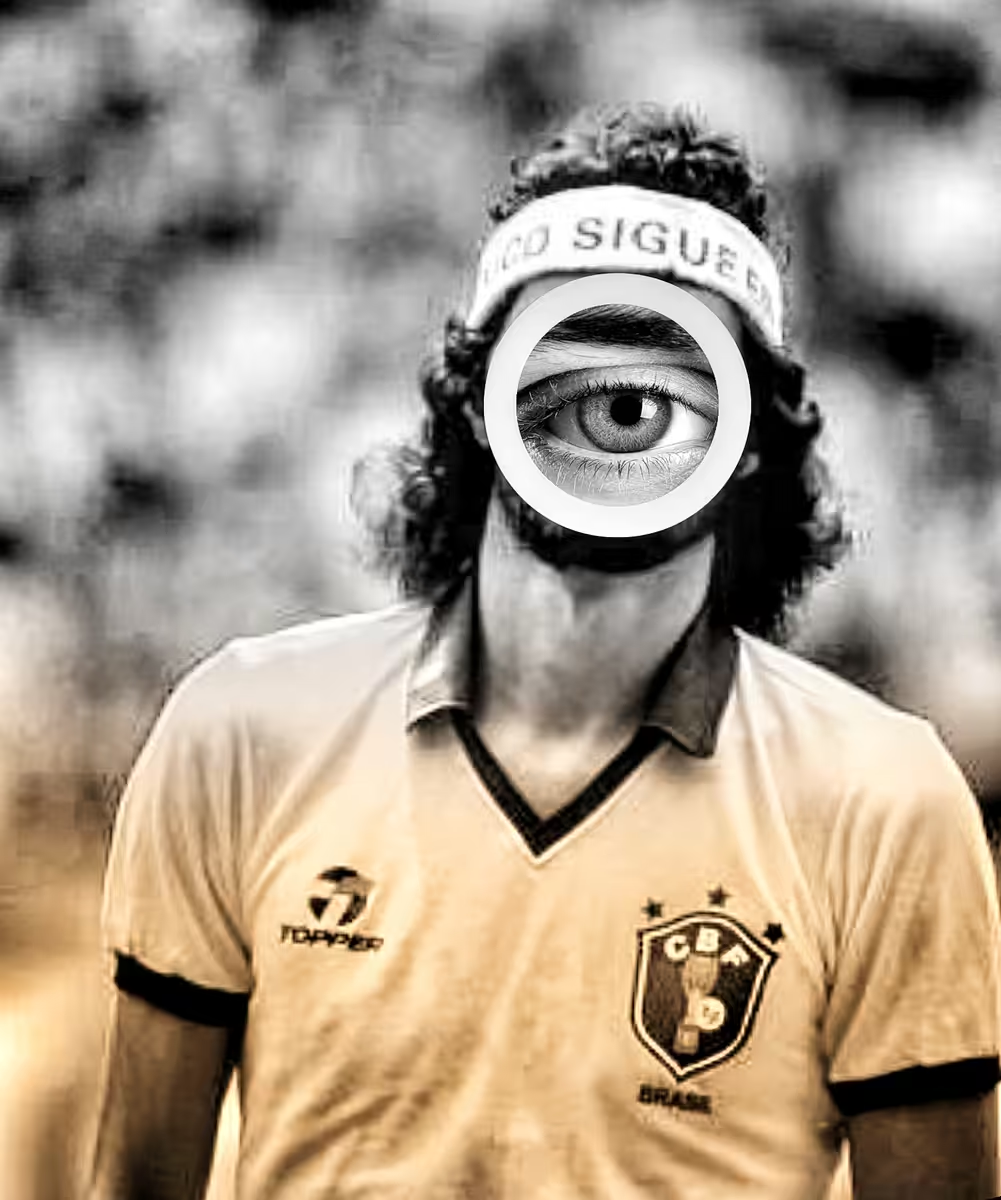
Doctor Sócrates'eye
Photo-Collage ‘My political victories are more important than my victories as a professional player. A match finishes in 90 minutes, but life goes on.” These are the profound and potent words of Sócrates Brasileiro Sampaio de Souza Vieira de Oliveira, known simply as Sócrates.
“On the field, with his talent and sophisticated touches, he was a genius. Off the field … he was active politically, concerned with his people and his country,” former Brazilian president Dilma Rousseff said in 2011, following Sócrates’ death.
Although he was a player with incredible flair and talent, it was his brilliant marrying of the game and politics that displayed his undeniable intellectual gift. Magrão (Big Skinny), as he was affectionately known, would stride on to the pitch sporting barely-there shorts, a jet-black beard and long curly locks that were either tucked under his trademark headbands or left dangling on his neck, and weave his magic.
Unlike most footballers, he didn’t turn professional until he was in his early 20s as he was studying medicine at the same time. Despite having ambidextrous football feet, he certainly did not regard himself as athletic and admitted that he had not honed his body for football’s athletic demands from a young age. Nonetheless, he started as a centre-forward in the late 1970s, before becoming a magnetic midfielder who won many hearts.
This is part of what made Sócrates so special: he was unlike any other footballer and barely conformed to expectations. The beer-guzzling chain-smoker, who could go through up to two boxes of cigarettes a day, wanted to be accepted for who he was. “I am anti-athlete. I cannot deny myself certain lapses from the strict regime of a sportsman,” he famously said.
Sócrates played for one of the greatest sports clubs in Brazil: Corinthians Paulista in São Paulo, a team founded by working-class men on the realisation that professional football clubs at the time were formed by — and for — the elite.