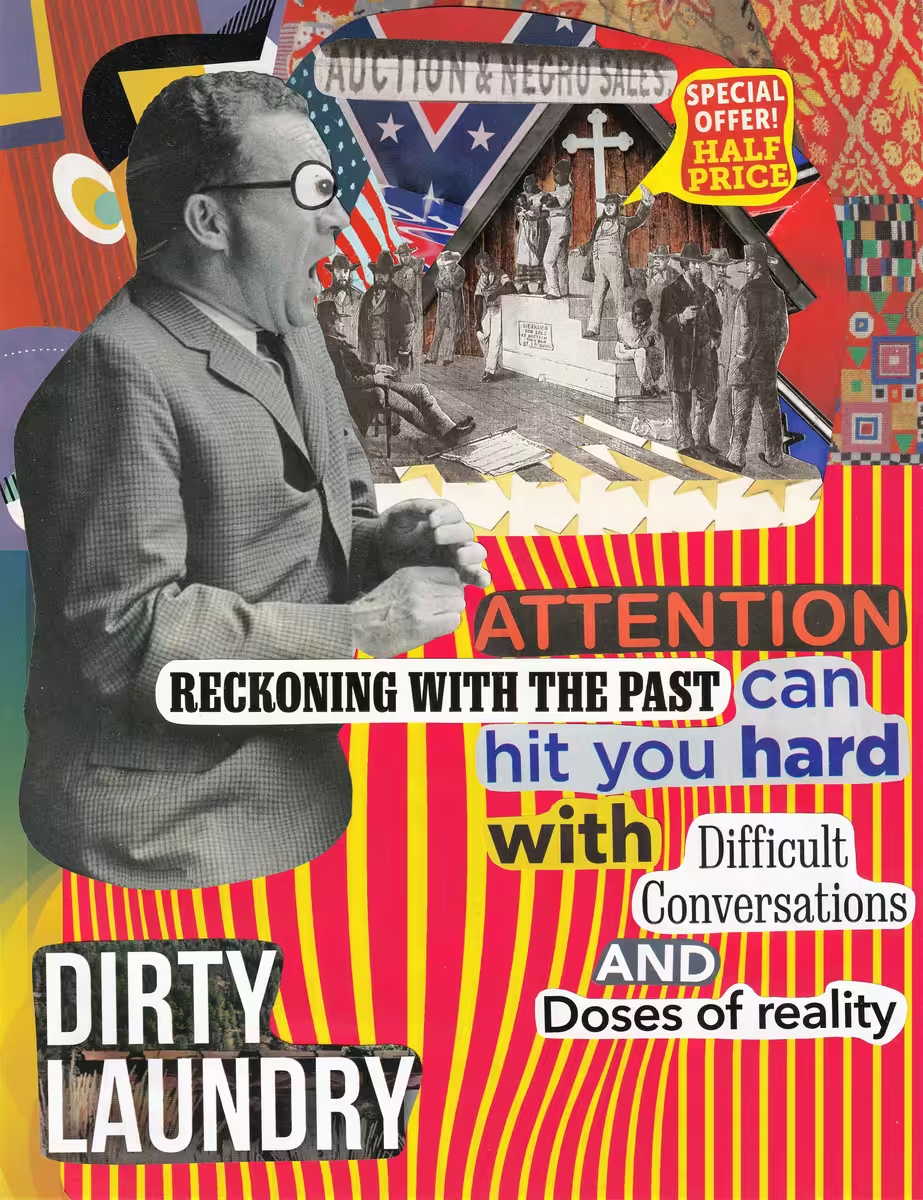
Dirty Laundry
Without the ability to see yourself, mirrors are nothing but reflective glass. I despise racism because it has decimated our progress as Canadians, as North Americans, and largely as a species globally. I despise racism because it is not natural, but rather a holdover of cultural brainwashing from a time not too long ago. While I despise racism, and despise the things racists say, I also pity the racists, because they have been robbed of their potential as human beings. Racist people have been ideologically kidnapped, bound without the tools necessary for escape. Their only tool is hatred, because they are fearful of what they do not understand, or worse, fearful of what they understand but are afraid to admit: the colour of one person’s skin may be different from that of another person, but those two people are the same creature. A White person who calls Black people apes and monkeys makes a vain attempt to forget that White people are, in fact, apes and monkeys that have been dressed up for so long that they believe it separates them from other humans. And so it goes for all racists, no matter their skin color and the skin of those they hate. We as individuals are far more willing to give ourselves the benefit of the doubt before we extend such kindness to others---when we forget our turn signal, we tell ourselves we made a simple mistake, but if someone else forgets their turn signal, we call them a bad driver. This double standard is innocuous when applied to benign events, like a forgotten turn signal, but it produces stereotypes when applied to people as a group, such as believing a woman forgot her turn signal because women are bad drivers. When these stereotypes build up over time, unconscious bias develops into malicious ignorance, like believing a woman forgot her turn signal, because women are bad drivers, because women are less intelligent than men and should stay in the house, because women are naturally intended to make babies and casseroles instead of careers and governments. As you may have guessed from the words and imagery, the first entry in the ‘Dirty Laundry’ series (which bears the same title as that of the entire series) does not aim to address the marginalization of women, but that of Black people. As a White artist, I would not dare attempt to summarize, or speak for, the Black experience, as my words could never encapsulate, individually or collectively, the triumph and suffering borne by Black people. What I can do, and what I dare to do here, is speak to my observations about racism as a White person. I meet White people who feel comfortable calling rap music ‘n*gger noise’ to my face, because they don’t think it will offend me. I’ve heard people call Black babies ‘niglets’ in passing conversation. I see news footage that purposefully frames images of looting as perpetrated uniquely by Black people. I’ve seen countless YouTube comments telling Black people to ‘go back to the jungle,’ and I’ve seen people argue that Black people owe White people for ‘bringing them out of the jungle.’ I’ve personally witnessed someone argue that Black people ‘didn’t fight hard enough’ to avoid being sold into slavery. Jalen Smereck was recently targeted in a hockey game when an opposing player pantomimed eating a banana toward him, as was Jordan Subban when an opposing player directed an imitation of a monkey at him. The last people born into U.S. slavery are documented to have died in the early 1970s---for comparison, my grandmother was 30 years old---so this is not ancient history that we are examining. Segregation of public schools was declared unconstitutional in the U.S. as recently as 1954, while remaining Jim Crow laws were overruled in the mid-60s. Obtaining the right for Black people to vote was a lengthy series of events that generally finalized with the Voting Rights Act of 1965, and yet the systemic obstruction and suppression of access to voting stations in Black communities is still a national issue to this day. And while this summary of history is largely U.S.-centric, the legacies of these events inevitably bleed into Canadian politics and culture as though they happened in our own backyards. My friend Ray once described hate as “a localized problem looking for outward mobility, and analyzation of oneself is largely the cure.” Without self-reflection, the roots of hate allow reproduction into the next generation, and unknowing children quickly grow into unfeeling adults, unconscious of their biases that will inevitably stretch into the future unless the roots of hatred are entirely removed from the soil. ‘Dirty Laundry’ will be released as 100 digital editions for free, and secondary sales will be set at 0% royalties for myself, for two reasons. First, I am a White artist, so I do not want to profit in any way from the legacies of slavery and racism. Second, this artwork is intended to spark conversation, and so I want it to be as accessible as possible.