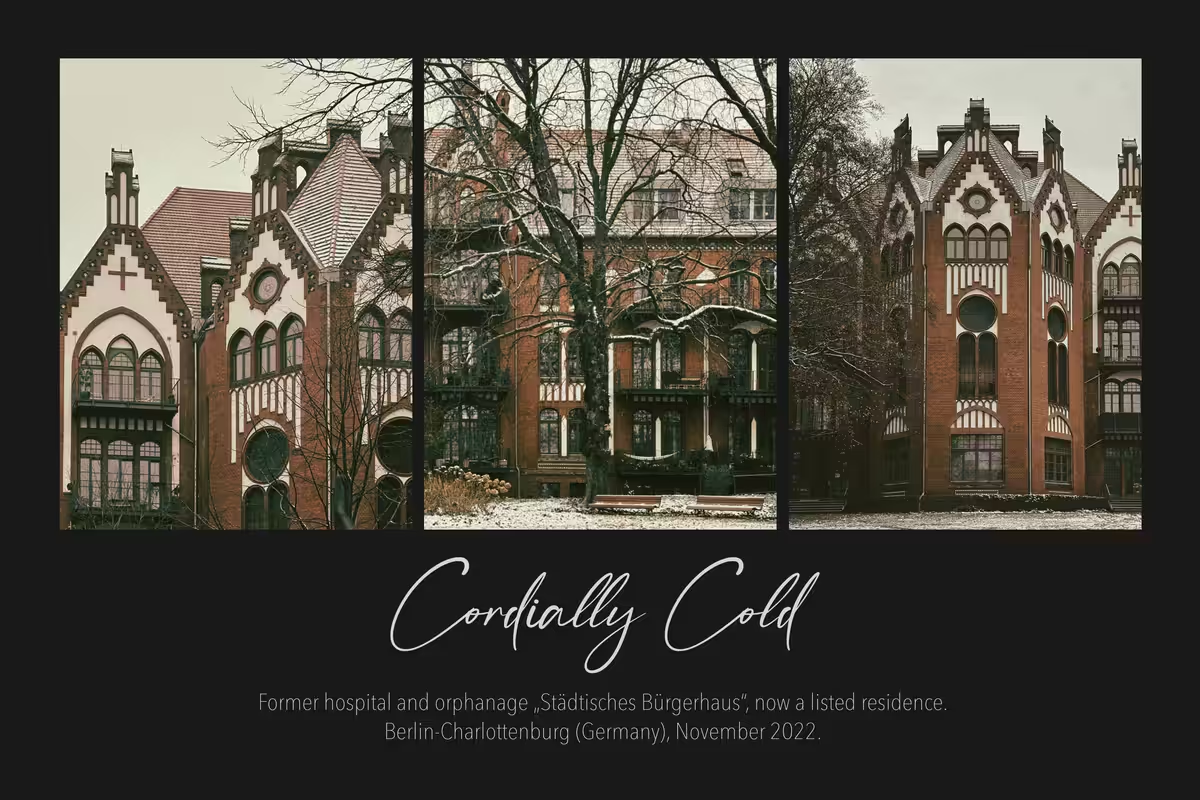
In 1898, Paul Friedrich Bratring (1840-1913), a Charlottenburg native, landed a lucrative contract. For his then still independent hometown of Charlottenburg, the architect was to build a so-called "Bürgerhaus" (community centre) close to the Schlosspark. This was understood to be a public welfare institution - half home, half hospital - for destitute old, incapacitated and/or chronically ill people.
After its completion, the Bürgerhaus offered space for almost 400 residents. After Bratring's death, the west wing was extended by the architect Heinrich Seeling (1852-1932). The new premises initially served as an orphanage.
The entire complex was finally repurposed for use as a hospital in 1933. After the Second World War, the building gradually transformed yet again, this time into a women's clinic. Countless children were born here until the 1970s. Under its new name "Max-Bürger-Krankenhaus", the clinic was one of the leading institutions of therapy for eldery people until its closure in 2002.
Ultimately, a British property developer acquired the entire four-and-a-half-hectare area, and created about 500 new flats within the listed buildings of the former hospital.