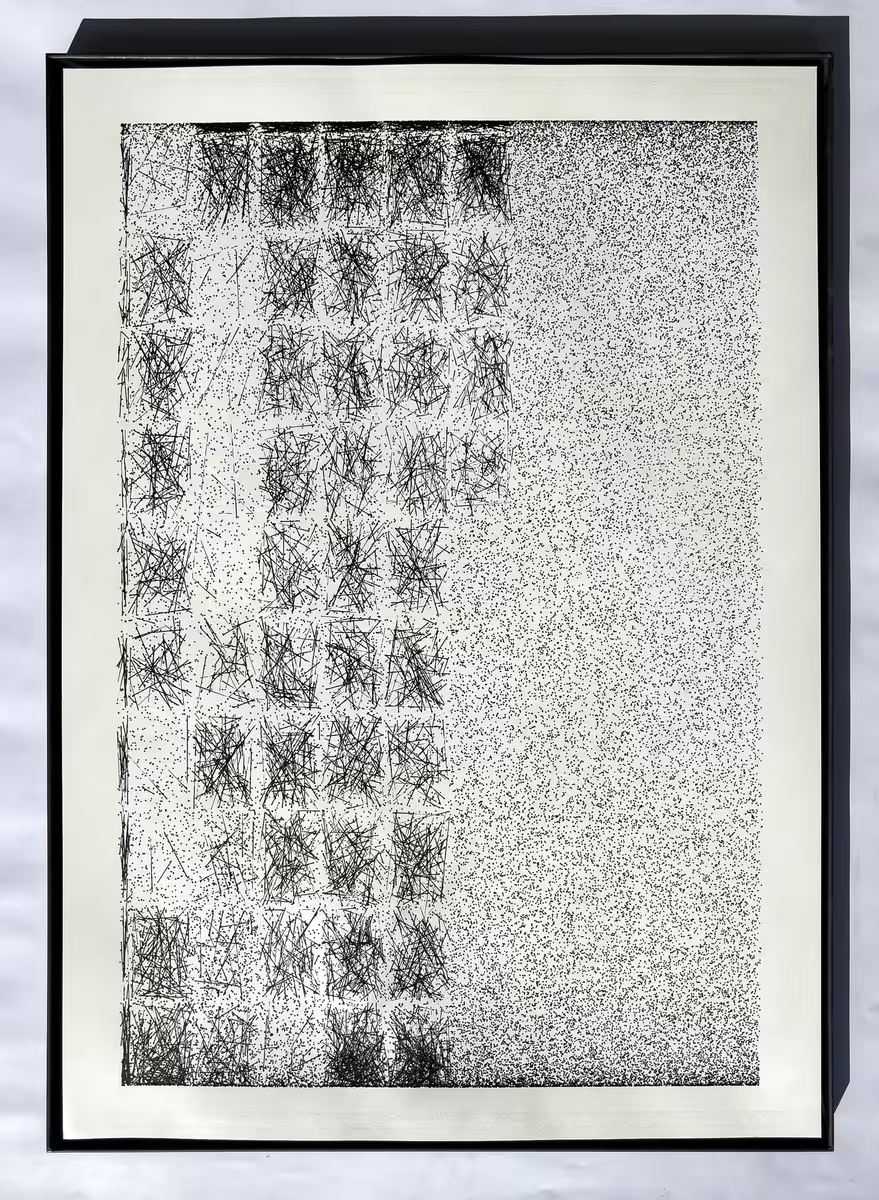
Composition #80
Sketch no 1 for Composition #80 A tribute to Herbert W. Franke
Besides his love for science fiction writing and table tennis, Herbert W. Franke was a pioneering computer artist and lecturer of cybernetics. His influence on the digital as well as electronic art scene is immense. I am eternally grateful for the body of work that he has left for the world to be inspired by.
In the book 'Phänomen Kunst - die kybernetischen Grundlagen der Ästhetik' from 1967, Herbert W. Franke writes about an approach to rational art. In this accessible encyclopedia of theories and ideas stemming from the cybernetic world of feedback in communication, aesthetic structures, and perception of signs within the scope of information theory, he claims that biological and technical approaches can yield universal truths about the phenomena 'art'.
Besides many other ideas, he describes the concept of a desirable bandwidth in the reception of art, ~16bits per second. Any information stream below or above this threshold will either be interpreted as boring or irritating, differentiating between art and kitsch.
Even though it appeals to me, it feels like a mystical endeavor to quantify the reception of art. For this sketch in tribute to Herbert W. Franke, I plotted 43.000 dots, one dot for every two seconds of a 24h timespan. Each dot is encoded as a coordinate of two digits, for the x- and y-value respectively. Since each value can be encoded as a 4-byte signed integer, one position results in a 32bit (2 x 4bytes) footprint. This concludes that drawing one new coordinate every two seconds will result in a pleasurable experience. When multiplying 43.000 by 32bits, one ends up with 1.382.400bits. This equals the amount of information a piece of art may transmit to be pleasurable for one day.
This drawing is in DIN A2 (42.0x59.4cm/16.53x23.39in) format, plotted with black Rotring ink on 190gsm Hahnemühle paper using an HP9594A pen plotter. The seemingly random lines in some sections are the result of buffer overflows when driving the plotter.
Berlin, September 2022 Marcel Schwittlick
Purchase of the NFT includes the original drawing. Upon resale on the secondary market, the original drawing shall be handed to the new owner. By purchasing the token, the collector agrees to lend the work for potentially upcoming exhibitions.
-- Some of Herbert W. Franke's writing on this topic (in English) can be found in the article 'Art as Data Processing' from 2009: http://www.biologie.uni-muenchen.de/~franke/KybKTheorie.htm