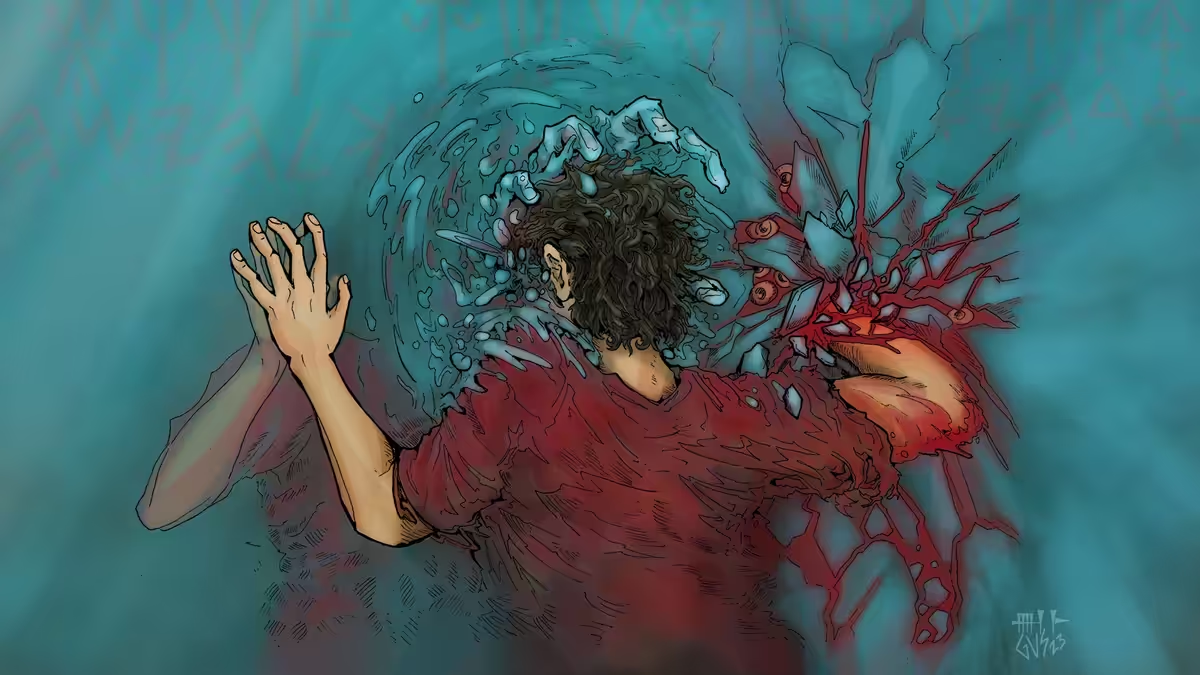
Who do you see in the mirror? You, your deeds, all of it? Your past, one which led you to either this/that path on the crossroads of reality; or the present clinging to slippery steps of a future— roadless track with a distant end? Does it occur to you, facing the mirror, that you're in constant change? Or it makes you feel alone, to stand still— even though you know much has passed, you feel like nothing has? Even if stillness is an illusion, it's a reference for the thread on which everything you can conceive to exist move over: time. No matter we try to distance ourselves as spectators, we experience time, collecting memories to set boundaries: "situations", "actions", "consequences", as we salvage our concept of self in the slipstream of our possibilities. How many of these selves do we let to take over on recollecting these memories? Which feelings are in this constant flux: shame to ecstasy, nostalgia and anxiety, dissociation and affirmation? This piece is an invitation to the philosophical matter of Closed, Open and Empty Individualism, each with metaphorical attributes.
Closed Reflection -- the surface of silver/gray glass The continuity of subjectivity which persist to a body over all times, refers to a continuation of these "selves" (past/future), regardless of corresponding to/conceiving actions and facing/suffering the outcome. It's perceived in a single direction and concerns a single body (mind as part of it too). One may argue that perception in this form could've been "evolutionarily selected" (in an environment marked by scarcity, mutations and recombining). Despite a subjective experience, it's regarded as objectively true, but incomplete/fallible when described to others by words alone. It's never a precise description of reality, regarded as a matter of alterity: words whose only authority refer to you. Suppose all your possible selves are actually just the same; even though the experience changes it, in essence, it remains— it's one self across a thread: that's CLOSED Individualism. Here, the mirror shows your reflection: all changes done, possibilities, it's part of who you are, who you've become, whoever it is, it will always be you.
Open Reflection -- the whirlpool in the stream, blur in the picture
There's something beside memory: consequences are scars, they're reminders or perceptions of change, so much that if we suppose one was possible to erase memory, it suggests as well it would be the erasing of the bond between the past/future selves, even if the scar remained. The concern for the past self, in a sense of identity, depends on the cultivation of memories. But are they capable of being emulated? One can't really stand connected to all memories it acquired, nor to conceive all possibilities — in that sense, the present and the past self are disconnected, if one can be deceived by it's memory, then the bond is questionable. To stand on that, the concept of subjectivity (of an I) may refer to either singular entities or just one, scattered in many selves, whose perception is anything but complete: that is OPEN Individualism. There, the mirror engulfs you among endless other mirrors, you emerge on the realm of possibilities, but may not come back the same as your former reflection, which you may not even remember clearly. Your eyes see what others' see, but like in the ocean, the closer to the depths, the darker it is. It's the metaphor of the elephant in the dark room, some perceive a snake from a trunk, a leaf from an ear and a column for a leg. You are one within another. You see yourself on all others. It's amid a myriad of mystical traditions, the pan-to-hen, monism, universal soul.
Empty Reflection -- the shattered glass What if we accept the idea that at every moment we are a different person? When acessing some memory from our past, one may face feelings of strangeness, causing sudden disassociation from the capacity of conceiving the thought/idea which sprung into effect the core event of this "strange" memory. Many would argue "only another person could've done that". It's about the impossibility of ever thinking of doing it, regardless if intentions are still toward the same end or not, even if ever the "same" situation presents itself once again. If we accept this, we admit that there's concern about another person: my “I of the past”. As if in every millisecond one lived as a different person. This is EMPTY Individualism. The mirror breaks, blood runs, the liquid spil on your skin, the glass cut the veins— it's like a liquid glass spilling from a bloodied shard. The attempt to look into yourself have you stare back to find that a stranger sees you. It's in Heraclitus of Ephesus, whom says "no man can cross the same river twice"; and in Zeno of Elea's paradoxes of motion.
Original Artwork, mixed media: ink pens and digital colours Part of the collaborative initiative among members of the Genie's Strangeland Discord Server