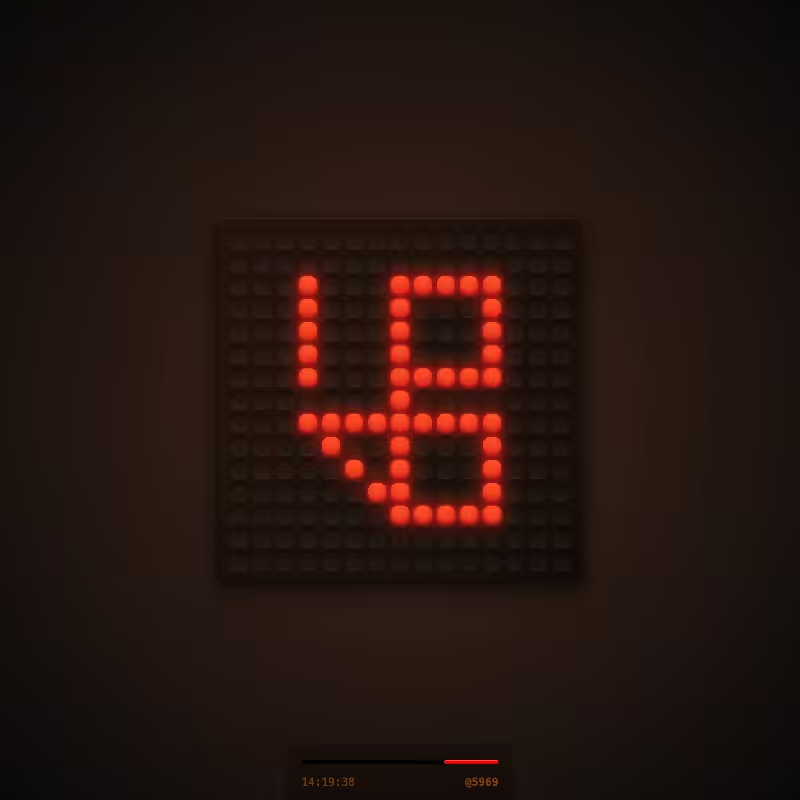
Cistercian Time · @9999
A functional clock that converts the viewer’s local time into the Cistercian numeral system, a 13th-century monastic notation system capable of representing any number from 0 to 9999 using a single glyph. The day is divided into 9999 decimal units, each rendered in real time on a matrix of LED dots. A self-contained piece in a single HTML/CSS/JS file, with no external dependencies.
The Cistercian numerals are a ingenious and compact number system developed by the Cistercian monastic order in the early 13th century. Unlike Roman or Arabic numerals, which require multiple characters for larger numbers, this system uses a single, unique glyph to represent any integer from 1 to 9,999. The key to their design is a simple horizontal or vertical stave; the position of a digit on this stave determines its place value (units on the lower right, tens on the lower left, hundreds on the upper right, and thousands on the upper left). By combining the shapes for digits 1 through 9 at these four positions, a complex number is formed in one compact symbol.
Monks primarily used these numerals for practical purposes like numbering pages, organizing indexes, and marking years in manuscripts across Europe. Though the Cistercians eventually abandoned the system in favor of Arabic numerals, its use lingered for centuries in specific pockets, such as by wine-gaugers in Bruges into the 18th century. Today, the system is a fascinating historical footnote, admired for its elegant efficiency and the unique way it solved the problem of writing large numbers with minimal space.